English has many words that sound alike but have different meanings, making them easy to confuse. One of the most common examples is how are you faring vs fairing. Although both words are pronounced the same, only one is correct in the familiar question people ask about someone’s well being.
If you’ve ever wondered whether to write “How are you faring?” or “How are you fairing?”, you’re not alone. This confusion appears in emails, text messages, social media posts, and even professional writing. In this guide, you’ll learn the difference between faring and fairing, understand why people mix them up, and discover simple tricks to remember the correct spelling every time.
Quick Answer
The correct phrase is “How are you faring?”
- Faring means doing, getting along, or progressing.
- Fairing is a technical noun or verb used in engineering, aviation, cycling, and boating to describe a smooth protective structure or the act of making something streamlined.
So, when asking about someone’s condition or progress, always write “How are you faring?”
Why People Confuse It
The confusion happens because faring and fairing are homophones—they sound exactly alike but have different meanings and spellings.
Other reasons include:
- Spell checkers may not flag the wrong word because both are valid English words.
- Many people have never encountered the technical word fairing.
- The phrase “How are you faring?” is more often heard than written.
- English spelling rules can make similar sounding words difficult to distinguish.
Understanding each word separately makes the difference much easier to remember.
Faring
Faring is the present participle of the verb fare.
It means:
- Doing or performing
- Managing a situation
- Progressing through an experience
- Getting along in life
Examples
- How are you faring after your surgery?
- She’s faring much better than expected.
- The company is faring well despite economic challenges.
- Students are faring well in the new curriculum.
In everyday English, faring almost always refers to someone’s condition, success, or progress.
Fairing
Fairing is primarily a technical term.
It refers to:
- A smooth covering that reduces air or water resistance.
- A structure attached to vehicles for better aerodynamics.
- The process of smoothing surfaces in construction or manufacturing.
Examples
- The motorcycle has a new front fairing.
- Aircraft engineers inspected the wing fairing.
- The boat required additional fairing before painting.
- The mechanic replaced the damaged fairing.
Unless you’re discussing engineering, transportation, or manufacturing, you probably won’t need this word.
Comparison Table
| Feature | Faring | Fairing |
| Part of speech | Verb (present participle) | Noun (sometimes verb) |
| Meaning | Doing or progressing | Streamlined protective covering |
| Used for | People, businesses, situations | Motorcycles, airplanes, boats, bicycles |
| Common phrase | How are you faring? | Motorcycle fairing |
| Everyday usage | Very common | Mostly technical |
| Correct in greetings? | ✅ Yes | ❌ No |
When to Use Each
Use faring when talking about:
- Health
- Personal progress
- Business performance
- Academic success
- Emotional well being
- Recovery
- General life situations
Examples:
- How are you faring at your new job?
- Our team is faring better this season.
- The crops are faring well after the rain.
Use fairing when discussing:
- Motorcycles
- Aircraft
- Boats
- Racing bicycles
- Engineering
- Aerodynamics
Examples:
- The racing bike has an aerodynamic fairing.
- The airplane’s engine fairing needed repair.
Examples
Here are more examples to help you remember the difference.
Correct Uses of Faring
- How are you faring today?
- She is faring much better now.
- Our business is faring well this year.
- The children are faring nicely at school.
- He’s faring better than expected.
- The local economy is faring surprisingly well.
- Patients are faring well after treatment.
Correct Uses of Fairing
- The motorcycle’s fairing protects the rider from wind.
- Engineers designed a lighter engine fairing.
- The damaged fairing was replaced immediately.
- The racing bicycle includes an aerodynamic fairing.
- Boat builders finished the hull fairing before painting.
Common Mistakes
Many writers accidentally substitute one word for the other.
Incorrect
- How are you fairing?
- I hope you’re fairing well.
- She’s fairing better now.
Correct
- How are you faring?
- I hope you’re faring well.
- She’s faring better now.
Remember: if you’re talking about a person’s condition, faring is always the correct choice.
Memory Trick
Here’s an easy way to remember:
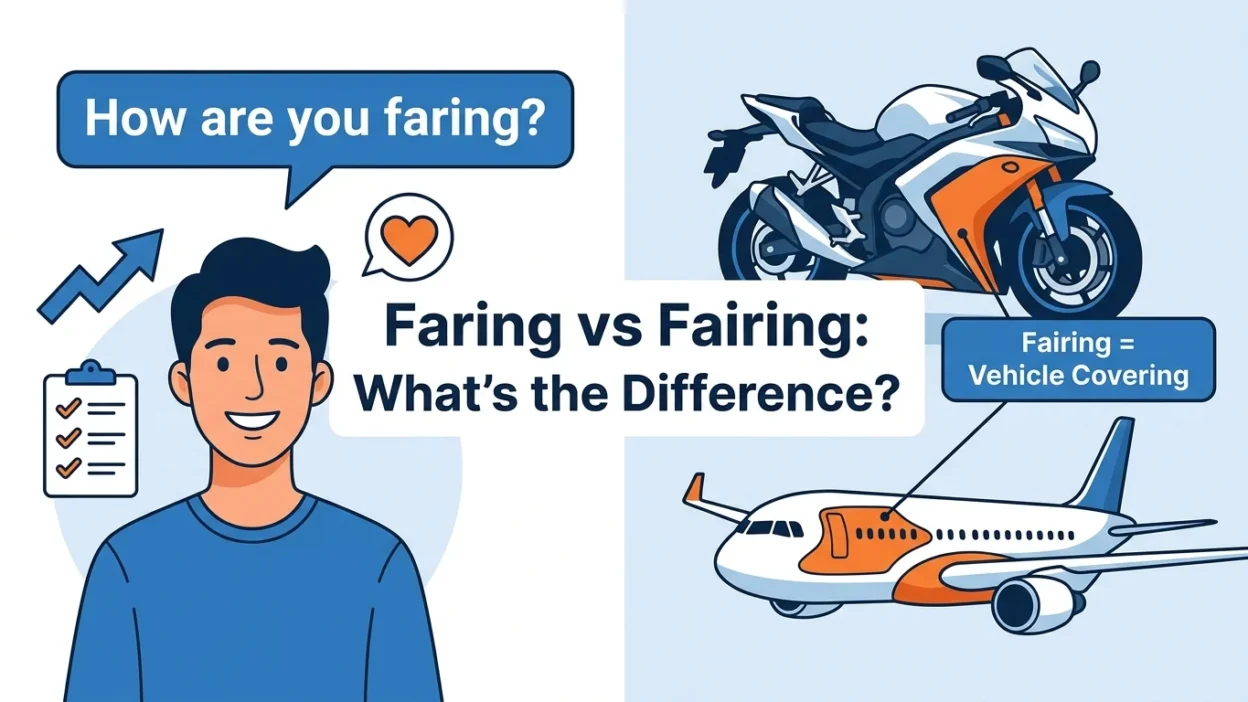
- Fare = How you’re doing
- Faring = Your progress
- Fairing = Vehicle covering
Think of this sentence:
People fare. Motorcycles have fairings.
This simple association prevents the mistake almost every time.
American vs British English
There is no difference between American and British English regarding these words.
Both varieties use:
- How are you faring? ✅
- How are you fairing? ❌
The meanings and spellings remain the same on both sides of the Atlantic.
Similar Words
English has many confusing word pairs similar to faring vs fairing:
- Affect vs Effect
- Accept vs Except
- Complement vs Compliment
- Principal vs Principle
- Stationary vs Stationery
- Advice vs Advise
- Then vs Than
- Lose vs Loose
Learning these pairs improves both writing accuracy and confidence.
Final Verdict
If you’re asking someone how they’re doing, the correct expression is always:
“How are you faring?”
Use faring for progress, success, health, or well being.
Reserve fairing for technical discussions involving motorcycles, airplanes, boats, bicycles, or engineering.
Keeping this distinction in mind will make your writing more accurate and professional.
Frequently Asked Questions
1. Is “How are you fairing?” grammatically correct?
No. The correct phrase is “How are you faring?”
2. What does “faring” mean?
It means doing, managing, progressing, or getting along.
3. What is a fairing?
A fairing is a streamlined covering used on vehicles like motorcycles, airplanes, boats, and racing bicycles to reduce air or water resistance.
4. Why do people confuse faring and fairing?
Because they are pronounced the same but have different meanings and spellings.
5. Is “faring well” a common expression?
Yes. It is commonly used in both spoken and written English to describe someone or something doing well.
6. Can “fairing” ever refer to a person?
No. It is generally a technical term and does not describe a person’s condition or progress.
7. Are both words found in dictionaries?
Yes. Both are legitimate English words, but they are used in completely different contexts.
Conclusion
Although faring and fairing sound identical, they belong to different areas of the English language. Faring is the word you need when talking about how someone is doing, coping, or progressing. It’s the correct choice in everyday conversations, professional emails, and written communication.
Fairing, by contrast, is a specialized engineering term describing streamlined coverings on vehicles or the process of smoothing surfaces. Once you remember that people fare, while vehicles have fairings, you’ll avoid this common spelling mistake with confidence.
Remember This
✅ “How are you faring?” = Asking about someone’s progress or well being.
✅ “Fairing” = A streamlined covering on a motorcycle, airplane, boat, or similar vehicle.
The easiest rule to remember: People fare. Vehicles have fairings.

Hadley Price creates heartfelt contemporary fiction exploring relationships, hope, resilience, and personal growth. Her emotionally rich storytelling connects with readers through memorable characters and inspiring life experiences worldwide.