Many English words look almost identical but have completely different meanings. Emersion and immersion are perfect examples. Because they differ by only one letter, people often assume they are interchangeable. In reality, these words belong to different contexts and describe opposite ideas.
Whether you’re writing an academic paper, studying English, or simply trying to improve your vocabulary, understanding the distinction between emersion vs immersion will help you communicate more accurately. This guide explains each word in simple language, provides practical examples, highlights common mistakes, and offers memory tricks so you’ll never confuse them again.
Quick Answer
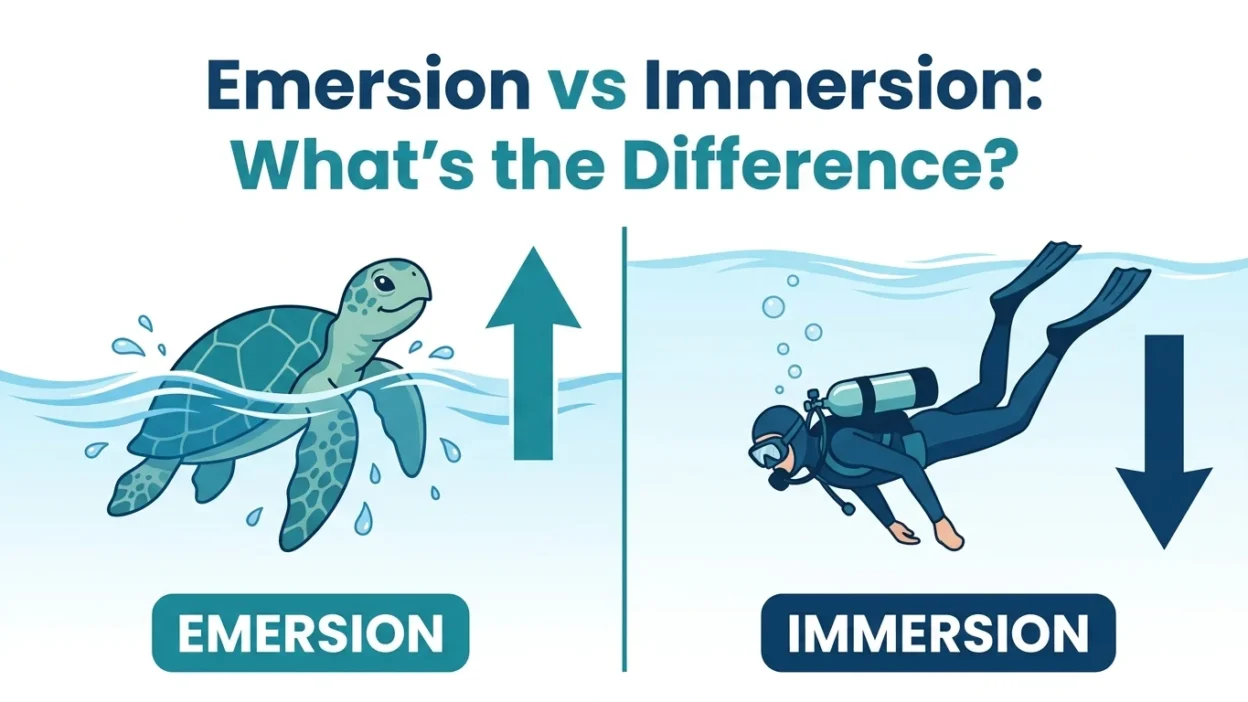
Immersion means being completely surrounded by or deeply involved in something, such as water, a language, or an experience. Emersion means coming out of water or emerging from a submerged state. In most everyday conversations, immersion is the correct choice, while emersion is mainly used in scientific and biological contexts.
Why People Confuse It
The confusion happens for several reasons:
- Both words share nearly the same spelling.
- They come from related Latin roots.
- Both are associated with water.
- They describe opposite stages of the same process.
- Immersion is very common, while emersion is relatively rare.
Many writers accidentally replace one with the other simply because they sound similar.
First Word: Emersion
Emersion refers to the act of coming out of a liquid or becoming exposed after being submerged.
Meaning
Emersion is the opposite of immersion.
Common Uses
- Biology
- Marine science
- Astronomy
- Environmental studies
- Wetland research
Example Sentences
- The turtle’s emersion from the sea attracted many tourists.
- Scientists observed the plant during its daily emersion above the water.
- The diver’s emersion signaled the end of the exploration.
- The moon’s emersion from behind the planet was recorded by astronomers.
Second Word: Immersion
Immersion means being completely surrounded by something or becoming deeply involved in an activity or environment.
Meaning
It often describes total engagement or complete submersion.
Common Uses
- Language learning
- Education
- Technology
- Virtual reality
- Water activities
- Religious ceremonies
Example Sentences
- Language immersion helps students become fluent faster.
- The phone stopped working after complete immersion in water.
- The game provides total immersion through realistic graphics.
- She enjoyed full cultural immersion during her stay in Japan.
Comparison Table
| Feature | Emersion | Immersion |
| Meaning | Coming out of water | Going into or being surrounded |
| Opposite Of | Immersion | Emersion |
| Frequency | Rare | Very common |
| Common Fields | Biology, astronomy, ecology | Education, technology, travel, religion |
| Everyday Use | Uncommon | Very common |
| Related Action | Emerging | Submerging |
When to Use Each
Use emersion when:
- Something comes out of water.
- Writing scientific or biological content.
- Describing emergence from a submerged position.
Use immersion when:
- Talking about language learning.
- Describing deep involvement.
- Referring to submerging an object.
- Discussing cultural experiences.
- Explaining virtual reality or gaming.
Examples
Here are more examples showing the correct usage.
Emersion
- The crocodile’s emersion frightened nearby visitors.
- Researchers measured the fish’s emersion time.
- The seal’s emersion lasted only a few seconds.
- Plant emersion changes its leaf structure.
- The diver celebrated after a safe emersion.
Immersion
- English immersion programs improve speaking skills.
- Cultural immersion teaches more than textbooks.
- Complete immersion in water damaged the camera.
- The museum creates historical immersion using sound effects.
- Meditation encourages mental immersion.
- Children benefit from reading immersion every day.
- VR headsets increase player immersion.
Common Mistakes
Many learners make these errors:
❌ Language emersion program
✔️ Language immersion program
❌ Phone damaged after emersion in water
✔️ Phone damaged after immersion in water
❌ The diver’s immersion from the sea
✔️ The diver’s emersion from the sea
Remember that immersion usually means going in, while emersion means coming out.
Memory Trick
A simple way to remember the difference:
- Immersion = In
- Emersion = Exit
Think of it this way:
- Immersion starts with Im, reminding you of going into something.
- Emersion starts with E, reminding you of exit or emerge.
This quick association makes choosing the right word much easier.
American vs British English
There is no significant difference between American and British English regarding these words.
- Immersion is common in both varieties.
- Emersion remains uncommon and is mainly used in scientific writing in both dialects.
Neither spelling changes between American and British English.
Similar Words
These words are related and may appear in similar contexts:
- Submersion
- Emergence
- Emergent
- Engage
- Involvement
- Absorption
- Exposure
- Participation
- Surface
- Dive
Understanding these related terms can expand your vocabulary and improve your writing precision.
Final Verdict
Although emersion and immersion look alike, they express opposite actions.
- Choose immersion when someone or something goes into, is surrounded by, or becomes deeply involved.
- Choose emersion when something emerges from water or another submerged environment.
For everyday English, immersion is by far the more frequently used word. Emersion mainly appears in scientific, ecological, and astronomical discussions.
Frequently Asked Questions
1. Is emersion a real English word?
Yes. Emersion is a valid English word, but it is uncommon and mostly used in science and biology.
2. Which word is more common?
Immersion is much more common in everyday English, education, technology, and travel.
3. Is emersion the opposite of immersion?
Yes. Emersion describes coming out, while immersion describes going into or being surrounded.
4. What is an immersion program?
An immersion program teaches a language by surrounding learners with it in everyday communication instead of relying mainly on translation.
5. Can I say “emersion learning”?
No. The correct expression is immersion learning or language immersion.
6. Does immersion always involve water?
No. While it can refer to physical submersion, it more commonly describes deep involvement in learning, culture, entertainment, or experiences.
7. Why is emersion rarely used?
Most situations involve discussing being immersed rather than emerging, so immersion has become much more common in modern English.
Remember This
Immersion = Involved or Inside
Emersion = Emerging or Exiting
If someone enters or is surrounded by something, use immersion.
If someone comes out from being submerged, use emersion.
Conclusion
Understanding the difference between emersion vs immersion is easier once you remember that the words describe opposite actions. Immersion refers to entering, being surrounded by, or becoming deeply engaged in something, while emersion refers to coming out of a submerged state. Although their spellings are similar, their meanings are distinct and should not be used interchangeably.
For most everyday conversations, academic writing, and professional communication, immersion is the word you’ll use far more often. Emersion has an important place in scientific and technical writing, particularly in biology, ecology, and astronomy. By remembering the simple rule immersion goes in, emersion comes out you can confidently choose the correct word every time.

Nova Turner specializes in imaginative science fiction blending futuristic technology, thrilling adventures, and powerful human emotions. Her innovative storytelling inspires curiosity, creativity, and exploration among readers of every age.