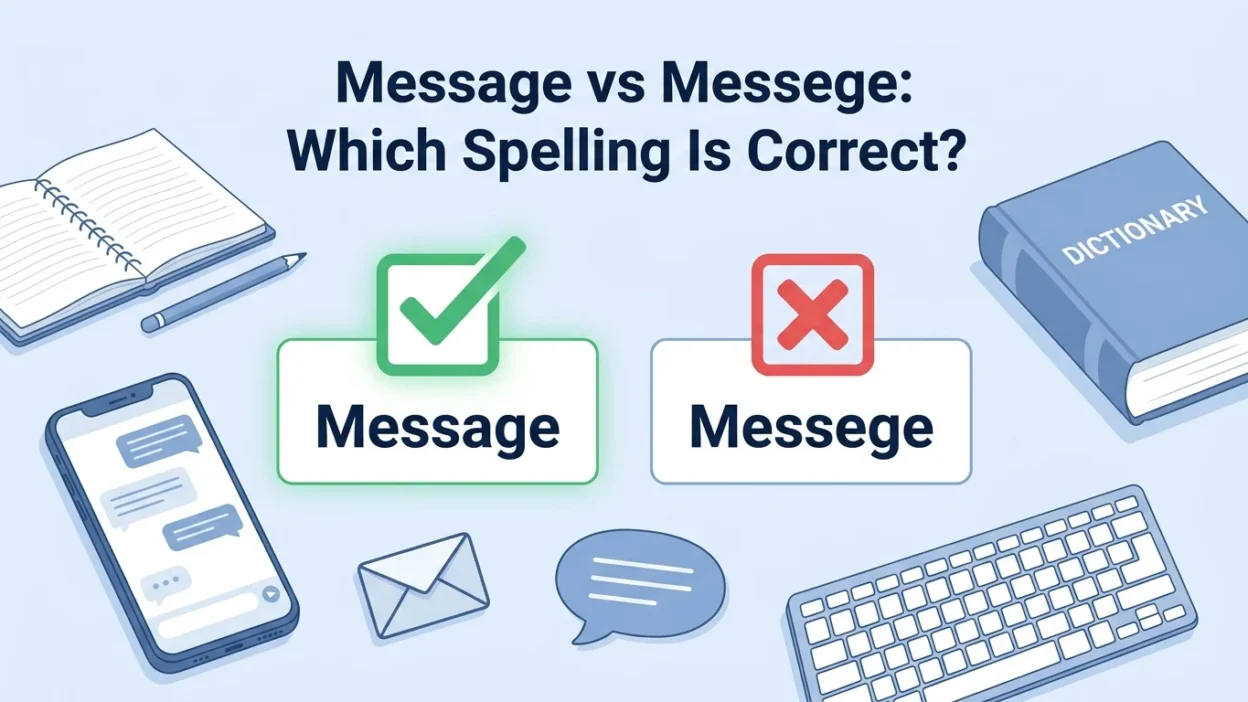
Have you ever typed “messege” instead of “message” and wondered which spelling is correct? You’re not alone. This is one of the most common English spelling mistakes because the pronunciation can make both versions seem believable. However, only one of them is accepted in standard English.
Whether you’re writing an email, sending a text, preparing school assignments, or creating professional documents, using the correct spelling improves your credibility and communication. In this guide, you’ll learn the difference between message and messege, why people often confuse them, how to remember the correct spelling, and plenty of real world examples to help you avoid this mistake forever.
Quick Answer
“Message” is the correct English spelling. “Messege” is simply a misspelling and is not recognized in dictionaries or standard English. Always use message when referring to spoken, written, or digital communication.
Why People Confuse It
Many English learners—and even native speakers—mistakenly write messege because English spelling doesn’t always match pronunciation.
Here are the main reasons:
- The word sounds similar to how many people imagine it should be spelled.
- The letters a and e are commonly mixed in English words.
- Fast typing leads to spelling mistakes.
- Autocorrect doesn’t always catch errors immediately.
- People rarely memorize the spelling since they type it so frequently.
Fortunately, once you understand the correct spelling pattern, this mistake becomes easy to avoid.
First Word: Message
Message is the correct spelling.
Definition
A message is information sent from one person to another through speech, writing, email, text, social media, or other communication methods.
Part of Speech
- Noun
- Verb (less common, as in “to message someone”)
Examples
- Please send me a message when you arrive.
- I received your message this morning.
- She left an important message on my voicemail.
- Can you message me later?
- His speech carried a powerful message.
Second Word: Messege
Messege is incorrect.
It is a spelling mistake and does not appear in reputable English dictionaries.
If you write messege in academic papers, business emails, or professional documents, it may create a negative impression and reduce your writing’s credibility.
Always replace messege with message.
Comparison Table
| Feature | Message | Messege |
| Correct spelling | ✅ Yes | ❌ No |
| Found in dictionaries | ✅ Yes | ❌ No |
| Accepted in formal writing | ✅ Yes | ❌ No |
| Used in business communication | ✅ Yes | ❌ No |
| Appears in exams | ✅ Yes | ❌ No |
| Recommended for everyday writing | ✅ Yes | ❌ Never |
When to Use Each
Use “Message”
Use message whenever you’re referring to communication.
Common situations include:
- Text messages
- Emails
- Social media chats
- Voice messages
- Business communication
- School assignments
- Personal letters
- Online messaging apps
Use “Messege”
Never use messege in formal or informal writing. If you accidentally type it, correct it to message before sending or publishing your content.
Examples
Here are practical examples showing the correct usage of message:
- I received your message yesterday.
- Please leave a message after the beep.
- She sent me a birthday message.
- His motivational message inspired everyone.
- I’ll message you after work.
- The teacher wrote an important message on the board.
- Your message was clear and polite.
- We exchanged several messages during the meeting.
- The company shared a welcome message with new employees.
- Don’t forget to check your voicemail messages.
- Thank you for your thoughtful message.
- He accidentally deleted an important message.
Common Mistakes
People often make these errors:
- ❌ Messege
- ❌ Messsage
- ❌ Mesage
- ❌ Messaage
- ❌ Messge
Correct version:
- ✅ Message
Always proofread your writing before submitting important documents or emails.
Memory Trick
A simple way to remember the correct spelling is:
Message contains “age” at the end.
Think of this sentence:
A message gets better with age.
Since age is a real English word, remembering it can help you spell message correctly every time.
American vs British English
Good news—there is no difference between American and British English for this word.
| American English | British English |
| Message | Message |
Both varieties use the identical spelling and meaning.
Similar Words
If you often confuse message, you might also find these commonly misspelled words helpful:
- Receive vs Recieve
- Separate vs Seperate
- Necessary vs Neccessary
- Believe vs Beleive
- Occasion vs Ocassion
- Tomorrow vs Tommorow
- Definitely vs Definately
- Business vs Buisness
Learning these common spelling corrections can significantly improve your written English.
Final Verdict
The answer is simple:
- Message ✅ Correct
- Messege ❌ Incorrect
Whenever you’re referring to written, spoken, or digital communication, always use message. The spelling messege is a common typo and should be avoided in all forms of English writing.
Frequently Asked Questions (FAQs)
1. Is “messege” a real English word?
No. Messege is not an accepted English word. It is simply a misspelling of message.
2. Which spelling is correct: message or messege?
Message is the correct spelling.
3. Why do people spell “message” as “messege”?
The mistake usually happens because of pronunciation, typing errors, or confusion between the vowels a and e.
4. Is “message” correct in both American and British English?
Yes. Both American and British English use the spelling message.
5. Can “message” be used as a verb?
Yes. For example:
“I’ll message you after dinner.”
6. Does Microsoft Word or Google Docs recognize “messege”?
Most spell checkers identify messege as a spelling error and suggest message.
Conclusion
Spelling mistakes are common, especially with frequently used words like message. Because the pronunciation can be slightly misleading, many people accidentally type messege. Fortunately, the rule is straightforward: message is always the correct spelling.
By remembering the simple “ends with age” trick, practicing the examples above, and proofreading your writing, you’ll avoid this mistake in emails, text messages, essays, and professional documents. Mastering small spelling details like this helps make your writing clearer, more polished, and more trustworthy.
Remember This
✅ Message = Correct
❌ Messege = Incorrect
If you’re ever unsure, remember that message ends with “age,” not “ege.”

Nova Turner specializes in imaginative science fiction blending futuristic technology, thrilling adventures, and powerful human emotions. Her innovative storytelling inspires curiosity, creativity, and exploration among readers of every age.