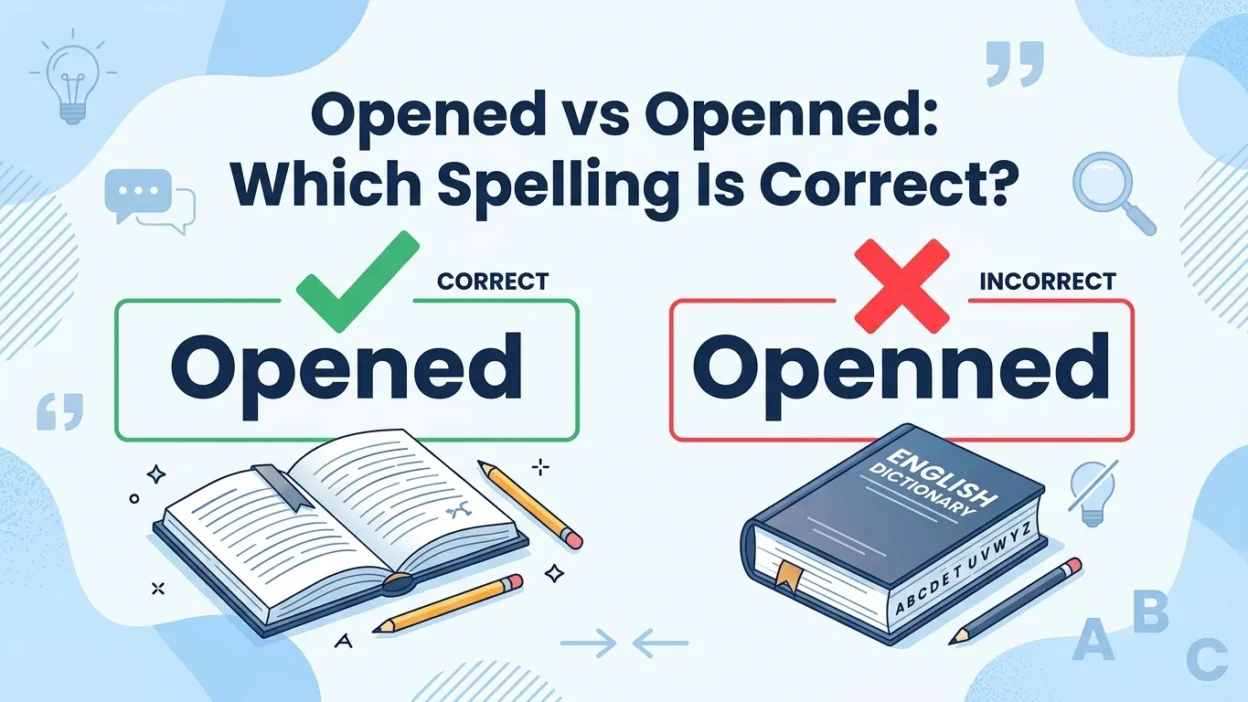
English spelling can be confusing, especially when words change form by adding endings like -ed. One common mistake people make is writing “openned” instead of “opened.” Since English contains many words that double the final consonant before adding -ed, it’s easy to assume that open follows the same rule.
The good news is that the answer is simple. Only one spelling is correct in standard English. In this guide, you’ll learn the difference between opened vs openned, why people confuse them, when to use the correct spelling, and how to remember it forever. You’ll also find comparison tables, examples, common mistakes, FAQs, and grammar tips to help you write with confidence.
Quick Answer
“Opened” is the correct spelling. “Openned” is incorrect and is not accepted in English dictionaries or grammar guides. The verb open simply adds -ed to become opened because it does not follow the consonant doubling rule.
Why People Confuse “Opened” and “Openned”
Many English learners believe every verb ending in a consonant should double the final letter before adding -ed.
For example:
- Stop → Stopped ✅
- Plan → Planned ✅
- Open → Openned ❌
This happens because English has specific spelling rules. Since open has two syllables and the stress falls on the first syllable (O-pen), the final n is not doubled.
That’s why the correct past tense is opened.
Opened
Opened is the correct past tense and past participle of the verb open.
Meaning
It means:
- Made something no longer closed
- Started or began something
- Became available
- Revealed something
Examples
- She opened the window.
- They opened a new restaurant last month.
- The museum opened at 9 a.m.
- He opened the email immediately.
Openned
Openned is not a correct English word.
Although it appears in spelling mistakes, online comments, or informal writing, it is not recognized by dictionaries or grammar authorities.
Always replace openned with opened.
Comparison Table
| Feature | Opened | Openned |
| Correct spelling | ✅ Yes | ❌ No |
| Dictionary word | ✅ Yes | ❌ No |
| Past tense of “open” | ✅ Yes | ❌ No |
| Accepted in formal writing | ✅ Yes | ❌ Never |
| Should you use it? | ✅ Always | ❌ Avoid |
When to Use Each
Use “Opened”
Use opened whenever you need the past tense or past participle of open.
Examples include:
- opened the door
- opened the file
- opened an account
- opened the meeting
- opened the discussion
- opened the package
- opened the app
Use “Openned”
Never use openned in formal or informal English writing.
Spell checkers and grammar tools will usually mark it as incorrect.
Examples
Here are examples showing the correct usage of opened.
- She opened the gift with excitement.
- I opened the window to let in fresh air.
- They opened a bakery downtown.
- The teacher opened the lesson with a question.
- He opened the email before breakfast.
- We opened our books to page ten.
- The store opened early today.
- Sarah opened the box carefully.
- The company opened a new office overseas.
- The flowers opened in the morning sunlight.
- My phone opened the document instantly.
- The manager opened the meeting on time.
Common Mistakes
Here are mistakes people often make.
❌ I openned the door.
✅ I opened the door.
❌ The shop openned yesterday.
✅ The shop opened yesterday.
❌ She openned the message.
✅ She opened the message.
Memory Trick
Here’s an easy way to remember the correct spelling:
Open already ends with “en.”
Simply add -ed.
Open + ed = Opened
There is no need to add another “n.”
Think of similar verbs:
- Open → Opened
- Listen → Listened
- Happen → Happened
None of these double the final consonant.
American vs British English
There is no difference between American and British English for this word.
Both use:
- Opened ✅
Neither variety accepts:
- Openned ❌
Whether you’re writing for the US, UK, Canada, Australia, or other English speaking countries, opened is always correct.
Similar Words
The same spelling rule applies to many other verbs.
| Base Verb | Correct Past Tense |
| Open | Opened |
| Listen | Listened |
| Happen | Happened |
| Enter | Entered |
| Offer | Offered |
| Order | Ordered |
| Answer | Answered |
| Deliver | Delivered |
Notice that none of these words double the final consonant.
Final Verdict
The answer is straightforward:
- ✅ Opened is the correct spelling.
- ❌ Openned is a spelling mistake.
Whenever you’re writing about something that was opened in the past, always choose opened. It’s the only spelling accepted in dictionaries, schools, professional writing, and exams.
Frequently Asked Questions (FAQs)
Is “openned” ever correct?
No. Openned is always incorrect.
Why doesn’t “open” double the “n”?
Because open has two syllables and the stress is on the first syllable. English spelling rules do not require doubling the final consonant in this case.
Is “opened” the past tense of “open”?
Yes. Opened is both the past tense and the past participle of open.
Do American and British English spell it differently?
No. Both use opened.
Why do people write “openned”?
People often apply the consonant doubling rule incorrectly because of words like planned and stopped.
Is “opened” correct in formal writing?
Yes. It is the only correct spelling in academic, business, and professional writing.
Will spell check detect “openned”?
Most modern spell checkers and grammar tools flag openned as a spelling error.
Remember This
Open + ed = Opened
There is never an extra n.
Whenever you’re unsure, remember:
If the word is “open,” the past tense is always “opened.”
Conclusion
English spelling rules can seem inconsistent, but once you understand them, mistakes like opened vs openned become much easier to avoid. The key rule is that open does not double its final n before adding -ed, making opened the only correct form.
Whether you’re writing emails, essays, blog posts, or professional documents, using opened ensures your writing is accurate and polished. Keep the simple memory trick in mind, practice with real examples, and you’ll never confuse these spellings again.

Willow Evans writes uplifting fantasy stories filled with magical worlds, courageous heroes, and meaningful life lessons. Her imaginative books encourage creativity, kindness, and hope in readers of all ages.