
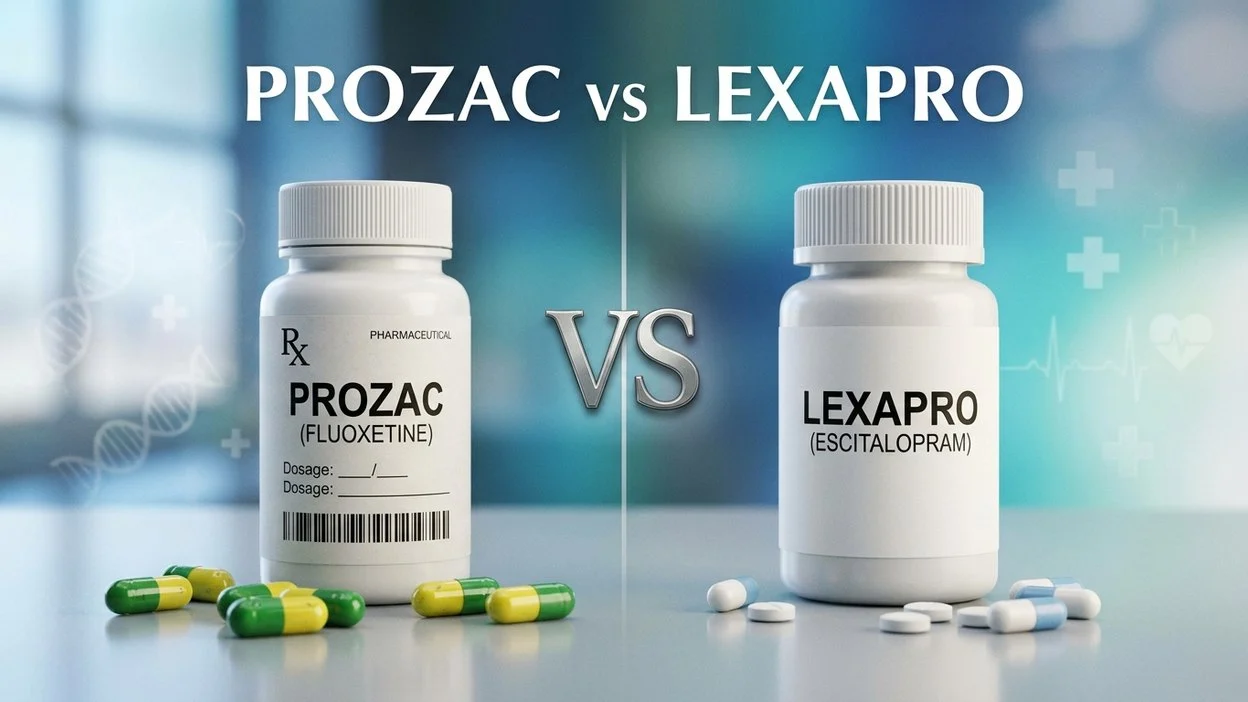
When comparing Prozac vs Lexapro, the main difference is that both are antidepressants, but they contain different active ingredients and may work differently for each person. Prozac contains fluoxetine, while Lexapro contains escitalopram. Both belong to a group of medicines called selective serotonin reuptake inhibitors (SSRIs), which are commonly prescribed to treat depression and certain anxiety disorders.
Although Prozac and Lexapro share some similarities, they differ in their approved uses, possible side effects, interactions, and how long they remain in the body. One medicine may suit a particular person better than the other, depending on their symptoms, medical history, other medications, and response to treatment. Neither medicine is automatically the best choice for everyone.
Understanding these differences can help patients, students, caregivers, and general readers learn more about these widely used medications. This guide explains Prozac vs Lexapro in simple English, with a comparison table, practical examples, common questions, and important safety information to help readers understand the topic clearly.
Quick Answer: Prozac vs Lexapro
Prozac (fluoxetine) and Lexapro (escitalopram) are both SSRI antidepressants used to treat depression. Prozac is also approved for conditions such as obsessive-compulsive disorder (OCD), panic disorder, and bulimia nervosa, while Lexapro is approved for depression and generalized anxiety disorder in the United States. The better option depends on individual needs, side effects, and medical advice.
Why Do People Confuse Prozac and Lexapro?
People often confuse Prozac and Lexapro because both medicines belong to the same drug family. They affect serotonin, a chemical messenger in the brain involved in mood and other functions.
Both medicines may help relieve symptoms such as:
- Persistent sadness
- Excessive worry
- Loss of interest in everyday activities
- Changes in sleep or appetite
- Difficulty concentrating
- Feelings of hopelessness
However, similar purposes do not mean identical effects. People may respond differently to each medication, and their side effects can vary.
Another reason for confusion is that both medicines may take several weeks to provide noticeable benefits. Neither is designed to produce an immediate change in mood.
First Word: What Is Prozac?
Prozac is the brand name for fluoxetine, an SSRI antidepressant.
Doctors prescribe fluoxetine for several mental health conditions. In the United States, its approved uses include major depressive disorder, obsessive-compulsive disorder, panic disorder, and bulimia nervosa. It is also used with olanzapine for certain conditions, including bipolar I depression and treatment-resistant depression, under specific prescribing guidance.
How Does Prozac Work?
Prozac helps increase the availability of serotonin signaling in the brain by reducing serotonin reuptake. This action may help improve mood and reduce certain symptoms over time.
The full benefits usually develop gradually rather than immediately.
What Are the Common Side Effects of Prozac?
Possible side effects include:
- Nausea
- Headache
- Difficulty sleeping
- Nervousness or restlessness
- Diarrhea
- Reduced sexual desire or other sexual difficulties
Fluoxetine has a relatively long half-life, meaning it takes longer for the body to eliminate it than many other SSRIs. This can affect drug interactions and the timing of side effects or withdrawal symptoms.
Second Word: What Is Lexapro?
Lexapro is the brand name for escitalopram, another SSRI antidepressant.
In the United States, Lexapro is approved to treat major depressive disorder and generalized anxiety disorder. Doctors may sometimes prescribe it for other conditions when clinically appropriate.
How Does Lexapro Work?
Lexapro also affects serotonin reuptake. By changing serotonin signaling, it may help reduce depressive symptoms and persistent anxiety.
Like Prozac, it usually takes several weeks for its full therapeutic effects to develop.
What Are the Common Side Effects of Lexapro?
Possible side effects include:
- Nausea
- Headache
- Sleepiness or difficulty sleeping
- Increased sweating
- Fatigue
- Sexual side effects
Some people tolerate Lexapro well, while others experience troublesome side effects. Individual responses vary, so a person’s experience cannot reliably predict how another person will respond.
Prozac vs Lexapro: What Are the Main Differences?
| Feature | Prozac | Lexapro |
| Generic name | Fluoxetine | Escitalopram |
| Drug class | SSRI | SSRI |
| Main approved uses in the US | Depression, OCD, panic disorder, bulimia nervosa, and certain combination treatments | Depression and generalized anxiety disorder |
| Common side effects | Nausea, insomnia, headache, restlessness | Nausea, fatigue, sleep changes, sexual side effects |
| Effect on sleep | May feel activating for some people | May cause sleepiness or insomnia |
| Time to benefit | Usually several weeks | Usually several weeks |
| Time in the body | Relatively long | Shorter than fluoxetine |
| Stopping treatment | Withdrawal may be delayed because of its long half-life | Withdrawal symptoms may occur after stopping or reducing the dose |
| Best choice | Depends on the individual | Depends on the individual |
The table summarizes general differences. Exact approved uses and prescribing recommendations can vary by country, age, formulation, and individual medical circumstances.
When Should Someone Use Prozac or Lexapro?
The right medication depends on the condition being treated, previous treatment experiences, other medications, and the person’s overall health.
When Might Prozac Be Considered?
Prozac may be considered when a person has a condition for which fluoxetine is an appropriate treatment, such as:
- Major depressive disorder
- Obsessive-compulsive disorder
- Panic disorder
- Bulimia nervosa
Its long half-life can be relevant when a clinician evaluates missed doses, discontinuation, or possible drug interactions. However, this does not mean it is automatically safer or more effective.
When Might Lexapro Be Considered?
Lexapro may be considered for people experiencing:
- Major depressive disorder
- Generalized anxiety disorder
A clinician may also consider factors such as previous medication response, tolerability, and the person’s preferences.
Which Is Better for Anxiety?
Both medicines may help with anxiety-related symptoms, but their approved indications differ.
Lexapro is approved for generalized anxiety disorder in the United States, while Prozac is approved for panic disorder. Neither fact means one medicine is best for every form of anxiety.
Which Is Better for Depression?
Both Prozac and Lexapro are effective options for many people with depression. Research does not support declaring one universally superior for every patient.
A healthcare professional can help select a medication based on symptom patterns, previous treatment, side effects, interactions, and other health considerations.
12 Examples of Prozac vs Lexapro in Everyday Situations
These examples illustrate how people may discuss the differences between the medicines. They are educational scenarios, not recommendations for individual treatment.
1. Depression: A patient asks whether Prozac or Lexapro might help with persistent sadness and loss of interest.
2. Generalized anxiety: Someone with constant worry discusses Lexapro with their healthcare professional.
3. Panic disorder: A clinician considers Prozac among the approved treatment options for recurrent panic attacks.
4. Obsessive-compulsive disorder: A patient learns that Prozac is an approved medication option for OCD.
5. Sleep problems: A person who has trouble sleeping reports this symptom before starting either medicine.
6. Daytime tiredness: Someone who feels sleepy after starting treatment asks their prescriber whether the medication could be contributing.
7. Sexual side effects: A patient discusses reduced sexual desire while taking an SSRI.
8. Missed doses: A person asks a pharmacist what to do after forgetting a dose of Prozac or Lexapro.
9. Switching medications: A patient wants to change from Prozac to Lexapro and receives an individualized switching plan.
10. Stopping treatment: Someone who feels better asks how to stop an antidepressant safely.
11. Other medications: A patient reviews their medication list to identify possible interactions before starting treatment.
12. Choosing a first antidepressant: A person discusses the benefits and risks of both medicines with a qualified healthcare professional.
The examples show why treatment decisions require more than comparing drug names. The same medicine may help one person and cause unwanted effects in another.
Common Mistakes When Comparing Prozac and Lexapro
Mistake 1: Assuming Both Medicines Are Identical
Both are SSRIs, but their active ingredients, approved uses, pharmacokinetics, and side-effect profiles differ.
Mistake 2: Believing One Is Always Stronger
There is no simple, universal rule that Prozac is stronger than Lexapro or that Lexapro is stronger than Prozac. Their doses are not directly interchangeable on a milligram-for-milligram basis.
Mistake 3: Expecting Immediate Results
Antidepressants generally take several weeks to provide meaningful benefits. Some side effects may appear before mood or anxiety symptoms improve.
Mistake 4: Ignoring Drug Interactions
Both medicines can interact with other drugs. Fluoxetine, in particular, can have clinically important interactions because of its effects on certain liver enzymes and its long persistence in the body.
Mistake 5: Stopping Suddenly
Stopping either medicine without medical guidance may cause problems. Discontinuation symptoms can include dizziness, irritability, sleep disturbances, and flu-like feelings, although the pattern differs between individuals and medicines.
Mistake 6: Choosing Based on Someone Else’s Experience
A friend’s positive experience with Lexapro does not guarantee the same result for another person. Individual medical factors matter.
Memory Trick: How to Remember Prozac vs Lexapro
Use this simple memory aid:
- Prozac = Fluoxetine. Remember the “F” in fluoxetine.
- Lexapro = Escitalopram. Remember the “E” in escitalopram.
Both are SSRIs, but they are different medications.
A second helpful reminder is to associate Prozac with its longer half-life. This means it remains in the body longer than Lexapro, which may affect interactions and the timing of discontinuation effects.
American vs British English: Are Prozac and Lexapro Names Different?
Prozac and Lexapro are brand names, not American or British spelling variations.
Medication names and availability can differ between countries. For example, fluoxetine is widely known by its generic name, while escitalopram may be sold under different brand names depending on the market.
In the United Kingdom, escitalopram is also available under the brand name Cipralex. Prozac is a familiar brand name in several countries, but generic fluoxetine is also available.
The important distinction is the active ingredient, not the spelling or pronunciation of the brand name.
Similar Words and Related Medication Terms
Understanding these related terms makes discussions about Prozac and Lexapro easier.
- SSRI: A selective serotonin reuptake inhibitor, a class of medicines used to treat depression and certain anxiety disorders.
- Antidepressant: A medication used to treat depression and, in some cases, other mental health conditions.
- Fluoxetine: The generic name of Prozac.
- Escitalopram: The generic name of Lexapro.
- Serotonin: A chemical messenger involved in mood, sleep, digestion, and other bodily functions.
- Half-life: The time it takes for the amount of a substance in the body to decrease by half.
- Side effect: An unwanted or unintended effect of a medication.
- Discontinuation symptoms: Symptoms that can occur when certain medicines are stopped or reduced, particularly if the change is too rapid.
These terms help explain why two medicines from the same class can have different practical effects.
Final Verdict: Prozac vs Lexapro
Prozac and Lexapro are both established SSRI antidepressants, but neither is universally better.
Prozac may be an appropriate option for conditions such as OCD, panic disorder, or bulimia nervosa, in addition to depression. Lexapro may be particularly relevant when treating depression or generalized anxiety disorder. Both can cause side effects and interact with other medicines.
The best choice depends on the person’s diagnosis, symptoms, medical history, treatment preferences, and response to medication. A healthcare professional should guide decisions about starting, switching, adjusting, or stopping either medicine.
Important safety note: Both medicines can increase the risk of suicidal thoughts or behaviors in some children, adolescents, and young adults, particularly early in treatment or after dose changes. Anyone experiencing new or worsening suicidal thoughts should seek urgent professional help. Do not combine, switch, or stop these medications without appropriate medical guidance.
FAQs:
1. Is Prozac better than Lexapro?
Neither medication is best for everyone. Both can treat depression, and their suitability depends on the person’s symptoms, medical history, other medications, and response to treatment.
2. Can Prozac and Lexapro be taken together?
Taking both together is generally not recommended unless a specialist has a specific reason and provides close supervision. Combining SSRIs can increase the risk of serotonin syndrome, a potentially serious reaction involving excess serotonin activity.
3. Which has fewer side effects, Prozac or Lexapro?
There is no universal answer. Both can cause nausea, sleep changes, and sexual side effects. The type and severity of side effects depend on the individual, the dose, and other medications.
4. How long do Prozac and Lexapro take to work?
Some people notice early changes within one or two weeks, but meaningful improvement often takes several weeks. The full benefit may take longer, depending on the condition and the individual response.
5. Is Prozac more activating than Lexapro?
Prozac may feel more activating for some people and can contribute to restlessness or difficulty sleeping. However, responses vary, and Lexapro can also cause insomnia or other sleep changes.
6. Can someone switch from Prozac to Lexapro?
Yes, a healthcare professional may recommend switching when appropriate. The process requires an individualized plan because fluoxetine remains in the body for a relatively long time and can interact with other antidepressants.
7. Are Prozac and Lexapro addictive?
Neither is generally considered addictive in the way substances such as nicotine or opioids can be. However, the body can adapt to antidepressants, and stopping them may cause discontinuation symptoms. This is one reason medical guidance is important when ending treatment.
8. Can Prozac or Lexapro cause weight changes?
Yes. Weight changes can occur with either medicine, but their likelihood and extent vary. Appetite, activity, the underlying condition, treatment duration, and other factors may also influence weight.
Remember This
- Prozac contains fluoxetine.
- Lexapro contains escitalopram.
- Both belong to the SSRI antidepressant family.
- Both can help with depression, but their other approved uses differ.
- Side effects and treatment responses vary from person to person.
- Neither medicine should be started, combined, switched, or stopped without appropriate medical guidance.
Conclusion:
The comparison of Prozac vs Lexapro shows that two medicines can belong to the same drug class while still having meaningful differences. Prozac contains fluoxetine and has a relatively long half-life, while Lexapro contains escitalopram. Their approved uses, possible side effects, and interactions can influence which medicine a healthcare professional recommends.
For anyone considering treatment for depression or anxiety, the most useful approach is to understand the options and discuss personal needs with a qualified healthcare professional. Neither medicine guarantees the same results for everyone, and finding an appropriate treatment may involve monitoring symptoms, reviewing side effects, and making carefully supervised adjustments.

Quinn Mitchell is celebrated for historical fiction that combines authentic settings, unforgettable characters, and compelling narratives. His thoughtful writing brings history alive while inspiring curiosity and deeper understanding among readers.