If you have ever confused accent, ascent, and assent, you are not alone. These three English words look and sound surprisingly similar, especially when spoken quickly. However, their meanings are completely different. Accent usually refers to a way of pronouncing a language or a mark used in writing, while ascent means a climb or upward movement. Assent, on the other hand, means agreement or approval. Knowing these distinctions can help you avoid spelling mistakes and choose the right word with confidence.
The confusion becomes even more understandable because all three words are pronounced similarly in many varieties of English. Their different meanings, spellings, and grammatical uses are the key to telling them apart. In this guide, you will learn the meaning of accent vs ascent vs assent, see clear examples in everyday sentences, discover common mistakes, and learn a simple memory trick. By the end, you should be able to distinguish all three words without hesitation.
Quick Answer
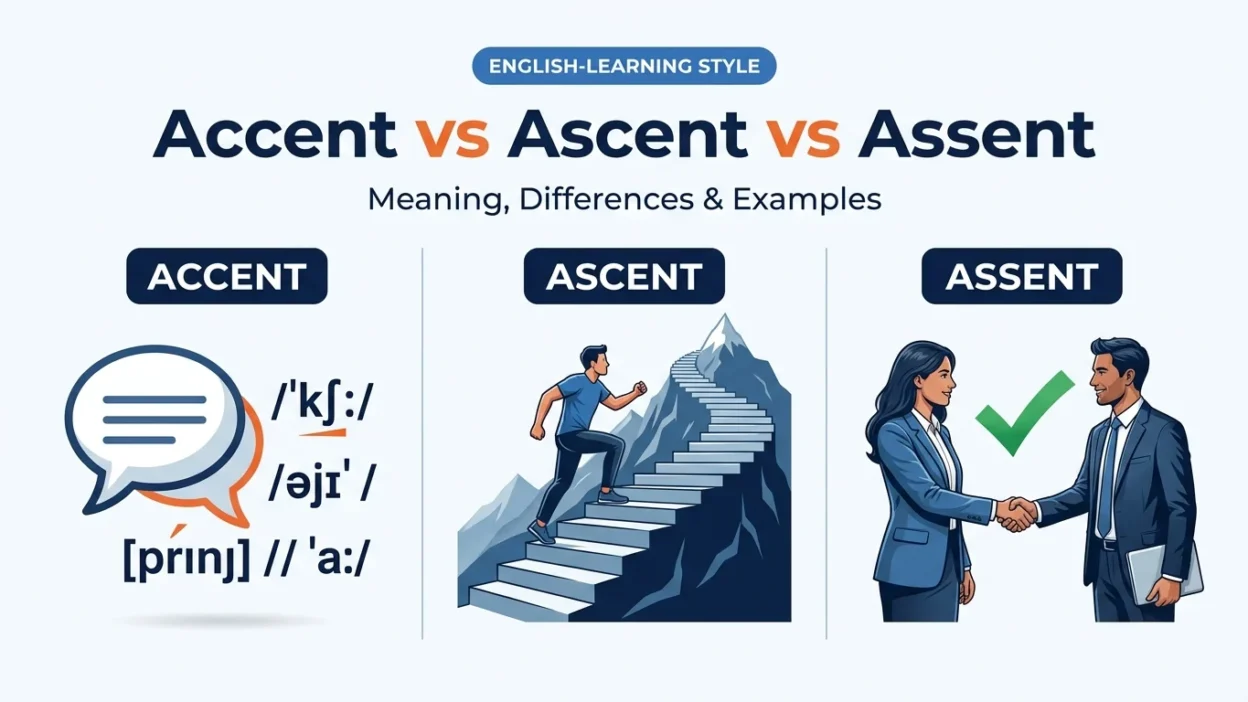
Accent means a pronunciation style or a written mark. Ascent means the act of climbing or moving upward. Assent means agreement or approval. Remember: you have an accent, you make an ascent, and you give assent.
Why People Confuse It
The main reason people confuse these words is their pronunciation. Accent, ascent, and assent all contain the sound /əˈsɛnt/ in common pronunciation, although accent can vary slightly depending on dialect and meaning.
Their spellings also differ by only one or two letters:
- Accent → related to pronunciation or emphasis
- Ascent → related to going up
- Assent → related to saying yes or agreeing
Another source of confusion is that all three can function as nouns, while assent can also be used as a verb.
The easiest solution is not to memorize the spellings alone. Instead, connect each word with its meaning and a visual or verbal clue.
First Word: Accent
Accent is a noun that commonly refers to the distinctive way someone pronounces a language.
For example:
She speaks English with a British accent.
An accent can reveal something about a speaker’s regional, national, or social background, although it does not necessarily indicate where someone was born.
Accent also has other meanings. In writing, an accent can be a special mark placed over a letter, such as the acute accent in café. In speech, it can refer to emphasis placed on a particular syllable or word.
Common meanings of accent
- A particular style of pronunciation
- A mark placed over a letter
- Special emphasis in speech
- A distinctive feature or decorative touch
Examples
- I love your accent.
- His French accent is easy to recognize.
- The word résumé contains accented letters.
- She put extra accent on the final word.
Second Word: Ascent
Ascent means the act of moving upward, climbing, or rising.
It is often used when talking about mountains, stairs, aircraft, or other forms of upward movement.
For example:
The hikers began their ascent before sunrise.
The opposite of ascent is descent, which means movement downward.
Common meanings of ascent
- An upward climb
- Movement from a lower position to a higher one
- The process of rising
- A climb toward a higher point or level
Examples
- The plane began its ascent shortly after takeoff.
- The mountain’s steep ascent took several hours.
- We stopped halfway through the ascent.
- The staircase makes the ascent easier.
A useful association is:
Ascent = up
Both words contain the idea of movement or direction, making this one of the easiest distinctions to remember.
Third Word: Assent
Assent means agreement, approval, or acceptance of a proposal or idea.
As a noun, it refers to agreement:
The committee gave its assent to the proposal.
As a verb, assent means to agree or approve:
She assented to the plan.
It is generally more formal than everyday expressions such as agree, approve, or say yes.
Common meanings of assent
- Agreement
- Approval
- Acceptance of a suggestion or proposal
- To agree to something formally
Examples
- The board gave its assent.
- He nodded in assent.
- The manager assented to the request.
- Parliament gave its assent to the measure.
A useful clue is:
Assent = agree
If someone gives their assent, they are essentially saying yes.
Comparison Table
| Word | Meaning | Part of Speech | Example |
| Accent | A way of pronouncing a language; a mark or emphasis | Noun | She has a distinctive accent. |
| Ascent | Movement upward or a climb | Noun | The ascent was difficult. |
| Assent | Agreement or approval; to agree | Noun / Verb | They gave their assent. |
The simplest distinction
- Accent → pronunciation or emphasis
- Ascent → going upward
- Assent → agreeing
When to Use Each
Use accent when you are talking about pronunciation, speech patterns, written accent marks, or emphasis.
Her accent changed after living abroad.
Use ascent when something or someone moves upward.
The climbers began their ascent at dawn.
Use assent when someone agrees to something or gives approval.
The director gave his assent to the proposal.
A quick substitution test can help:
- Can you replace it with pronunciation? → accent
- Can you replace it with climb or rise? → ascent
- Can you replace it with agreement or approval? → assent
Examples
- She has a noticeable accent when she speaks English.
- His American accent became stronger after several years in the United States.
- The word contains an accent mark over the vowel.
- The speaker placed an accent on the importance of education.
- The hikers prepared for a challenging ascent.
- The aircraft began its ascent into the clouds.
- The final part of the mountain ascent was extremely steep.
- We completed the ascent in less than three hours.
- The committee gave its assent to the new policy.
- She nodded in assent.
- The manager assented to the employee’s request.
- The proposal cannot proceed without the board’s assent.
- His regional accent was immediately recognizable.
- The climbers’ ascent was delayed by bad weather.
- The members expressed their assent by raising their hands.
Common Mistakes
1. Using “ascent” when you mean pronunciation
Incorrect:
She has a beautiful ascent.
Correct:
She has a beautiful accent.
A pronunciation style is an accent, not an ascent.
2. Using “assent” when you mean climbing
Incorrect:
The mountain assent was difficult.
Correct:
The mountain ascent was difficult.
Remember that ascent describes upward movement.
3. Using “accent” when you mean agreement
Incorrect:
The committee gave its accent to the plan.
Correct:
The committee gave its assent to the plan.
Assent means agreement or approval.
4. Confusing “ascent” with “assent”
The spelling difference is only one letter, but the meanings are unrelated.
- Ascent → upward movement
- Assent → agreement
5. Forgetting the verb form of “assent”
Unlike accent and ascent, assent can also work as a verb.
They assented to the proposal.
This formal usage is perfectly correct.
Memory Trick
Try these three simple associations:
Accent = A for Accent in speech
Think:
Accent → how you sound
Ascent = A for Above
Think:
Ascent → going up
Assent = A for Agreement
Think:
Assent → saying yes
So remember:
Accent = sound
Ascent = up
Assent = agree
Another useful pair is:
Ascent ↔ Descent
Both describe direction. An ascent goes up, while a descent goes down.
American vs British English
The meanings and spellings of accent, ascent, and assent are essentially the same in American and British English.
The biggest potential difference is pronunciation, particularly with accent, because people in different regions naturally have different accents. The word itself does not change meaning simply because the speaker uses American or British English.
For example:
- American English: She has a British accent.
- British English: She has an American accent.
Both varieties use ascent for upward movement and assent for agreement or approval.
So, unlike some British American spelling differences, there is no major spelling distinction to learn here.
Similar Words
Understanding related words can make these distinctions even easier.
Accent
Similar words include:
- pronunciation
- intonation
- emphasis
- stress
- dialect
Note that accent and dialect are not exactly the same. An accent mainly concerns pronunciation, while a dialect can include vocabulary, grammar, and pronunciation.
Ascent
Similar words include:
- climb
- rise
- elevation
- upward movement
- uphill journey
Its opposite is descent.
Assent
Similar words include:
- agreement
- approval
- acceptance
- consent
- concurrence
Its common opposite is dissent, meaning disagreement.
Notice the helpful pair:
Assent ↔ Dissent
The spelling and meanings contrast neatly.
FAQs
Is it “accent” or “ascent”?
It depends on the meaning. Use accent for pronunciation or emphasis and ascent for upward movement or climbing.
Is “assent” the same as “agree”?
Yes, assent means agreement or approval. As a verb, to assent means to agree, although it is more formal than simply saying “agree.”
What is the difference between ascent and descent?
Ascent means movement upward, while descent means movement downward.
What is an example of assent?
The committee gave its assent to the proposal.
Here, assent means approval or agreement.
What is an example of ascent?
The hikers began their ascent up the mountain.
Here, ascent means an upward climb.
Can accent be a verb?
Yes. Accent can be used as a verb in some contexts, meaning to emphasize something.
For example:
The design accents the room’s natural features.
Are accent, ascent, and assent pronounced the same?
They are very similar in pronunciation, and in many varieties of English they are homophones or near homophones. Context usually makes the intended meaning clear.
Final Verdict
Accent, ascent, and assent may sound alike, but their meanings are easy to separate once you connect each word to its core idea. Accent concerns pronunciation, emphasis, or a written mark. Ascent describes movement upward. Assent means agreement or approval.
When choosing between them, focus on the meaning rather than the sound. If you are talking about how someone speaks, choose accent. If someone or something is moving upward, choose ascent. If someone agrees to something, choose assent.
Remember This
Accent = sound
Ascent = up
Assent = agree
If you remember those three associations, you will rarely confuse these words again.
Conclusion
The difference between accent vs ascent vs assent becomes much clearer when each word is connected to a specific idea. An accent is associated with speech or emphasis, an ascent with upward movement, and assent with agreement. Although their pronunciation can make them tricky, their meanings are distinct.
For everyday writing, the best strategy is to pause and ask what you actually mean. Are you describing someone’s pronunciation, a climb, or someone’s approval? Once you identify the meaning, the correct spelling becomes much easier to choose. Keep the simple rule in mind accent is sound, ascent is up, and assent is agreement and you have a reliable way to distinguish all three.

Adam Aaron writes engaging mystery and adventure novels featuring intelligent characters, unexpected twists, and emotional storytelling. His creative imagination and compelling narratives have earned admiration from readers across generations.