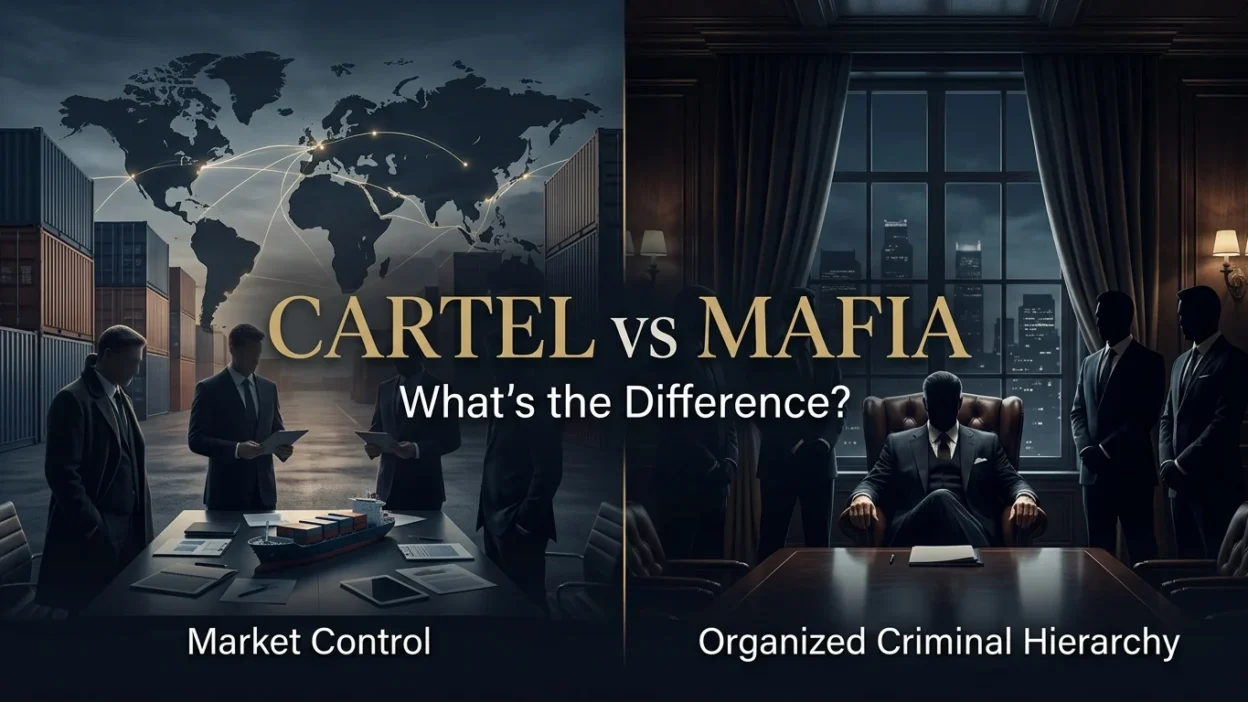
When people hear cartel and mafia, they often picture the same thing: powerful criminal organizations involved in illegal business, violence, corruption, and secrecy. Although the two terms can overlap in everyday conversation, they do not mean exactly the same thing. Each word has a distinct background and is used to describe somewhat different organizational structures and activities.
The main difference is that cartel usually refers to a group of independent parties that cooperate to control a market or illegal trade, while mafia generally refers to a structured criminal organization built around long term relationships, hierarchy, loyalty, and territorial influence.
A drug cartel, for example, may control the production and trafficking of narcotics, whereas a mafia organization may be involved in extortion, illegal gambling, protection rackets, smuggling, and other crimes. Understanding this distinction makes it easier to use both terms accurately in English.
Quick Answer
A cartel is typically an organized alliance that cooperates to control a trade, market, or illegal business, while a mafia is a more structured criminal organization with hierarchy, loyalty, and territorial influence. The terms can overlap, but they emphasize different organizational ideas.
Why People Confuse It
The confusion comes from the fact that both cartels and mafias are associated with organized crime.
Both may:
- Operate secretly
- Make large amounts of illegal money
- Use intimidation or violence
- Corrupt officials or institutions
- Control territory or business activities
- Engage in smuggling or trafficking
- Have leadership structures
However, the words focus on different characteristics.
Cartel emphasizes cooperation or coordination among groups or individuals, especially to control a particular market or trade.
Mafia emphasizes a persistent criminal organization with a strong internal structure, personal loyalty, hierarchy, and often territorial influence.
There is also an important linguistic point: cartel is not exclusively a criminal word. In economics, a cartel can be a group of businesses that agree to limit competition or control prices.
First Word: Cartel
A cartel is an organization or alliance in which separate parties cooperate to control a market, supply, price, or trade.
In everyday news and crime reporting, the word is especially associated with drug cartels and other organized criminal networks.
Examples of cartel usage
- The authorities investigated an international drug cartel.
- The cartel controlled a significant portion of the illegal trade.
- Several companies were accused of forming a price fixing cartel.
- Police launched an operation against a powerful criminal cartel.
The word can therefore describe both legal business terminology in economics and criminal organizations, depending on context.
What does cartel mean in organized crime?
In organized crime, a cartel is generally a powerful network involved in controlling or coordinating an illicit market. Drug cartels are the most familiar example.
The emphasis is often on control of a particular trade or supply chain.
Second Word: Mafia
A mafia is a secretive, organized criminal group, traditionally associated with a hierarchical structure, loyalty, intimidation, and long term criminal activity.
The word is strongly associated with the historical Sicilian and Italian American criminal organizations, although modern English sometimes uses mafia more broadly for powerful organized crime groups.
Examples of mafia usage
- The investigation focused on alleged mafia activity.
- The mafia organization operated through a strict hierarchy.
- The authorities accused the group of extortion and money laundering.
- He was portrayed as a powerful mafia boss.
The term often suggests a durable criminal organization, rather than simply a group cooperating to control one particular market.
What does mafia mean?
In its traditional sense, mafia refers to organized criminal groups characterized by secrecy, loyalty, hierarchy, and criminal enterprises. In informal English, however, people sometimes use mafia metaphorically to describe an influential or tightly connected group, even when no criminal activity is involved.
Comparison Table
| Feature | Cartel | Mafia |
| Basic idea | Cooperative group or network controlling a market or trade | Structured criminal organization |
| Common context | Drug trafficking, illegal markets, price fixing | Extortion, racketeering, gambling, smuggling, organized crime |
| Always criminal? | No | Generally refers to criminal activity |
| Structure | Can be a network of separate groups | Often hierarchical and internally organized |
| Main emphasis | Market or trade control | Organization, loyalty, power, and criminal influence |
| Common phrase | Drug cartel | Mafia family |
| Broader meaning | Economic and criminal | Mostly criminal, sometimes metaphorical |
| Example | A cartel controls an illegal drug supply chain | A mafia group controls criminal operations in an area |
When to Use Each
Use cartel when you want to emphasize a group or alliance working together to control a particular market, trade, or supply chain.
The investigation uncovered a drug cartel operating across several countries.
Use mafia when you are describing an established criminal organization, particularly one associated with hierarchy, secrecy, loyalty, or territorial power.
The detective spent years investigating the local mafia.
A simple rule
Think:
Cartel = coordinated control of a market or trade
Mafia = organized criminal network and power structure
There can certainly be overlap. A criminal organization may participate in a cartel like network while also having mafia style characteristics.
Examples
Here are examples showing how the two words work naturally in English:
- The police arrested several suspected members of a drug cartel.
- The cartel allegedly controlled a major trafficking route.
- Authorities are investigating the international criminal cartel.
- The company was accused of participating in a price fixing cartel.
- The journalist investigated the activities of a powerful mafia organization.
- The mafia allegedly used intimidation to protect its criminal interests.
- The detective spent years studying the structure of the mafia.
- The authorities targeted a suspected mafia boss.
- The cartel operated through a network of suppliers and distributors.
- The mafia organization had a reputation for secrecy and loyalty.
- Several criminal groups formed an alliance that functioned like a cartel.
- The investigation revealed connections between different organized crime groups.
Notice the difference
In sentences about a cartel, the focus is often on trade, supply, markets, or coordinated operations.
In sentences about the mafia, the focus is more likely to be on criminal organization, hierarchy, influence, loyalty, or territorial power.
Common Mistakes
1. Treating the words as exact synonyms
Although they can overlap, cartel and mafia are not interchangeable in every context.
Incorrect assumption:
A cartel always means mafia.
Better:
A cartel can be a criminal network, but the term can also describe an economic agreement between businesses.
2. Assuming cartel always means drugs
Drug cartels are extremely well known, but cartel has an important economic meaning too.
For example:
Several companies were accused of forming a cartel to keep prices artificially high.
Here, cartel has nothing to do with drug trafficking.
3. Using mafia for any criminal group
Not every organized crime group is automatically a mafia.
The term carries particular historical and cultural associations and often suggests a distinctive type of organized criminal structure.
4. Assuming mafia is always a formal name
Sometimes mafia is used broadly or metaphorically.
For example:
The media described the group as the “fashion mafia.”
This does not necessarily mean the group is literally a criminal organization.
5. Thinking cartel and mafia have identical structures
A cartel may consist of separate groups cooperating for a particular purpose. A mafia organization is generally understood as a more established criminal structure involving internal relationships and hierarchy.
Memory Trick
Use this simple association:
CARTEL → CONTROL
Think of a cartel as a group focused on controlling a market, trade, or supply.
MAFIA → MEMBERSHIP
Think of a mafia as a long standing organized group with loyalty, hierarchy, and criminal relationships.
Another quick trick:
Cartel controls a trade. Mafia controls a criminal organization.
This is not a perfect definition in every situation, but it is an effective way to remember the central distinction.
American vs British English
The words cartel and mafia are used in both American and British English, and their core meanings are essentially the same.
American English frequently uses cartel in discussions of drug trafficking, organized crime, and economics.
British English also uses the word in these contexts, particularly in reporting about organized crime and competition law.
Mafia likewise has the same basic meaning in both varieties of English.
The main difference is not spelling or pronunciation but context and frequency. American media often use terms such as drug cartel, organized crime, and mafia family, while British publications may discuss criminal networks, organized crime groups, or cartels depending on the situation.
So you do not need different vocabulary simply because you are writing for an American or British audience.
Similar Words
Several words are related to cartel and mafia, but each has its own meaning.
Organized crime
A broad term for criminal activity carried out by structured groups or networks.
Gang
A group of people involved in organized or criminal activity. Gang is usually less specific than mafia.
Syndicate
A group or organization working together for a particular purpose. In crime contexts, criminal syndicate can describe an organized network.
Crime family
A term often associated with mafia style organizations, particularly groups organized around family like relationships.
Criminal network
A broad expression for connected individuals or groups involved in illegal activities.
Mob
An informal term often used to refer to organized criminal groups, especially mafia style organizations.
Ring
A group of people secretly cooperating in illegal activity, as in a smuggling ring or a fraud ring.
FAQs
Is a cartel the same as a mafia?
No. A cartel generally emphasizes cooperation or control over a market or trade, while mafia usually refers to a structured criminal organization. However, the two concepts can overlap.
Is a cartel always involved in drugs?
No. A cartel can refer to businesses that cooperate to control prices or reduce competition. In crime related contexts, however, drug cartel is one of the most common uses.
Is the mafia a cartel?
Not necessarily. A mafia organization can participate in market control or cooperate with other criminal groups, but mafia and cartel describe different concepts.
Which is more organized, cartel or mafia?
There is no universal answer. Both can be highly organized. A cartel may be a network of independent groups, while a mafia organization is often described as having a more established internal hierarchy.
Can a cartel be legal?
The word itself does not always mean something illegal. In economics, a cartel is generally an agreement among businesses to coordinate in ways that restrict competition, and such conduct may be illegal under competition laws.
Can mafia be used metaphorically?
Yes. In informal language, mafia can sometimes describe a powerful, tightly connected group, even when the group is not literally a criminal organization.
What is the easiest way to remember cartel vs mafia?
Remember: cartel is about coordinated control, especially of a market or trade; mafia is about an organized criminal group and its network of power and loyalty.
Remember This
Cartel = a cooperating group or network focused on controlling a market, trade, or supply.
Mafia = a structured criminal organization associated with secrecy, hierarchy, loyalty, and criminal influence.
The two terms can overlap, especially when discussing organized crime, but they are not exact synonyms.
Final Verdict
The simplest distinction between cartel vs mafia is the focus of each word. A cartel describes an alliance or network that coordinates to control a market, trade, or supply, and the term can be used in both economic and criminal contexts. A mafia, on the other hand, traditionally refers to a structured criminal organization built around relationships, hierarchy, secrecy, and power.
If you’re writing about illegal drug distribution or market control, cartel may be the more precise word when coordination and trade are central to the discussion. If you’re describing a long established criminal organization with bosses, members, loyalty, and territorial influence, mafia is generally more appropriate. When in doubt, look at what the sentence is emphasizing: control of a trade suggests cartel; organized criminal power suggests mafia.
Conclusion
Understanding cartel vs mafia is less about memorizing two dictionary definitions and more about recognizing what each word emphasizes. Cartel commonly points toward cooperation and control of a market or trade, while mafia points toward an organized criminal structure with hierarchy, loyalty, and influence. That distinction remains useful whether you are reading news reports, studying English vocabulary, or writing about organized crime.
The words may sometimes appear in similar contexts, but choosing the right one makes your writing more precise.
Remember the shortcut: cartel focuses on coordinated control; mafia focuses on organized criminal power. Once you understand that difference, it becomes much easier to use both terms naturally and accurately.

Adam Aaron writes engaging mystery and adventure novels featuring intelligent characters, unexpected twists, and emotional storytelling. His creative imagination and compelling narratives have earned admiration from readers across generations.