
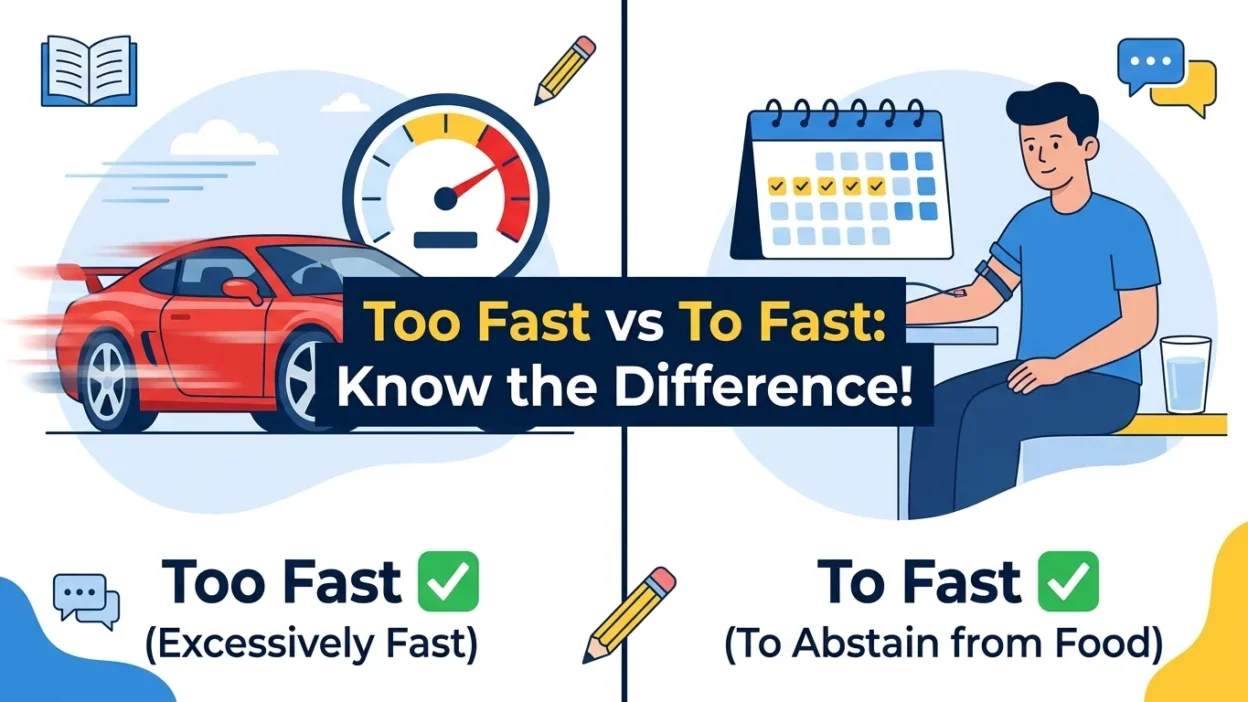
English has many word pairs that look almost identical but have completely different meanings. One of the most common examples is too fast vs to fast. Because the words to and too sound exactly alike, many writers accidentally choose the wrong spelling, especially when typing quickly or using informal communication.
If you’ve ever wondered whether you should write too fast or to fast, you’re not alone. This simple grammar mistake appears in emails, social media posts, essays, and even professional writing. Fortunately, the rule is easy to remember once you understand the purpose of each word. This guide explains the difference with clear definitions, examples, comparison tables, common mistakes, and memory tricks to help you use the correct phrase every time.
Quick Answer
Too fast is the correct phrase when you mean excessively fast or more quickly than desired. To fast is usually incorrect because to is a preposition or part of an infinitive, not an adverb meaning “excessively.” In nearly every situation where speed is discussed, too fast is the correct choice.
Why People Confuse It
People often confuse too and to because:
- They are pronounced the same.
- Spell check may not catch the mistake.
- Fast typing leads to omitted letters.
- Both words are extremely common in English.
- Many learners remember pronunciation better than spelling.
Since both words sound identical, writers must rely on grammar rather than pronunciation to choose the correct spelling.
Too Fast
Too fast means more quickly than is appropriate, safe, comfortable, or desired.
Here, too functions as an adverb meaning:
- excessively
- overly
- more than necessary
Examples
- You’re driving too fast.
- She spoke too fast for me to understand.
- The movie ended too fast.
- Don’t eat too fast.
- The internet connection is surprisingly too fast for my old computer to handle.
Common meanings
- Excessive speed
- Greater speed than expected
- Faster than recommended
- Difficult to keep up with
To Fast
To fast is usually incorrect when talking about speed.
However, to fast can occasionally appear in sentences where to belongs to one part of the sentence and fast begins another.
Rare Examples
- The doctor advised him to fast before surgery.
- She decided to fast for religious reasons.
- They planned to fast during the festival.
In these examples, fast is a verb meaning to abstain from eating, not an adjective describing speed.
Comparison Table
| Feature | Too Fast | To Fast |
| Correct for excessive speed | ✅ Yes | ❌ No |
| Uses “too” meaning excessively | ✅ Yes | ❌ No |
| Uses infinitive “to fast” (avoid food) | ❌ No | ✅ Yes |
| Common in everyday English | ✅ Very common | Rare |
| Example | You’re driving too fast. | I need to fast before surgery. |
When to Use Each
Use too fast when:
- Something moves excessively quickly.
- Someone speaks very rapidly.
- A vehicle exceeds a comfortable speed.
- An action happens sooner than desired.
- You mean “overly fast.”
Use to fast only when:
- Fast is a verb.
- You mean not eating for a period of time.
- It follows an infinitive (to fast).
Examples
Here are practical examples showing the correct usage.
- You’re driving too fast.
- She talks too fast during presentations.
- I finished the book too fast.
- The children ran too fast.
- The music was playing too fast.
- He answered too fast without thinking.
- We walked too fast for Grandma.
- The game ended too fast.
- Patients may need to fast before surgery.
- Some people choose to fast for religious reasons.
- The doctor instructed me to fast for twelve hours.
- The car accelerated too fast on the wet road.
Common Mistakes
Here are mistakes many English learners make.
❌ I was driving to fast.
✅ I was driving too fast.
❌ She talks to fast.
✅ She talks too fast.
❌ He needs too fast before surgery.
✅ He needs to fast before surgery.
❌ We finished to fast.
✅ We finished too fast.
Memory Trick
A simple trick can help you remember forever.
- Too = excessively = extra “O” = extra amount
- To = direction or infinitive
Ask yourself:
Do I mean “more than necessary”?
If yes, choose too.
If you’re talking about not eating, use to fast.
American vs British English
There is no difference between American and British English regarding too fast and to fast.
Both varieties follow the same grammar rules.
Examples:
- UK: You’re driving too fast.
- US: You’re driving too fast.
Likewise:
- UK: You must to fast? ❌
- UK: You need to fast before the operation. ✅
The spelling and usage remain identical across English dialects.
Similar Words
If you’re learning too vs to, these similar word pairs are also worth studying:
- Too vs To
- Their vs There vs They’re
- Your vs You’re
- Than vs Then
- Affect vs Effect
- Accept vs Except
- Its vs It’s
- Lose vs Loose
- Quiet vs Quite
- Farther vs Further
Mastering these commonly confused words will greatly improve your writing accuracy.
Final Verdict
The difference is straightforward once you know the rule.
Use too fast whenever you mean excessively fast or faster than desired. This is the phrase you’ll use in almost every conversation about speed.
Use to fast only when fast is a verb meaning to avoid eating. Outside of that specific context, to fast is incorrect and should be replaced with too fast.
Frequently Asked Questions (FAQs)
Is “to fast” ever correct?
Yes. It is correct only when fast is used as a verb meaning to avoid food.
Which is correct: “driving to fast” or “driving too fast”?
Driving too fast is correct.
Why do people confuse too and to?
Because they are homophones—they sound identical but have different meanings and grammatical functions.
Does “too fast” mean very fast?
Not exactly. It means excessively fast or faster than is appropriate.
Can “too fast” be used in formal writing?
Yes. It is completely correct in both formal and informal English.
Is “too fast” an adverb phrase?
Yes. Here, too modifies the adjective or adverb fast to indicate an excessive degree.
What does “to fast” mean?
It means to abstain from eating, usually for medical, religious, or personal reasons.
Conclusion
Understanding the difference between too fast and to fast is easier than it first appears. Although both phrases sound the same, they have completely different meanings. Too fast is the correct expression when describing excessive speed, while to fast refers to the action of avoiding food. Knowing this distinction will help you write with greater confidence and accuracy.
The best way to remember the rule is to focus on meaning rather than pronunciation. Whenever you mean “more than necessary,” choose too. If you’re referring to fasting before surgery or for religious purposes, use to fast. With regular practice, this common grammar confusion will quickly become a thing of the past.
Remember This
Use too fast for excessive speed. Use to fast only when talking about abstaining from food. If you mean “overly fast,” the correct choice is always too fast.

Adam Aaron writes engaging mystery and adventure novels featuring intelligent characters, unexpected twists, and emotional storytelling. His creative imagination and compelling narratives have earned admiration from readers across generations.