People often get confused by “at the house” and “in the house” because both phrases talk about a house. However, they do not mean the same thing. The difference is small, but it changes what you want to say. Using the wrong one can make your sentence sound less natural or even change its meaning.
The good news is that the rule is easy to understand. Once you know whether you are talking about a location or being inside a building, choosing the correct phrase becomes simple. This guide explains everything in clear English with easy examples, practical tips, and common mistakes so you can use both expressions with confidence.
Quick Answer
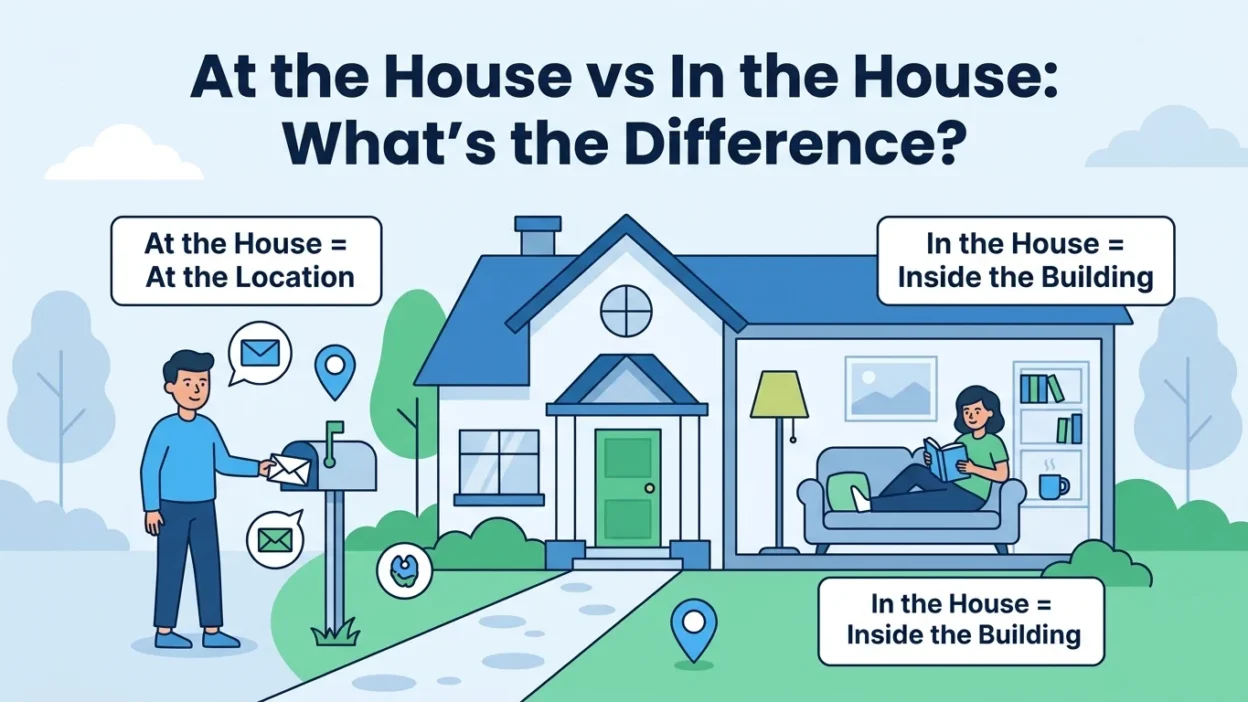
“At the house” refers to someone’s location or presence at a house, without focusing on whether they are inside or outside. “In the house” means someone or something is physically inside the building. Use “at” for a place or destination and “in” for being inside the house.
Why People Confuse It
Many English learners think at and in can always replace each other because both refer to a house. In reality, each preposition has a different job.
The confusion happens because:
- Both phrases mention the same place.
- People often hear both in everyday conversations.
- The difference is about location versus physical position.
- Some situations allow either phrase, but the meaning changes slightly.
Learning this difference helps your English sound more natural.
What Does “At the House” Mean?
“At the house” means someone is at the location of the house. It does not tell us whether the person is inside, outside, in the yard, or standing at the front door.
It simply identifies the place.
Examples
- I’ll meet you at the house after work.
- Everyone is at the house waiting for you.
- The delivery driver arrived at the house early.
- We stopped at the house before going to dinner.
Think of at as talking about a point or destination.
What Does “In the House” Mean?
“In the house” means someone or something is inside the building.
It focuses on being within the walls of the house.
Examples
- The children are in the house watching television.
- Is anyone in the house?
- We stayed in the house because it was raining.
- My phone is somewhere in the house.
Think of in as showing that something is enclosed by the building.
Comparison Table
| Feature | At the House | In the House |
| Main meaning | At the location | Inside the building |
| Focus | Place or destination | Physical position |
| Inside required? | No | Yes |
| Common use | Arriving, meeting, visiting | Staying, living, finding something |
| Example | I’m at the house. | I’m in the house. |
When to Use Each
Use “At the House” When:
- Talking about someone’s location.
- Meeting someone.
- Referring to a destination.
- Describing where an event is happening.
- Saying someone has arrived.
Use “In the House” When:
- Talking about being inside.
- Describing where an object is.
- Mentioning activities happening indoors.
- Talking about safety indoors.
- Explaining where people are physically located.
Examples
Here are everyday examples to make the difference clear.
- I’ll be at the house around six.
- The plumber is at the house now.
- We met everyone at the house before the party.
- She waited at the house until her parents came home.
- The dog is in the house sleeping.
- There is nobody in the house right now.
- We ate dinner in the house because it was cold.
- The kids stayed in the house during the storm.
- I left my wallet in the house.
- Please come in the house when you’re ready.
- Everyone gathered at the house for the family reunion.
- There’s a strange noise in the house.
Common Mistakes
Here are mistakes learners often make.
Incorrect: I’m in the house waiting outside.
Correct: I’m at the house waiting outside.
Incorrect: Meet me in the house at 5 p.m. (when you mean the location)
Correct: Meet me at the house at 5 p.m.
Incorrect: My keys are at the house kitchen.
Correct: My keys are in the house, in the kitchen.
Always ask yourself:
- Am I talking about the location? Use at.
- Am I talking about being inside? Use in.
Memory Trick
Here’s an easy way to remember.
- At = Address or location.
- In = Inside.
If you can imagine being surrounded by the walls of the house, use in.
If you simply mean the house as a place, use at.
American vs British English
Both American English and British English use these phrases in the same way.
There is no important difference in meaning.
Examples:
- I’m at the house.
- I’m in the house.
Speakers in both countries follow the same basic rule.
Similar Words and Expressions
These phrases follow the same pattern:
- At school vs in school
- At work vs in the office
- At the hospital vs in the hospital
- At the airport vs in the airport
- At the station vs in the station
- At home vs in the home
- At the park vs in the park
- At the office vs in the office
Learning these pairs will improve your understanding of English prepositions.
Final Verdict
The difference is simple once you know what each preposition does.
Choose “at the house” when talking about a person’s location or destination.
Choose “in the house” when talking about someone or something physically inside the building.
Remember this simple idea:
- At = location
- In = inside
Frequently Asked Questions
Is “at the house” grammatically correct?
Yes. It is a correct and common English expression for talking about someone’s location.
Is “in the house” grammatically correct?
Yes. It means someone or something is physically inside the house.
Can I use both in the same situation?
Sometimes, yes. For example:
- I’m at the house. (You are at that location.)
- I’m in the house. (You are inside the building.)
The meaning changes slightly.
Which phrase is more common?
Both are common. The correct choice depends on what you want to say.
Is “at the house” the same as “at home”?
Not always. At home means being at your own home, while at the house can refer to any specific house.
How can I remember the difference?
Think:
- At = address
- In = inside
This simple trick works in most situations.
Can “at the house” mean inside?
Sometimes people who say they’re at the house may actually be inside, but the phrase itself does not focus on that detail.
Remember This
When you talk about where someone is, use “at the house.”
When you talk about being inside the building, use “in the house.”
A simple question helps:
Am I talking about the place or the inside?
If it’s the place, use at. If it’s the inside, use in.
Conclusion
Understanding the difference between “at the house” and “in the house” is an important step toward speaking and writing more natural English. Although the two expressions refer to the same building, they describe different ideas. “At the house” focuses on the location, while “in the house” focuses on being physically inside.
The more you notice these phrases in conversations, books, emails, and everyday speech, the easier they become to use correctly. Practice by making your own sentences and asking yourself whether you are talking about a location or the inside of a building. With that simple habit, you’ll choose the right expression every time.

Willow Evans writes uplifting fantasy stories filled with magical worlds, courageous heroes, and meaningful life lessons. Her imaginative books encourage creativity, kindness, and hope in readers of all ages.