Many English learners feel confused about by which and in which because both phrases appear in formal writing, books, reports, and academic texts. At first glance, they look similar since they both contain the word which. However, they are used for different purposes, and choosing the wrong one can make a sentence sound unnatural or change its meaning.
The good news is that the difference is easier than it seems. Once you understand what each phrase does, you’ll be able to use them with confidence in emails, essays, business writing, and everyday English. This guide explains everything in simple language, with clear examples, practical tips, and an easy memory trick to help you remember the difference.
Quick Answer
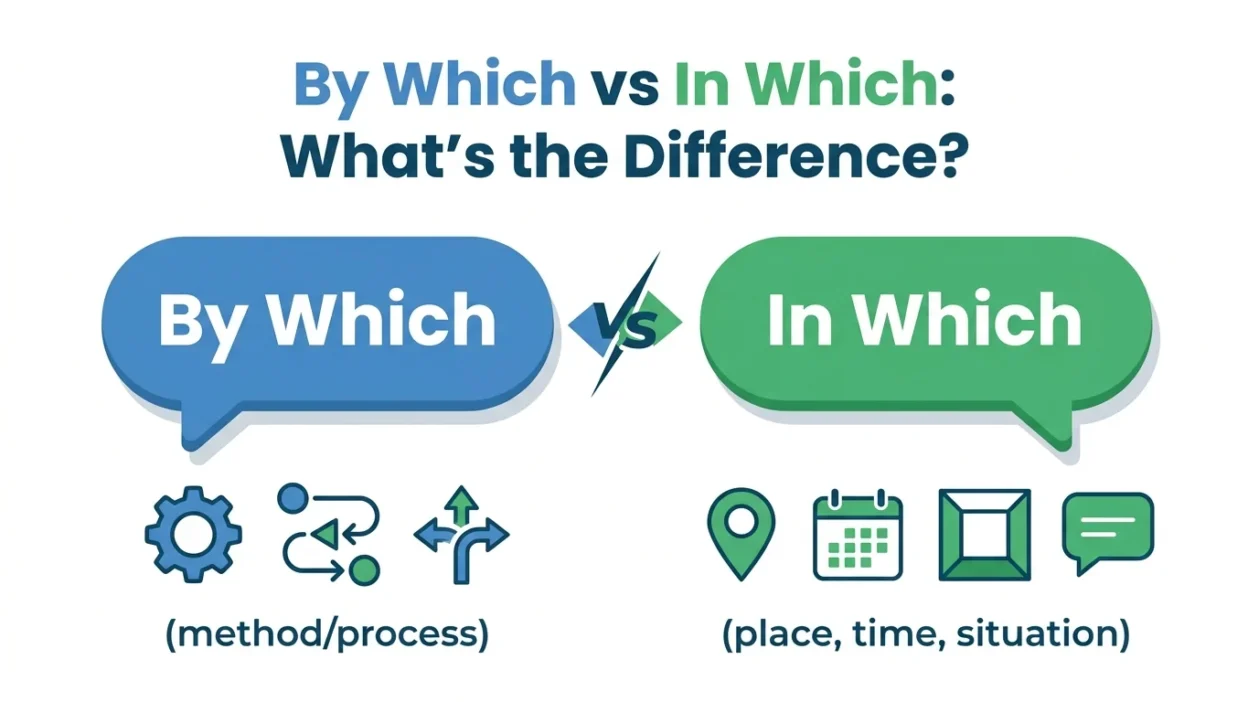
By which explains the method, means, or way something happens. In which tells the place, situation, time period, or condition where something happens. If you can replace the phrase with through which, by which is often correct. If you can replace it with where, in which is usually the better choice.
Why People Confuse By Which and In Which
People often confuse these phrases because they both begin with a preposition followed by which. They are also common in formal English, where they replace simpler words like where or how.
Another reason for the confusion is that both can connect two parts of a sentence. The real difference is the job of the preposition.
- By shows a method, means, or action.
- In shows a place, condition, situation, or period.
Understanding this small difference makes choosing the correct phrase much easier.
What Does “By Which” Mean?
By which refers to the way, method, process, or means that makes something happen.
You can often replace by which with:
- through which
- using which
- by means of which
Examples
- This is the method by which the data was collected.
- The agreement explains the process by which payments are made.
- We found the route by which the animals entered the farm.
- She described the steps by which the machine operates.
- The law defines the procedure by which complaints are handled.
In each example, by which explains how something happens.
What Does “In Which” Mean?
In which refers to a place, situation, condition, event, or period where something happens.
It often replaces where in formal writing.
Examples
- This is the room in which the meeting was held.
- We reached a point in which everyone agreed.
- She described the situation in which the mistake happened.
- That was the year in which the company expanded.
- The book explains the environment in which these animals live.
Here, in which answers questions like where, when, or under what condition.
By Which vs In Which Comparison Table
| Feature | By Which | In Which |
| Main meaning | Method or means | Place, situation, or time |
| Answers | How? By what method? | Where? In what situation? |
| Often replaced with | Through which | Where |
| Common in | Procedures, processes, instructions | Locations, events, conditions |
| Example | The process by which water is cleaned | The city in which she lives |
When to Use Each
Choose by which when you are talking about:
- A method
- A process
- A system
- A technique
- A means of doing something
Examples:
- The formula by which prices are calculated.
- The method by which students are selected.
Choose in which when you are talking about:
- A place
- A room
- A country
- A situation
- A period of time
- An event
Examples:
- The house in which they grew up.
- The meeting in which the decision was made.
Examples of By Which and In Which
Here are more examples to make the difference clear.
- The process by which plants make food is called photosynthesis.
- This is the system by which customers receive updates.
- The method by which the results were measured is reliable.
- The village in which my grandparents live is very peaceful.
- The classroom in which we studied was newly painted.
- The situation in which they found themselves was difficult.
- That was the month in which we moved to a new home.
- The rules by which the game is played are simple.
- The conditions in which the workers lived were improved.
- The process by which the company hires employees is fair.
- The country in which she was born is famous for its mountains.
- The way by which he solved the problem impressed everyone.
Common Mistakes
Here are mistakes that English learners often make.
Incorrect: The room by which we met was large.
Correct: The room in which we met was large.
Reason: A room is a place, not a method.
Incorrect: The process in which the machine works.
Correct: The process by which the machine works.
Reason: A process explains how something works.
Incorrect: The city by which I live is beautiful.
Correct: The city in which I live is beautiful.
Memory Trick
A simple way to remember the difference is this:
- By = By means of = How
- In = Inside = Where
If you’re talking about how something happens, choose by which.
If you’re talking about where or in what situation something happens, choose in which.
This quick trick works in most formal writing.
American vs British English
Both American English and British English use by which and in which in the same way.
The main difference is style rather than grammar. In everyday conversation, speakers in both varieties often use simpler alternatives.
For example:
- Formal: The office in which she works.
- Everyday: The office where she works.
And:
- Formal: The method by which the results were obtained.
- Everyday: The way the results were obtained.
Formal documents, research papers, contracts, and official reports are more likely to use by which and in which.
Similar Words and Phrases
These expressions have related meanings and are often used in similar contexts.
- where
- through which
- by means of which
- during which
- under which
- through which
- according to which
- with which
- from which
Knowing these alternatives helps you write more naturally and vary your sentence structure.
Final Verdict
The difference is simple once you know what each phrase does.
Use by which when explaining the method, process, or means.
Use in which when describing the place, situation, time, or condition.
When you’re unsure, ask yourself one question:
- Does the sentence answer how? Use by which.
- Does it answer where or in what situation? Use in which.
Frequently Asked Questions
Is “by which” grammatically correct?
Yes. It is completely correct and commonly used in formal English to describe a method, process, or means.
Is “in which” the same as “where”?
Often, yes. In many sentences, in which can be replaced by where, especially when referring to a place.
Which is more formal, “where” or “in which”?
In which is more formal and is common in academic, legal, and professional writing.
Can I use “by which” in everyday conversation?
You can, but most native speakers usually choose simpler wording like how or the way during casual conversation.
How do I know which one to choose?
Think about the meaning. If you’re describing how something happens, use by which. If you’re describing where or in what situation something happens, use in which.
Can both phrases appear in the same sentence?
Yes.
Example: The process by which the product is made takes place in a factory in which safety rules are strictly followed.
Are these phrases common in academic writing?
Yes. They are frequently used in research papers, reports, legal documents, and formal essays because they create precise and professional sentences.
Conclusion
Although by which and in which look similar, they serve different purposes. By which focuses on the method or means used to achieve something, while in which points to the place, situation, or period where something happens. Understanding this distinction will make your writing clearer and more accurate.
With regular practice, choosing between these expressions becomes natural. Read formal English texts, notice how each phrase is used, and try writing your own examples. Over time, you’ll recognize the difference immediately and use both expressions with confidence.
Remember This
- By which = How something happens
- In which = Where or in what situation something happens
- By = Method
- In = Place, condition, or time
- If you can replace it with through which, use by which.
- If you can replace it with where, use in which.

Adam Aaron writes engaging mystery and adventure novels featuring intelligent characters, unexpected twists, and emotional storytelling. His creative imagination and compelling narratives have earned admiration from readers across generations.