People often get confused when talking about someone walking past them. Should you write passersby, passerbyers, or passerby? At first glance, all three seem possible because English has many unusual plural forms. However, only some of these words are correct in standard English.
Learning the difference is easier than it looks. Once you understand how the word is formed, you will never have to guess again. This guide explains the meaning of each word, shows the correct plural form, highlights common mistakes, and provides everyday examples. By the end, you will know exactly which word to use in conversations, emails, school assignments, and professional writing.
Quick Answer
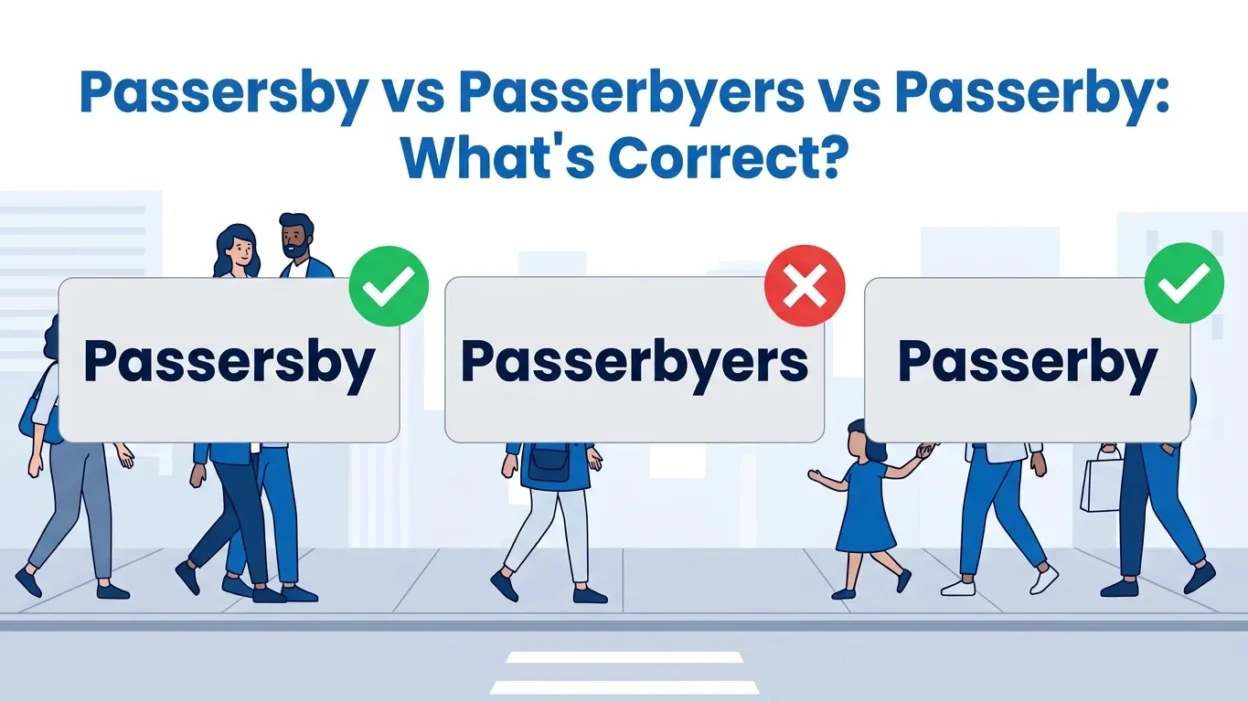
Passerby is the correct singular noun for one person passing by. Passersby is the correct plural form for two or more people passing by. Passerbyers is not a standard English word and should not be used in formal or everyday writing.
Why People Confuse It
Many English words become plural by adding -s or -es at the end. Because of this rule, some people naturally think the plural of passerby should be passerbyers.
The confusion happens because passerby is a compound noun. Instead of adding -s to the last part of the word, English adds the plural ending to the main noun, passer. This creates passersby, just like mothers in law and attorneys general.
Passerby
Passerby is the correct singular form.
It refers to one person who is passing a place by chance.
Meaning
A person who happens to walk or travel past a place without stopping.
Examples
- A passerby helped the lost child.
- One passerby called the police.
- The passerby smiled at everyone.
- A passerby found the missing wallet.
- The driver thanked the passerby for the directions.
Passerbyers
Passerbyers is not a correct English word.
Although it may sound logical, English dictionaries do not recognize it as the plural of passerby. Using it in writing can make your English look incorrect.
Incorrect Examples
- ❌ Several passerbyers watched the accident.
- ❌ The passerbyers gathered outside the store.
Correct Versions
- ✅ Several passersby watched the accident.
- ✅ The passersby gathered outside the store.
Comparison Table
| Word | Correct? | Number | Meaning |
| Passerby | ✅ Yes | Singular | One person passing by |
| Passersby | ✅ Yes | Plural | More than one person passing by |
| Passerbyers | ❌ No | None | Not a standard English word |
When to Use Each
Use passerby when:
- Talking about one person.
- Writing news reports.
- Describing a single witness.
- Referring to one stranger passing by.
Example:
“A passerby reported the fire.”
Use passersby when:
- Talking about two or more people.
- Describing crowds.
- Writing stories or articles.
- Mentioning several witnesses.
Example:
“Several passersby stopped to help.”
Do not use passerbyers
It is not accepted in standard English.
Examples
Here are some everyday examples.
- A passerby picked up the dropped phone.
- One passerby offered to help.
- Several passersby watched the parade.
- The passersby applauded the street performer.
- A passerby gave directions to the tourists.
- Curious passersby gathered around the scene.
- The police interviewed nearby passersby.
- A friendly passerby helped carry the bags.
- Passersby stopped to admire the artwork.
- The loud noise surprised nearby passersby.
- A passerby returned the lost wallet.
- Many passersby took photos of the event.
Common Mistakes
Here are mistakes learners often make.
- Using passerbyers instead of passersby.
- Adding -s to the wrong part of the word.
- Using passersby when talking about only one person.
- Thinking every compound noun follows normal plural rules.
- Mixing singular and plural verbs.
Incorrect
- ❌ A passersby was waiting.
- ❌ Three passerbyers stopped.
Correct
- ✅ A passerby was waiting.
- ✅ Three passersby stopped.
Memory Trick
Think about the main noun.
The important word is passer.
To make it plural, add -s to passer, not to by.
- One passerby
- Many passersby
Just remember:
Pluralize the person, not the direction.
American vs British English
Both American English and British English use exactly the same forms.
- Singular: passerby
- Plural: passersby
Neither variety of English uses passerbyers as a standard word.
Similar Words
Many compound nouns have unusual plural forms.
- Brother in law → Brothers in law
- Mother in law → Mothers in law
- Attorney general → Attorneys general
- Editor in chief → Editors in chief
- Court martial → Courts martial
Like these words, passerby follows a special plural pattern.
Final Verdict
The rule is simple.
- Passerby = one person.
- Passersby = more than one person.
- Passerbyers = incorrect.
If you want clear, natural English, always choose passerby for singular and passersby for plural.
Frequently Asked Questions
Is “passerbyers” a real word?
No. It is not a standard English word and should be avoided.
What is the plural of passerby?
The correct plural is passersby.
Why isn’t the plural “passerbyers”?
Because passerby is a compound noun. English makes the main noun (passer) plural.
Can I use “passersby” in formal writing?
Yes. It is correct in academic, business, journalistic, and everyday writing.
Is “passerby” one word or two?
It is written as one word.
Do American and British English use different forms?
No. Both use passerby and passersby.
Is “passersby” common in newspapers?
Yes. News articles often use passersby when describing witnesses or people nearby.
Conclusion
English sometimes surprises learners with unusual plural forms, and passerby is one of those words. Instead of following the usual pattern of adding -s to the end, it becomes passersby because the main noun is passer. Once you know this rule, the correct choice becomes easy.
Whenever you write about one person walking past, use passerby. When talking about several people, use passersby. Avoid passerbyers, since it is not accepted in standard English. Using the correct form will make your writing sound natural, accurate, and professional.
Remember This
- ✅ Passerby = one person passing by.
- ✅ Passersby = more than one person passing by.
- ❌ Passerbyers = not a correct English word.
- Remember: Pluralize “passer,” not “by.”

Hadley Price creates heartfelt contemporary fiction exploring relationships, hope, resilience, and personal growth. Her emotionally rich storytelling connects with readers through memorable characters and inspiring life experiences worldwide.