Many English learners and even native speakers mix up too and to because they sound exactly the same. These words are homophones, meaning they have the same pronunciation but different meanings and spellings. Using the wrong one can make your writing look careless, especially in emails, school assignments, blogs, and professional communication.
The good news is that the difference between too and to is actually very simple once you understand their purpose. In this guide, you’ll learn clear definitions, practical examples, common mistakes, memory tricks, and easy tips to help you choose the correct word every time. Whether you’re preparing for an exam or improving your everyday English, this guide will make the distinction easy to remember.
Quick Answer
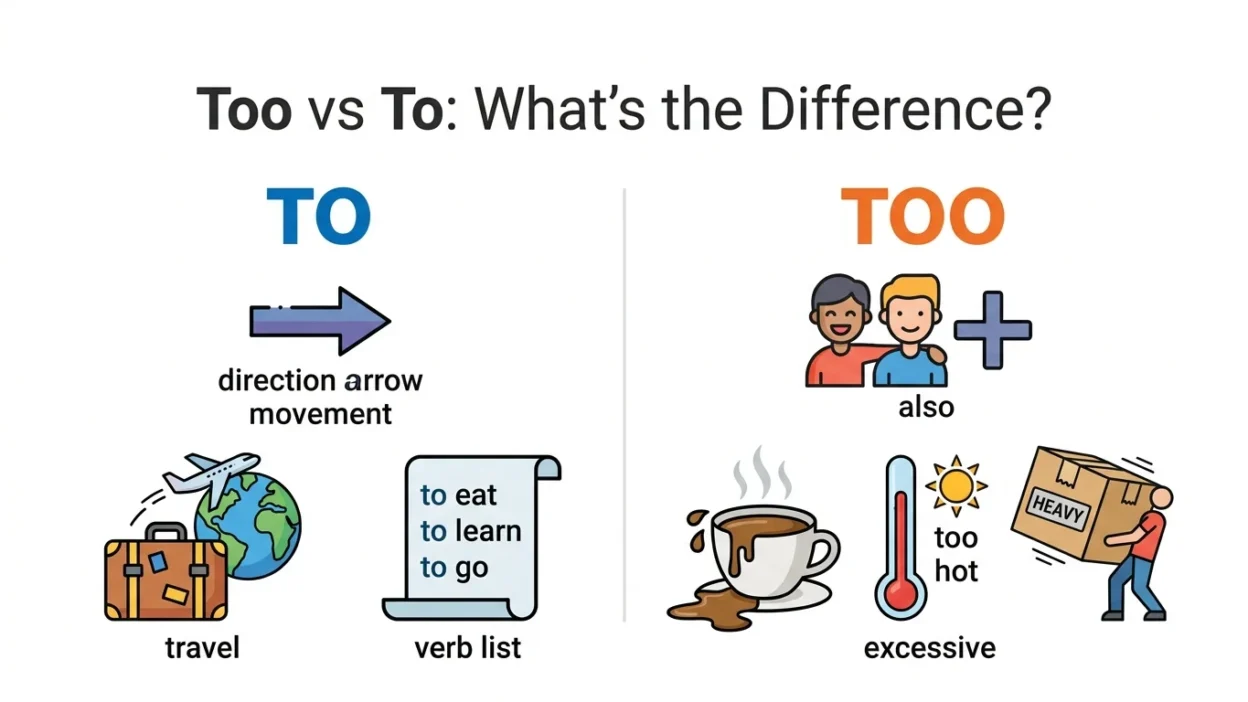
To is mainly used as a preposition or as part of the infinitive form of a verb (to eat, to go, to learn). Too means also or more than necessary. If you can replace the word with also or excessively, then too is usually the correct choice.
Why People Confuse It
People often confuse too and to because:
- They are pronounced the same.
- Their spellings differ by only one letter.
- Both appear frequently in everyday English.
- Fast typing often leads to accidental mistakes.
- Autocorrect may not catch the error because both are real words.
Understanding the role each word plays in a sentence makes choosing the correct one much easier.
To
To is one of the most commonly used words in English. It has two primary functions.
1. To as a Preposition
It shows direction, destination, time, purpose, or relationship.
Examples:
- I walked to the park.
- She gave the book to her friend.
- The meeting starts to the minute.
- We traveled to Canada.
2. To Before a Verb (Infinitive)
It introduces the base form of a verb.
Examples:
- I want to learn English.
- They hope to win.
- She likes to read before bed.
- We need to leave now.
Too
Too has two common meanings.
1. Too Means “Also”
It adds another person or thing.
Examples:
- I want coffee too.
- She is coming too.
- They enjoyed the movie too.
2. Too Means “Excessively”
It describes something beyond what is necessary or acceptable.
Examples:
- The soup is too hot.
- This bag is too heavy.
- You’re driving too fast.
- The room is too noisy.
Comparison Table
| Feature | To | Too |
| Part of speech | Preposition or infinitive marker | Adverb |
| Main meaning | Direction, purpose, relationship, before verbs | Also; more than enough |
| Can mean “also”? | No | Yes |
| Can mean “excessively”? | No | Yes |
| Example | I want to sleep. | I want dessert too. |
| Example | Walk to school. | It’s too cold outside. |
When to Use Each
Use to when:
- Showing direction
- Expressing destination
- Connecting a verb to its infinitive
- Indicating purpose
- Showing relationships between people or objects
Use too when:
- You mean also
- Something is more than necessary
- Something exceeds a limit
- You want to emphasize excess
Examples
Here are practical examples showing both words correctly.
- I want to visit Paris.
- She came too.
- It’s too expensive for me.
- We need to finish the project.
- He walked to school.
- I’d like some cake too.
- The coffee is too cold.
- They decided to wait.
- You’re speaking too quietly.
- She sent the letter to her manager.
- Can I come too?
- It’s never too late to learn.
Common Mistakes
Here are some mistakes learners often make.
❌ I want too go home.
✅ I want to go home.
❌ She is to tired.
✅ She is too tired.
❌ Can I come to?
✅ Can I come too?
❌ The box is to heavy.
✅ The box is too heavy.
❌ I gave it too him.
✅ I gave it to him.
Memory Trick
A simple trick can help you remember.
- Too has two O’s.
- Think of the two O’s as meaning extra or also.
Examples:
- Too much
- Me too
- Too many
- Too expensive
If the word means also or more than enough, choose too.
Otherwise, use to.
American vs British English
There is no difference between American and British English in the use of too and to.
Both varieties follow the same spelling, grammar, and usage rules.
Examples:
- American English: I want to travel too.
- British English: I want to travel too.
The only differences you may notice involve pronunciation or vocabulary elsewhere not these two words.
Similar Words
If you often confuse too and to, you may also struggle with these common word pairs:
- Two vs Too vs To
- Your vs You’re
- Their vs There vs They’re
- Then vs Than
- Its vs It’s
- Affect vs Effect
- Accept vs Except
- Lose vs Loose
Learning these pairs together helps improve both writing accuracy and confidence.
Final Verdict
Although too and to sound identical, they serve completely different purposes.
Use to for direction, destinations, relationships, and before verbs. Use too when you mean also or more than necessary. Asking yourself whether the word could be replaced with also or excessively is one of the easiest ways to choose correctly.
With regular practice and careful proofreading, you’ll soon use both words naturally and accurately in everyday writing.
Frequently Asked Questions
1. What is the difference between too and to?
To is used as a preposition or before a verb, while too means also or more than necessary.
2. Is it “me too” or “me to”?
The correct phrase is “me too” because it means me also.
3. Is it “too much” or “to much”?
The correct expression is “too much” because it describes an excessive amount.
4. Can “too” come at the beginning of a sentence?
Yes. For example:
Too often, people ignore small grammar mistakes.
5. Is “to” ever an adverb?
No. To functions mainly as a preposition or an infinitive marker.
6. Why are too and to confusing?
They are homophones they sound the same but have different meanings and spellings.
7. How can I remember the difference?
Remember that too has two O’s, which represent something extra or also.
Remember This
- Use to for direction, destination, and before verbs.
- Use too when you mean also or more than necessary.
- If you can replace it with also or excessively, choose too.
- If not, to is probably the correct choice.
- Proofreading your writing for these two words can instantly improve your grammar.
Conclusion
Understanding the difference between too and to is one of the simplest ways to improve your English writing. Although these words sound the same, they perform very different grammatical functions. To connects ideas by showing direction, purpose, or introducing a verb, while too adds the meaning of also or excessively.
The best way to master them is through regular reading, writing, and practice. Whenever you’re unsure, pause and ask yourself whether the word could mean also or more than enough. If it can, use too. If not, to is almost certainly the correct choice. With this simple habit, you’ll avoid one of the most common English grammar mistakes and write with greater confidence.

Quinn Mitchell is celebrated for historical fiction that combines authentic settings, unforgettable characters, and compelling narratives. His thoughtful writing brings history alive while inspiring curiosity and deeper understanding among readers.