People often wonder whether they should write timeslot or time slot. You may see both versions online, in booking systems, event websites, software, and business emails. That makes it easy to think they are equally correct in every situation.
The truth is that the best choice depends on the writing style, industry, and audience. One version is the traditional spelling, while the other has become common in technology, scheduling apps, and digital platforms. Knowing when to use each can make your writing look more natural and professional.
In this guide, you’ll learn the difference between timeslot and time slot, see real life examples, avoid common mistakes, and discover which spelling fits different situations.
Quick Answer
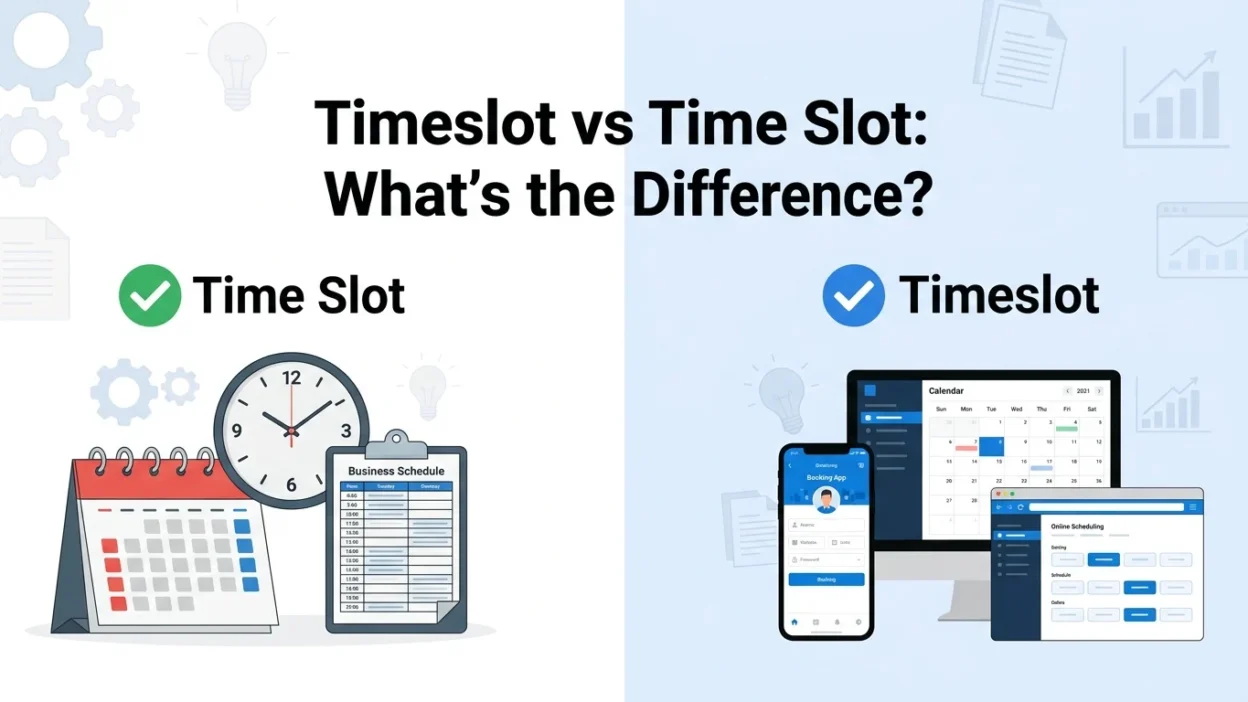
Time slot is the traditional and widely accepted spelling in standard English. Timeslot is a newer closed compound that is common in technology, scheduling software, and some businesses. If you’re unsure, use time slot because it is accepted almost everywhere.
Why People Confuse It
The confusion happens because English often changes over time. Many two word expressions eventually become one word.
For example:
- Website (once written as web site)
- Email (once written as E mail)
- Notebook
- Smartphone
The same thing is happening with time slot. Many digital products and online booking systems now display timeslot, while dictionaries and style guides still commonly prefer time slot.
As a result, both spellings appear regularly, leading many writers to wonder which is correct.
What Does “Time Slot” Mean?
A time slot is a specific period set aside for an activity, appointment, meeting, event, or broadcast.
Examples include:
- A doctor’s appointment at 10:30 AM
- A television program scheduled from 8 PM to 9 PM
- A meeting reserved from 2 PM to 3 PM
- A delivery window during the afternoon
Because it clearly describes a “slot” of time, many editors still prefer writing it as two separate words.
What Does “Timeslot” Mean?
Timeslot has exactly the same meaning as time slot.
The difference is only the spelling.
You’ll often find timeslot in:
- Online booking systems
- Calendar applications
- Event registration software
- Airline reservation systems
- Scheduling platforms
- Technology documentation
Many software developers and companies use the one word form because it is shorter and works well in user interfaces and databases.
Comparison Table
| Feature | Time Slot | Timeslot |
| Spelling | Two words | One word |
| Meaning | A scheduled period of time | Same meaning |
| Traditional English | Yes | Less traditional |
| Common in formal writing | Yes | Sometimes |
| Common in technology | Yes | Very common |
| Safe choice for school or business | Yes | Usually acceptable in technical contexts |
When to Use Each
Use time slot when:
- Writing school assignments
- Creating formal documents
- Sending business emails
- Following most style guides
- Writing articles or reports
- You want the safest choice
Examples:
- Please choose your preferred time slot.
- The interview time slot has changed.
- Every speaker received a different time slot.
Use timeslot when:
- Writing software documentation
- Designing booking systems
- Following a company’s branding
- Working on apps or scheduling tools
- Matching an existing interface
Examples:
- Select your preferred timeslot.
- Each timeslot allows one booking.
- The system automatically creates a new timeslot.
Examples
Here are everyday examples showing both spellings.
- Please book your time slot before Friday.
- Every student received a different time slot for the presentation.
- Our meeting time slot starts at 9:00 AM.
- The doctor has no available time slots today.
- Choose a delivery time slot that suits you.
- The booking app displays every available timeslot.
- You can reserve a timeslot in just a few clicks.
- Each timeslot lasts thirty minutes.
- The software creates a new timeslot automatically.
- We filled every timeslot for the conference.
- Please arrive during your assigned time slot.
- The calendar highlights each available timeslot in blue.
Common Mistakes
Many writers make these simple mistakes.
Mistake: Time slot
Unless a style guide specifically prefers it, the hyphen is usually unnecessary.
Mistake: Switching spellings in one document
Choose one spelling and stay consistent throughout your writing.
Mistake: Assuming one is always wrong
Both spellings are used today. The choice depends on the context.
Mistake: Using “timeslot” in highly formal writing without checking style requirements
Formal documents often prefer time slot.
Memory Trick
Here’s an easy way to remember the difference.
Think of it this way:
- Time slot = traditional writing, books, schools, and formal documents.
- Timeslot = technology, apps, booking systems, and digital products.
When you’re unsure, choose time slot because it is accepted in more situations.
American vs British English
There is no major difference between American and British English for these spellings.
Both varieties commonly recognize time slot as the standard form.
However, timeslot is becoming increasingly common worldwide in:
- Software
- Mobile apps
- Online booking platforms
- Digital scheduling tools
The preference is based more on industry than on country.
Similar Words
English contains many word pairs that have changed from two words into one over time.
Examples include:
- Login and log in
- Website and web site
- Email and E mail
- Healthcare and health care
- Database and data base
- Workflow and work flow
These examples show how English spelling naturally evolves as words become more widely used.
Final Verdict
If you want the safest and most widely accepted spelling, use time slot.
Choose timeslot if you’re writing for software, digital products, or an organization that already uses that spelling.
The most important rule is consistency. Once you pick one form, use it throughout your document.
Frequently Asked Questions
Is “timeslot” a real word?
Yes. It is widely used, especially in technology, scheduling software, and online booking systems.
Which spelling is more correct?
Time slot is generally considered the traditional and safer spelling for most types of writing.
Can I use “timeslot” in business writing?
Yes, especially if your company or software already uses that spelling consistently.
Is “time slot” two words?
Yes. It is traditionally written as two separate words.
Do both spellings mean the same thing?
Yes. Both refer to a scheduled period reserved for a particular activity.
Which spelling should students use?
Students should usually write time slot unless their teacher or style guide recommends otherwise.
Why do booking websites use “timeslot”?
Many technology companies prefer the shorter one word version because it fits well in interfaces and databases.
Conclusion
Choosing between timeslot and time slot is easier once you understand that they have exactly the same meaning. The main difference is style rather than definition. Traditional writing, academic work, and many professional documents continue to favor time slot, while software companies and digital platforms often use timeslot.
As English continues to evolve, both spellings are likely to remain in use. If your audience expects formal, polished writing, time slot is the safest option. If you’re writing for a technical product or following an established company style, timeslot is perfectly reasonable. Above all, stay consistent from beginning to end.
Remember This
Time slot is the traditional and safest spelling for most writing.
Timeslot is a modern variation commonly used in technology, booking systems, and scheduling software.
When in doubt, choose time slot and use the same spelling consistently throughout your document.

Nova Turner specializes in imaginative science fiction blending futuristic technology, thrilling adventures, and powerful human emotions. Her innovative storytelling inspires curiosity, creativity, and exploration among readers of every age.