Many English learners struggle with affirm vs confirm because both words involve saying that something is true. At first glance, they appear interchangeable, but they have different meanings and are used in different situations. Understanding the distinction will help you communicate more accurately in conversations, academic writing, and professional communication.
In this guide, you’ll learn the meaning of affirm and confirm, discover when to use each word, compare them side by side, and see plenty of real life examples. By the end, you’ll know exactly which word fits your sentence and avoid one of the most common English vocabulary mistakes.
Quick Answer
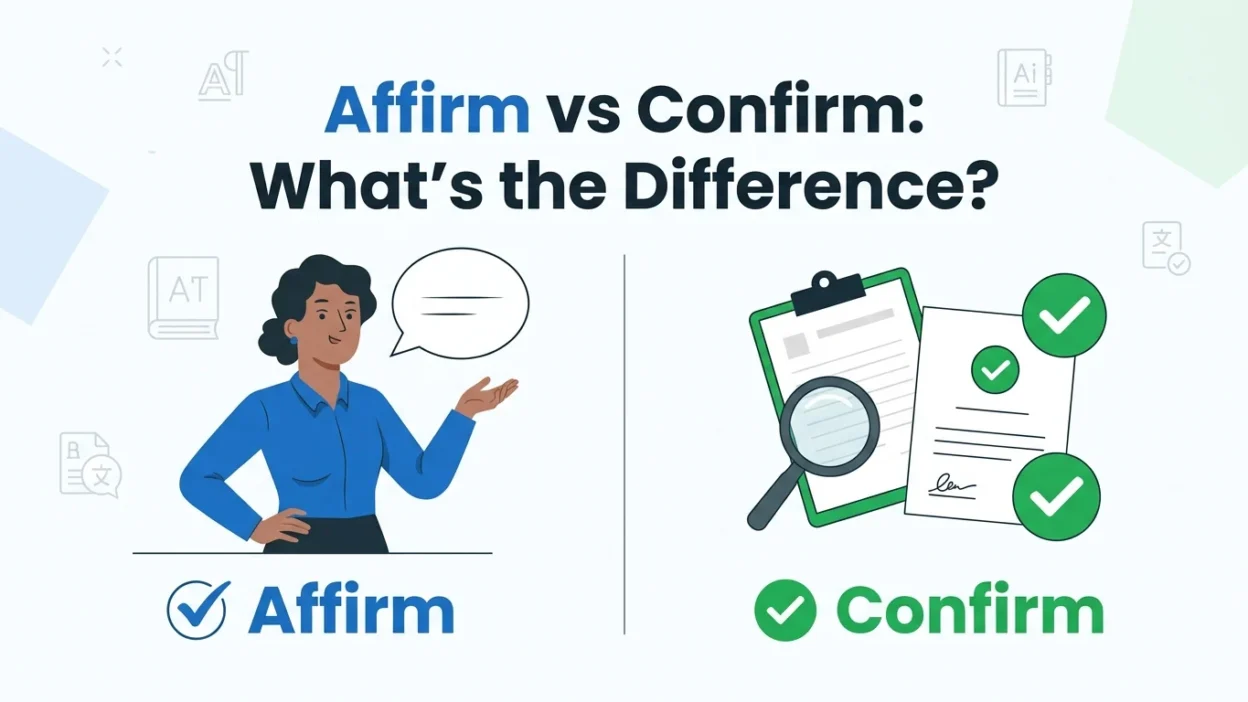
Affirm means to state or declare something to be true, often with confidence or conviction. Confirm means to verify, prove, or establish that something is true using evidence, facts, or official approval. In simple terms, you affirm an opinion or belief, but you confirm information or facts.
Why People Confuse Affirm and Confirm
These two verbs are often confused because both relate to truth and certainty.
The confusion happens because:
- Both suggest that something is true.
- Both are common in formal English.
- Both appear in legal, business, and academic writing.
- Their meanings overlap in certain contexts.
The key difference is that affirm is about declaring, while confirm is about verifying.
What Does “Affirm” Mean?
Affirm means to declare, state firmly, or assert that something is true.
It usually expresses confidence, belief, agreement, or support.
Common Uses of Affirm
- Affirm a belief
- Affirm a decision
- Affirm one’s commitment
- Affirm someone’s rights
- Affirm an opinion
Examples
- She affirmed her loyalty to the company.
- The witness affirmed that the statement was accurate.
- I affirm my commitment to this project.
- The court affirmed the earlier ruling.
- He affirmed his support for the proposal.
What Does “Confirm” Mean?
Confirm means to verify, validate, or prove that something is true.
It is commonly used when evidence, facts, or official approval is involved.
Common Uses of Confirm
- Confirm a booking
- Confirm an appointment
- Confirm a rumor
- Confirm a reservation
- Confirm the results
- Confirm an email address
Examples
- Please confirm your attendance.
- The laboratory confirmed the diagnosis.
- The airline confirmed our reservation.
- Police confirmed the reports.
- She confirmed that the meeting starts at 10 a.m.
Affirm vs Confirm Comparison Table
| Feature | Affirm | Confirm |
| Primary Meaning | Declare something to be true | Verify or prove something is true |
| Focus | Personal statement or declaration | Evidence or verification |
| Based On | Belief, confidence, conviction | Facts, proof, official information |
| Common Contexts | Legal, personal, emotional | Business, travel, medicine, research |
| Typical Objects | Belief, commitment, opinion | Reservation, appointment, report, information |
When to Use Each Word
Use affirm when you:
- State something confidently.
- Express support or commitment.
- Declare beliefs or opinions.
- Reinforce a previous statement.
- Make a formal declaration.
Use confirm when you:
- Verify information.
- Check facts.
- Approve something officially.
- Validate reports.
- Ensure accuracy.
Examples of Affirm vs Confirm
Examples with “Affirm”
- I affirm my promise to help you.
- She affirmed her innocence.
- The manager affirmed the company’s values.
- They affirmed their friendship.
- The judge affirmed the lower court’s decision.
- He affirmed his confidence in the team.
Examples with “Confirm”
- Please confirm your email address.
- The doctor confirmed the diagnosis.
- We confirmed the hotel reservation.
- The company confirmed the interview date.
- Scientists confirmed the discovery through testing.
- Can you confirm whether the package arrived?
Common Mistakes
Mistake 1
❌ I affirm my hotel reservation.
✅ I confirm my hotel reservation.
Reason: Reservations are verified, not declared.
Mistake 2
❌ She confirmed her loyalty.
✅ She affirmed her loyalty.
Reason: Loyalty is a declaration or commitment.
Mistake 3
❌ The evidence affirmed the claim.
✅ The evidence confirmed the claim.
Reason: Evidence verifies facts.
Mistake 4
❌ Please affirm your attendance.
✅ Please confirm your attendance.
Reason: Attendance is verified before an event.
Memory Trick
A simple way to remember the difference is:
- Affirm = Assert
- Confirm = Check
Another helpful trick:
- Affirm starts with A, which reminds you of Assert.
- Confirm starts with C, which reminds you of Check.
If you’re declaring, use affirm.
If you’re verifying, use confirm.
American vs British English
Both affirm and confirm have the same meanings in American and British English.
The difference lies more in frequency than meaning.
In both varieties:
- Confirm is much more common in everyday communication.
- Affirm appears more often in legal, formal, religious, and official contexts.
There is no spelling difference between American and British English for these words.
Similar Words
Here are some related words and how they differ:
| Word | Meaning |
| Assert | State something confidently |
| Verify | Check accuracy with evidence |
| Validate | Prove something is acceptable or accurate |
| Approve | Officially accept something |
| Acknowledge | Admit or recognize something |
| Certify | Officially declare something valid |
| Declare | Announce formally |
Final Verdict
Although affirm and confirm both relate to truth, they serve different purposes.
Use affirm when making a confident declaration, expressing commitment, or stating a belief.
Use confirm when checking facts, verifying information, or giving official approval.
Remember this simple rule:
- Affirm = Declare
- Confirm = Verify
Using the correct word will make your English clearer, more natural, and more professional.
Frequently Asked Questions
1. Is affirm the same as confirm?
No. Affirm means to declare something as true, while confirm means to verify or prove it is true.
2. Can I use affirm instead of confirm?
Usually not. They have different meanings and are only interchangeable in limited formal contexts.
3. Which word is more common?
Confirm is much more common in everyday English.
4. Do lawyers use affirm?
Yes. In legal settings, affirm is frequently used for declarations, sworn statements, and court decisions.
5. What does confirm mean in business English?
It usually means to verify appointments, meetings, orders, bookings, or information.
6. Is affirm a formal word?
Yes. It is generally more formal than confirm and is common in legal and official writing.
7. How can I remember the difference?
Think:
- Affirm = Assert
- Confirm = Check
Remember This
Affirm is about declaring something with confidence.
Confirm is about verifying something with proof or official acknowledgment.
If you’re expressing belief or commitment, affirm is the right choice. If you’re checking facts or validating information, always use confirm.
Conclusion
Learning the difference between affirm and confirm is an important step toward mastering English vocabulary. Although both words deal with truth, they perform different roles in communication. Affirm emphasizes making a confident statement or expressing commitment, whereas confirm focuses on verifying facts, evidence, or official information.
Whenever you’re unsure which word to choose, ask yourself a simple question: Am I declaring something or verifying it? If you’re declaring, use affirm. If you’re verifying, use confirm. Keeping this distinction in mind will make your writing and speaking more accurate, natural, and professional.

Hadley Price creates heartfelt contemporary fiction exploring relationships, hope, resilience, and personal growth. Her emotionally rich storytelling connects with readers through memorable characters and inspiring life experiences worldwide.