English has many words that describe very similar actions, which can make choosing the right one surprisingly difficult. Spatter and splatter are a good example. Both words can describe small drops of liquid being scattered around, and both can function as verbs and nouns. Because their meanings overlap, people often use them interchangeably.
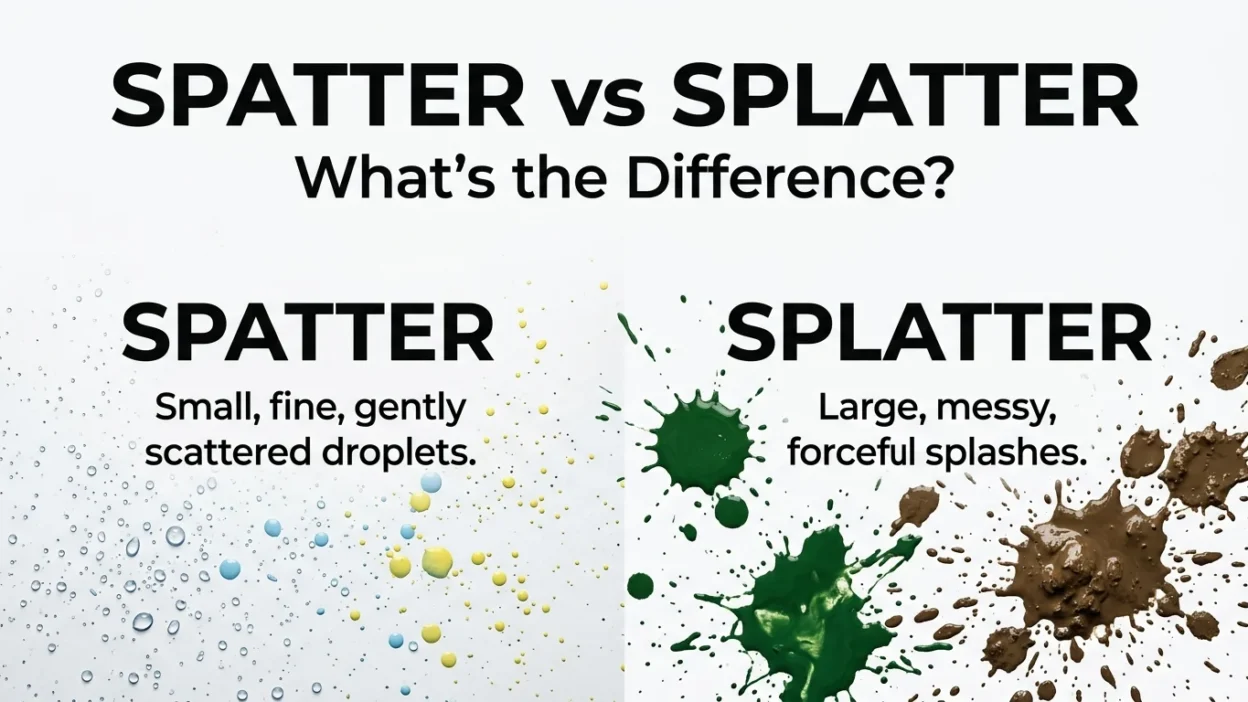
However, there is a subtle difference in how these words are commonly understood. Spatter usually suggests small drops or particles scattered over an area, often in a relatively light or controlled way. Splatter, on the other hand, tends to suggest a messier, heavier, or more dramatic scattering of liquid or material. Understanding this distinction can help you choose the more precise word in everyday writing, journalism, technical descriptions, and creative contexts.
Quick Answer
Spatter usually means small drops scattered or sprinkled over something, while splatter suggests a messier or more forceful scattering of liquid or material. They overlap considerably, but splatter often creates a stronger image of mess, impact, or uncontrolled movement.
Why People Confuse It
The confusion between spatter and splatter is understandable because both words describe substances being scattered in drops or small pieces.
For example:
- Water can spatter onto a window.
- Water can splatter onto a window.
- Mud can spatter your shoes.
- Mud can splatter your shoes.
All of these sentences can be grammatically correct.
The main difference is often degree and imagery rather than basic meaning.
Spatter tends to sound lighter, finer, or more evenly distributed. Splatter often suggests larger drops, greater force, or a messier result.
There is no absolute boundary between the two words, so context matters.
First Word: Spatter
Spatter means to scatter small drops or particles over a surface or through the air.
It can be used as both a verb and a noun.
As a verb
The rain spattered against the windshield.
Here, spattered describes small drops of rain hitting the windshield.
Another example:
Grease spattered onto the kitchen counter.
The word suggests drops being scattered around, often in relatively small amounts.
As a noun
There were spatters of paint on the floor.
In this sentence, spatters refers to small drops or marks produced by scattered paint.
Common associations with “spatter”
You may see spatter used with:
- rain
- water
- paint
- mud
- grease
- blood
- ink
- food
- dirt
The word can describe ordinary, accidental, or technical situations.
Second Word: Splatter
Splatter also means to scatter liquid or small pieces of material, but it often suggests a more energetic, messy, or uncontrolled action.
It can also be used as both a verb and a noun.
As a verb
The car splattered mud all over my jacket.
The word splattered creates a stronger image of mud being thrown or scattered messily.
Another example:
Sauce splattered across the wall.
The emphasis is on the messy result.
As a noun
There was a splatter of paint on the floor.
Here, splatter refers to the scattered material or the resulting mark.
The word is especially common when describing something that has been thrown, hit, burst, or scattered with noticeable force.
Common associations with “splatter”
You may see splatter used with:
- mud
- paint
- sauce
- water
- grease
- rain
- blood
- food
- dirt
In creative writing, splatter can create a much more vivid and dramatic image than spatter.
Comparison Table
| Feature | Spatter | Splatter |
| Basic meaning | Small drops scattered around | Liquid or material scattered messily |
| Typical impression | Light, fine, scattered | Messy, forceful, dramatic |
| Part of speech | Noun and verb | Noun and verb |
| Common contexts | Rain, paint, grease, ink | Mud, paint, sauce, water |
| Suggests force? | Not necessarily | Often suggests more force |
| Suggests mess? | Sometimes | Usually more strongly |
| Formal/technical use | Relatively common | More vivid and informal |
| Example | Rain spattered the glass. | Mud splattered the car. |
When to Use Each
Choosing between spatter and splatter depends largely on the image you want to create.
Use “spatter” when:
- You mean small drops scattered over an area.
- The action is relatively light.
- You are describing fine droplets or marks.
- You want a more neutral or technical description.
- The substance is scattered without emphasizing a major impact.
Example:
Fine drops of rain spattered the window.
Use “splatter” when:
- The substance is scattered forcefully.
- The result is noticeably messy.
- You want to emphasize impact.
- Large or irregular drops are involved.
- You are writing descriptively or dramatically.
Example:
Mud splattered across the side of the truck.
An important point
These are not strict opposites, and native speakers sometimes use them interchangeably.
The distinction is best understood as a matter of connotation and intensity, rather than a rigid grammar rule.
Examples
Here are practical examples showing how spatter and splatter work in everyday English.
Examples with “spatter”
- Rain spattered against the bedroom window.
- The chef noticed oil spattering from the hot pan.
- A few drops of paint spattered the floor.
- Mud spattered his shoes after the hike.
- The windshield was covered with tiny spatters of water.
- Ink spattered across the page when the pen broke.
Examples with “splatter”
- The truck splattered mud onto the pedestrians.
- Tomato sauce splattered across the kitchen wall.
- Water splattered everywhere when the pipe burst.
- Paint splattered onto her clothes while she was decorating.
- The puddle splattered under the cyclist’s tires.
- Grease splattered onto the stove during cooking.
Comparing the same situation
You can often use either word, but the image changes slightly:
Rain spattered against the window.
This sounds relatively light and descriptive.
Rain splattered against the window.
This can sound wetter, stronger, or more dramatic.
Both can work, depending on the writer’s intended meaning.
Common Mistakes
1. Thinking one word is always correct
A common mistake is assuming that spatter is correct for small drops and splatter is always incorrect.
That is too strict.
There is significant overlap between the two words.
2. Assuming “splatter” is grammatically informal
Splatter is a standard English word. It is not simply a slang version of spatter.
It is perfectly acceptable in everyday and creative writing.
3. Ignoring context
The best choice depends on what you are describing.
Compare:
The artist spattered paint onto the canvas.
and
The artist splattered paint onto the canvas.
The first sounds more like scattered drops or a technique. The second emphasizes a messier or more energetic application.
4. Believing there is always a difference in size
Some explanations claim that spatter always means tiny drops while splatter always means large drops.
That distinction is useful as a memory aid, but it is not an absolute rule.
Context, intensity, and style all influence the choice.
Memory Trick
Think of the extra “l” in splatter as adding a little extra mess.
- Spatter = scattered drops
- Splatter = scattered + messy/forceful
A simple memory sentence is:
Spatter is lighter; splatter is messier.
This is not a strict dictionary rule, but it is a useful way to remember the typical difference in tone.
American vs British English
Both spatter and splatter are used in both American and British English.
There is no major British versus American spelling difference that makes one word exclusively British or American.
For example, speakers in both varieties can naturally say:
The rain spattered against the window.
or:
Mud splattered across the road.
The difference is therefore primarily about meaning, emphasis, and context, not regional spelling.
That said, individual speakers and writers may have different preferences depending on the situation.
Similar Words
Several English words are related to spatter and splatter, but they are not always interchangeable.
Splash
Splash usually refers to liquid being thrown or spread more broadly.
The child splashed water into the pool.
Sprinkle
Sprinkle suggests small amounts distributed over something, often deliberately.
Sprinkle some cheese over the pasta.
Spray
Spray usually describes a fine stream or mist of liquid particles.
The hose sprayed water across the garden.
Spill
Spill means liquid accidentally escapes from its container.
I spilled coffee on my shirt.
Drizzle
Drizzle means to pour or fall in a thin stream or small drops, often gently.
She drizzled honey over the toast.
Speckle
Speckle means to cover something with many small spots or marks.
The white wall was speckled with blue paint.
These words can overlap with spatter and splatter, but each has its own typical meaning and imagery.
FAQs
Is “spatter” the same as “splatter”?
They have very similar meanings and can often be used interchangeably. However, spatter commonly suggests small scattered drops, while splatter often suggests a messier or more forceful scattering.
Is “splatter” a real word?
Yes. Splatter is a standard English word used as both a noun and a verb. It commonly describes liquid or small pieces of material being scattered around.
Is it “paint spatter” or “paint splatter”?
Both expressions are correct. Paint spatter can sound more neutral or technical, while paint splatter often emphasizes a messy or energetic scattering of paint.
Is “spatter” more formal than “splatter”?
Not necessarily, but spatter is sometimes preferred in technical or descriptive contexts. Splatter often has a more vivid or informal feel because it emphasizes mess and impact.
Can rain “splatter”?
Yes. You can say that rain splattered against a window, especially when describing heavy or forceful rain. For lighter rain, spattered may sound more natural.
Can you say “blood spatter”?
Yes. Blood spatter is a well established expression, particularly in forensic and scientific contexts. Blood splatter is also used in ordinary English, especially when emphasizing a messy visual effect.
Which is correct: “spattered” or “splattered”?
Both can be correct. Choose spattered when you want to emphasize scattered drops and splattered when you want to emphasize a messier or more forceful result.
Final Verdict
Spatter and splatter are both correct English words. Their meanings overlap, so the choice is usually about nuance rather than grammar. Spatter tends to suggest small drops or particles scattered around, while splatter often conveys greater force, mess, or visual impact.
When you are unsure, think about the picture your sentence creates. If you are simply describing scattered droplets, spatter is often a natural choice. If you want readers to imagine something messy, energetic, or forcefully thrown around, splatter may be better.
Remember This
Spatter = small scattered drops.
Splatter = scattered material with a messier or stronger effect.
The distinction is useful, but don’t treat it as an absolute rule. Native English speakers frequently use both words in overlapping contexts.
Conclusion
The difference between spatter vs splatter is subtle but useful. Both words describe the scattering of liquid or small particles, and both can work in many of the same sentences. The main distinction is the feeling they create: spatter often sounds lighter and more neutral, whereas splatter tends to suggest greater force, mess, or drama.
Learning this distinction can make your English more precise without making it unnecessarily complicated. Remember that context matters more than memorizing a rigid rule. When you want a neutral description of scattered drops, choose spatter; when you want to highlight a messy or forceful result, splatter is often the stronger choice.

Quinn Mitchell is celebrated for historical fiction that combines authentic settings, unforgettable characters, and compelling narratives. His thoughtful writing brings history alive while inspiring curiosity and deeper understanding among readers.