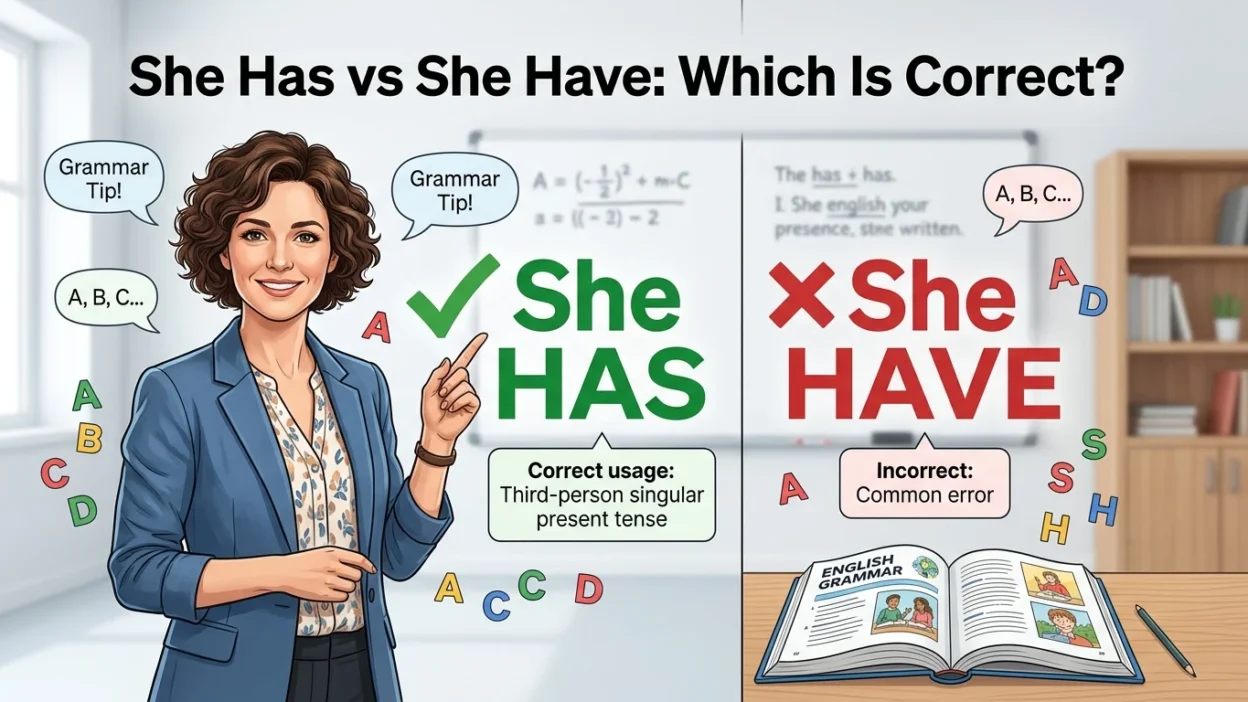
If you have ever hesitated between “she has” and “she have,” you are not alone. This is a common English grammar mistake, especially for learners who are still getting comfortable with subject verb agreement. Both has and have are forms of the verb to have, but they are not interchangeable. The correct choice depends mainly on the subject of the sentence.
The good news is that the rule is quite simple once you understand it. We normally use “she has” because she is a third person singular subject. “She have” is generally incorrect in standard English when she is the subject. In this guide, you will learn exactly when to use she has, why she have is usually wrong, and how the rule works in everyday sentences. You will also see practical examples, common mistakes, and an easy memory trick.
Quick Answer
“She has” is correct in standard English, while “she have” is normally incorrect. We use has with third person singular subjects such as he, she, and it. Use have with I, you, we, and they. For example: She has a car.
Why People Confuse It
The confusion usually comes from the fact that has and have are both forms of the same verb.
For example:
- I have a book.
- You have a book.
- We have a book.
- They have a book.
- She has a book.
- He has a book.
- It has a problem.
Because have is the base form, learners sometimes use it with every subject. However, English changes the verb form for third person singular subjects in the present tense.
The key point is subject verb agreement.
When the subject is she, use has, not have.
First Word: “She Has”
“She has” is the grammatically correct form in standard English.
The word she is a third person singular pronoun, so the present tense form of have changes to has.
Examples
- She has a new phone.
- She has three sisters.
- She has a meeting today.
- She has finished her homework.
- She has been very helpful.
“Has” can express several meanings. It can show possession, relationships, experiences, conditions, or actions connected to the present.
Possession
She has a beautiful house.
Relationships
She has two children.
Experiences
She has a lot of experience.
Present perfect
She has completed the assignment.
So, whenever she is the subject and have is being used as a present tense verb, has is normally the correct form.
Second Word: “She Have”
“She have” is generally incorrect in standard English when “she” is the subject.
For example:
❌ She have a car.
The correct sentence is:
✅ She has a car.
However, you may occasionally see have near she in sentences where another grammatical structure requires the base form.
For example:
Does she have a car?
Here, have is correct because the auxiliary verb does carries the present tense agreement. After does, we use the base form of the main verb.
Compare:
- She has a car.
- Does she have a car?
- She doesn’t have a car.
This distinction is extremely important. It explains why “Does she have?” is correct even though “She have” is not.
Comparison Table
| Expression | Correct? | Why? | Example |
| She has | ✅ Yes | She is third person singular | She has a dog. |
| She have | ❌ Usually no | Have does not agree with she in a simple present statement | She have a dog. |
| Does she have | ✅ Yes | Does takes the tense; have stays in base form | Does she have a dog? |
| She doesn’t have | ✅ Yes | Doesn’t carries the tense | She doesn’t have a dog. |
| She has had | ✅ Yes | Has works as the auxiliary | She has had lunch. |
| She has to | ✅ Yes | Has is used in the expression has to | She has to leave. |
When to Use Each
Use “She Has” in Statements
Use she has when she is the subject of a normal present tense statement.
Examples:
- She has a new job.
- She has enough money.
- She has a good idea.
- She has two brothers.
Use “Have” After “Does”
Use have after does or doesn’t.
Examples:
- Does she have a passport?
- Does she have enough time?
- She doesn’t have a car.
- She doesn’t have any questions.
The reason is simple: does already marks the third person singular present tense.
Use “Have” With Modal Verbs
After modal verbs such as can, could, will, would, should, and might, use the base form have.
Examples:
- She can have some cake.
- She will have dinner later.
- She might have a meeting.
- She should have more time.
So don’t automatically assume that every sentence containing she needs has. The entire verb structure matters.
Examples
Here are practical examples showing how she has and have work in different sentence structures.
- She has a new laptop.
- She has two younger brothers.
- She has enough experience for the job.
- She has a meeting at noon.
- She has already finished the project.
- She has been working all morning.
- Does she have a driver’s license?
- Does she have enough money?
- She doesn’t have any free time.
- She doesn’t have a problem with the decision.
- She can have whatever she wants.
- She will have lunch with us.
- She might have an opportunity tomorrow.
- She should have more information by Friday.
- She has to leave early today.
Notice the pattern: has is used directly with she in affirmative present tense statements, while have appears after auxiliaries and modal verbs.
Common Mistakes
Mistake 1: Using “She Have” in a Simple Statement
❌ She have a new car.
✅ She has a new car.
Use has because she is third person singular.
Mistake 2: Changing “Have” After “Does”
Some learners write:
❌ Does she has a car?
This is incorrect.
The correct version is:
✅ Does she have a car?
Once does is used, the main verb returns to its base form.
Mistake 3: Using “Has” After “Doesn’t”
❌ She doesn’t has a sister.
✅ She doesn’t have a sister.
Again, doesn’t already carries the grammatical marking, so use have afterward.
Mistake 4: Forgetting the Difference in Questions
❌ Has she have a ticket?
Usually, the natural question is:
✅ Does she have a ticket?
However, has can appear in other structures, such as:
Has she finished the work?
Here, has is an auxiliary verb forming the present perfect.
Memory Trick
Here is an easy way to remember the rule:
He, She, It → HAS
I, You, We, They → HAVE
Think of the phrase:
She HAS it.
The word she naturally pairs with has in a simple present tense statement.
For questions and negatives, remember a second rule:
Does → HAVE
So:
- She has a car.
- Does she have a car?
- She doesn’t have a car.
That three sentence pattern is one of the easiest ways to master the difference.
American vs British English
The basic rule is the same in both American English and British English.
Both varieties use:
She has a car.
And both use:
Does she have a car?
There can be differences between American and British English in particular expressions involving have, especially when discussing possession or experiences.
For example, British English commonly uses have got:
She has got a new job.
American English may more commonly use:
She has a new job.
But this does not change the basic subject verb agreement rule. She has remains standard in both major varieties of English.
Similar Words
Understanding related verb forms can make this grammar rule easier.
Has vs Have
- She has a car.
- They have a car.
Has vs Had
Has is generally used for present tense structures, while had is the past form.
- She has a dog.
- She had a dog when she was younger.
Has vs Have Had
Has had is used in the present perfect.
- She has had lunch.
- She has had this phone for two years.
Does She Have vs Has She
These structures have different grammatical functions.
Does she have a car?
This is a simple present question about possession.
Has she finished her work?
This uses the present perfect.
Understanding the role of the auxiliary verb helps prevent many English grammar mistakes.
FAQs
Is “she has” grammatically correct?
Yes. “She has” is grammatically correct in standard English. Since she is a third person singular pronoun, the present tense form of have is has.
Is “she have” ever correct?
“She have” is generally not correct as a simple present tense statement. However, have can correctly appear after auxiliary or modal verbs, as in “Does she have a car?” or “She can have one.”
Should I say “Does she have” or “Does she has”?
The correct form is “Does she have?” After does, use the base form have, not has.
Is “she doesn’t have” correct?
Yes. “She doesn’t have” is correct because doesn’t carries the third person singular present tense marking.
Why is it “she has” but “they have”?
Because she is third person singular, while they is plural. Standard English uses has with he, she, and it, but have with I, you, we, and they.
Is “she has” used in American and British English?
Yes. The rule is standard in both American and British English. Regional differences may affect some expressions, but not this basic subject verb agreement rule.
What is the easiest way to remember “she has” vs “she have”?
Remember: He, she, it → has. I, you, we, they → have. After does, doesn’t, can, will, should, and similar auxiliary or modal verbs, use have.
Final Verdict
The correct choice in a normal present tense statement is “she has.” Because she is a third person singular subject, it takes has, not have.
However, don’t treat have as completely impossible near she. Structures such as “Does she have?”, “She doesn’t have,” and “She can have” are perfectly grammatical because another auxiliary or modal verb controls the structure.
Remember This
She HAS a car.
Does she HAVE a car?
She doesn’t HAVE a car.
If she directly takes the verb have in a simple affirmative present tense sentence, use has. If does, doesn’t, or a modal verb comes before it, use the base form have.
Conclusion
The difference between “she has” and “she have” becomes much easier once you focus on subject verb agreement. In a simple present tense statement, she requires has, so “She has a book” is correct, while “She have a book” is not. This same principle applies to other third person singular subjects such as he and it.
At the same time, remember that English verb forms depend on the whole sentence. “Does she have?” and “She doesn’t have” are correct because does or doesn’t carries the tense. Mastering this small distinction will help you avoid a common grammar error and make your everyday English sound much more natural.

Hadley Price creates heartfelt contemporary fiction exploring relationships, hope, resilience, and personal growth. Her emotionally rich storytelling connects with readers through memorable characters and inspiring life experiences worldwide.