English prepositions often seem small, but they can completely change the meaning of a sentence. One of the most common examples is in the street vs on the street. Although both expressions refer to streets, they are not always interchangeable. Choosing the wrong one can make your English sound unnatural or even change what you’re trying to say.
If you’ve ever wondered which phrase native speakers actually use, you’re not alone. This guide explains the difference in plain English with practical examples, grammar tips, and easy memory tricks. Whether you’re preparing for an English exam, improving your writing, or simply speaking more confidently, you’ll know exactly when to use each expression by the end of this article.
Quick Answer
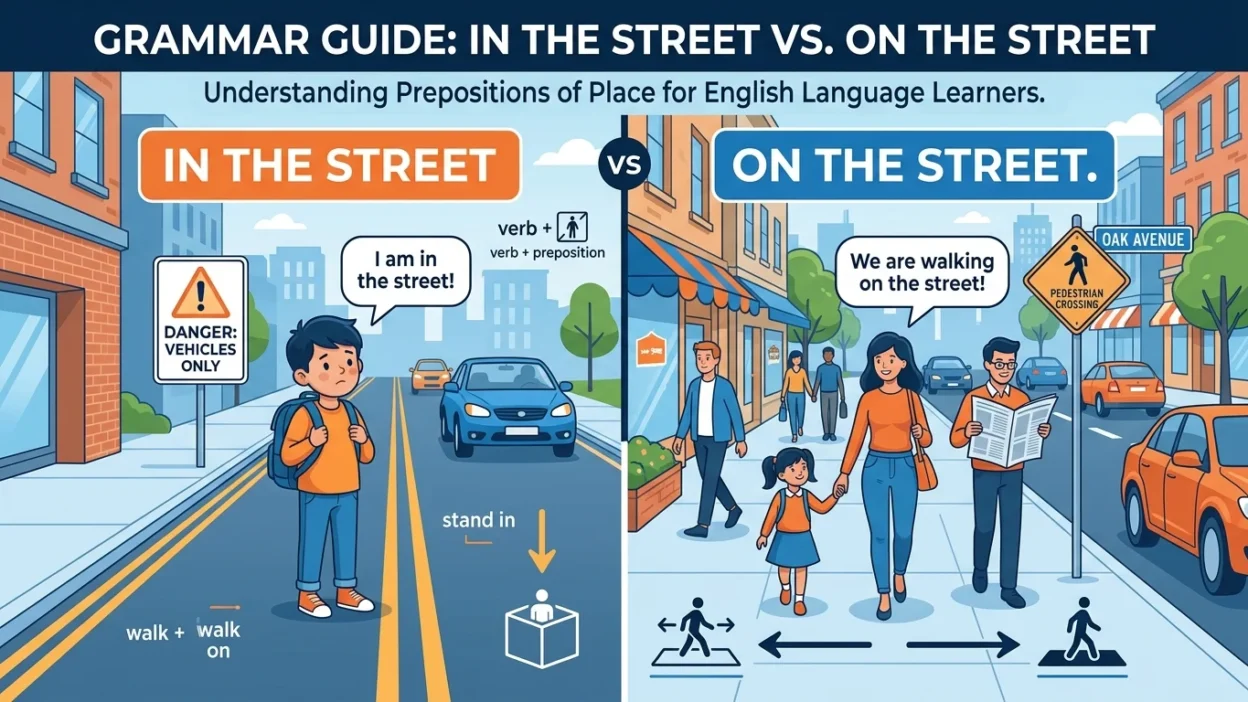
On the street usually means located on a street, living without a home, or generally outside in public, especially in American English. In the street means inside the roadway where vehicles travel and is more common when talking about physical position, particularly in British English. The correct choice depends on the context rather than a strict grammar rule.
Why People Confuse It
The confusion happens because both phrases refer to the same place—a street—but from different perspectives.
Several factors make them difficult to distinguish:
- Both are grammatically correct.
- British and American English use them differently.
- Some meanings are literal, while others are idiomatic.
- Native speakers often choose one expression naturally without explaining why.
Understanding the intended meaning is much more important than memorizing a fixed rule.
In the Street
In the street generally emphasizes being within the street itself, especially the road where cars, bicycles, or pedestrians travel.
It often suggests someone’s physical location in the roadway.
Common uses
- Standing in the road
- Playing where traffic moves
- Something lying in the roadway
- Describing a physical position
Examples
- The children were playing in the street.
- There was a broken bicycle in the street.
- A dog was running in the street.
- We saw water flowing in the street after the storm.
- Don’t stand in the street while talking.
In British English, this expression is heard more frequently than in American English.
On the Street
On the street is more common in everyday English, especially in North America.
It has several meanings depending on the situation.
1. Located along a street
- There’s a new café on the street.
- I met my neighbor on the street yesterday.
2. Outside in public
- Thousands of people celebrated on the street.
- Musicians performed on the street.
3. Homeless
- Sadly, many families ended up on the street.
- The charity helps people living on the street.
4. Informal information or public opinion
- Word on the street is that the store is closing.
- The latest rumor on the street spread quickly.
Comparison Table
| Feature | In the Street | On the Street |
| Main meaning | Inside the roadway | On or along a street; outside in public |
| Physical focus | Position within the road | General location or activity |
| Common in American English | Less common | Very common |
| Common in British English | More common | Also common |
| Can mean homeless | No | Yes |
| Used in idioms | Rarely | Frequently |
When to Use Each
Choose in the street when:
- Someone is physically in the roadway.
- You want to emphasize location inside the street.
- Writing in British English about physical position.
Choose on the street when:
- Referring to general street locations.
- Talking about outdoor public spaces.
- Describing homeless people.
- Using idioms like word on the street.
- Writing in American English.
Examples
Here are practical examples showing both expressions in context.
Using “In the Street”
- The children shouldn’t play in the street.
- There was broken glass in the street.
- A cyclist fell in the street.
- We found a wallet in the street.
- Snow collected in the street overnight.
- The workers repaired a hole in the street.
Using “On the Street”
- I saw him on the street this morning.
- We danced on the street during the festival.
- She was forced to live on the street.
- There’s a bakery on the street near my office.
- Word on the street is that prices will increase.
- Street performers entertained everyone on the street.
Common Mistakes
Many English learners make these mistakes:
Using “on the street” for objects inside the road
❌ There is a large rock on the street.
✅ There is a large rock in the street.
Using “in the street” for public activities
❌ We celebrated in the street all night.
✅ We celebrated on the street all night.
Confusing the homelessness meaning
❌ He has lived in the street for years.
✅ He has lived on the street for years.
Memory Trick
Here’s an easy way to remember the difference:
- In = Inside the roadway.
- On = On the public street or along it.
If you’re talking about someone’s exact position within the road, think in.
If you’re talking about being outside, along the street, public life, or the idiomatic meaning, think on.
American vs British English
Regional English influences which expression sounds more natural.
American English
American speakers generally prefer on the street in many everyday situations.
Examples:
- I saw her on the street.
- People gathered on the street.
British English
British speakers often use in the street when describing someone’s physical location in the roadway.
Examples:
- The children are playing in the street.
- There’s water in the street.
Both varieties understand each expression, but preferences differ depending on context.
Similar Words
If you’re learning English prepositions, you may also want to compare:
- In the road vs on the road
- At the corner vs on the corner
- In town vs around town
- At home vs in home
- On the sidewalk vs in the street
- At the station vs in the station
Learning these pairs improves both spoken and written English.
Final Verdict
Neither in the street nor on the street is universally correct—they simply express different ideas.
Use in the street when emphasizing something physically located within the roadway. Use on the street for general street locations, outdoor public activities, homelessness, and common idiomatic expressions. Paying attention to context and regional English will help you sound much more natural.
Frequently Asked Questions
Is “in the street” grammatically correct?
Yes. It is completely correct and commonly used, especially when referring to something physically located in the roadway.
Is “on the street” more common?
Yes. It is generally more common in everyday American English and has several additional meanings beyond physical location.
Which expression is used for homeless people?
On the street is the correct expression.
Example: Many charities help people living on the street.
Which phrase is more common in British English?
British English often prefers in the street when describing someone or something physically in the roadway.
Can both expressions be correct?
Yes. Depending on the context, both can be correct, but they often communicate slightly different meanings.
What does “word on the street” mean?
It is an idiom meaning a rumor, public opinion, or unofficial information.
Should I use “in the street” in formal writing?
Yes, if it accurately describes physical location. Choose the expression that best fits your intended meaning rather than the level of formality.
Conclusion
Mastering the difference between in the street and on the street is less about memorizing grammar rules and more about understanding context. While in the street usually highlights a physical position within the roadway, on the street has broader uses, including public locations, everyday activities, homelessness, and popular idioms.
The more authentic English you read and hear, the more naturally you’ll recognize which expression fits each situation. Keep practicing with real-life examples, and soon you’ll choose the correct phrase without even thinking about it.
Remember This
Use in the street for something physically inside the roadway. Use on the street for general street locations, public life, homelessness, and idiomatic expressions like word on the street.

Adam Aaron writes engaging mystery and adventure novels featuring intelligent characters, unexpected twists, and emotional storytelling. His creative imagination and compelling narratives have earned admiration from readers across generations.