Have you ever wondered whether you should say “have fun” or “enjoy”? Many English learners hear both expressions every day and assume they mean exactly the same thing. While they are closely related, they are not always used in the same way. Understanding the difference can make your English sound more natural and help you choose the right expression in conversations, emails, and everyday situations.
The good news is that the difference is easy to understand. Both expressions are positive and are used to talk about pleasure, but they work differently in sentences and are used in different situations. In this guide, you’ll learn the meaning of each phrase, how they compare, common mistakes to avoid, and plenty of simple examples to help you remember when to use each one.
Quick Answer
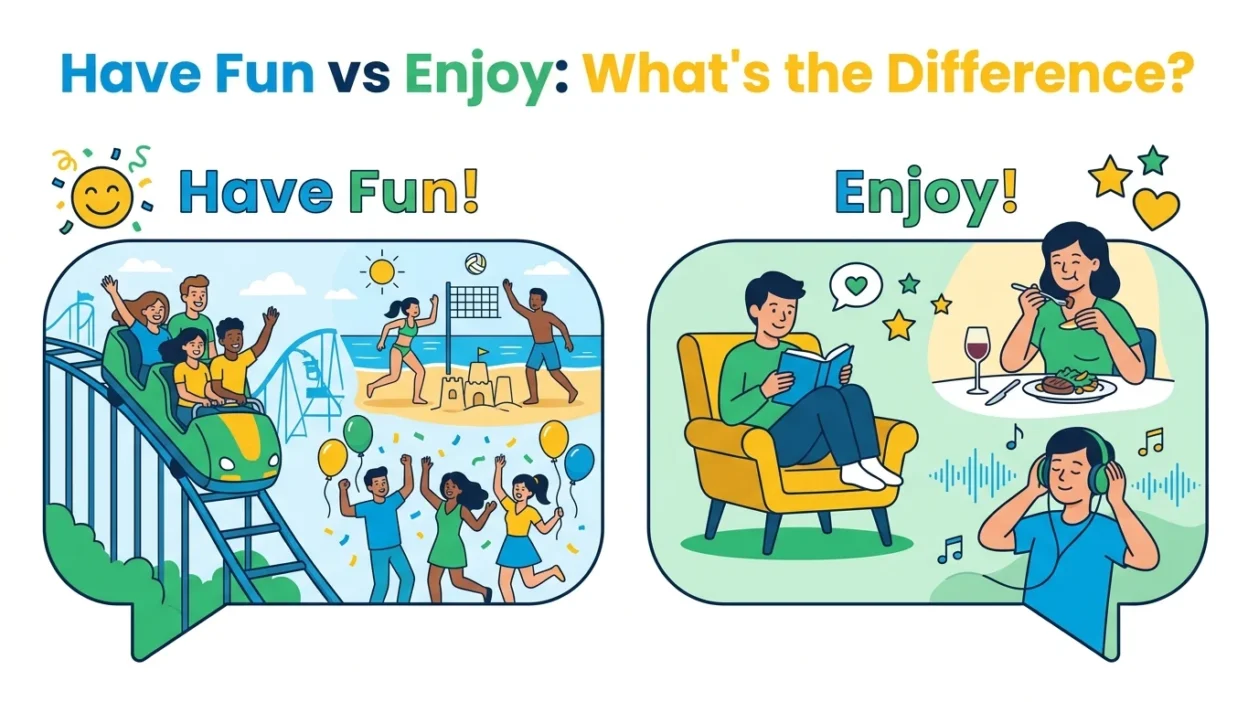
“Have fun” is a friendly expression that means to spend time enjoying yourself or is used to wish someone a good time. “Enjoy” is a verb that means to like, take pleasure in, or experience something happily. While both relate to happiness, they are used in different sentence patterns.
Why People Confuse Have Fun and Enjoy
People often confuse have fun and enjoy because both talk about positive experiences.
The confusion becomes even greater because native English speakers sometimes use them in similar situations.
For example:
- Have fun at the party!
- Enjoy the party!
Both sound natural, but they are built differently and have slightly different meanings.
What Does “Have Fun” Mean?
Have fun is a common English expression that means to enjoy yourself while doing something.
It is often used:
- To wish someone a good time
- To describe an enjoyable activity
- In casual conversations
Examples:
- Have fun on your vacation.
- The children had fun at the beach.
- We always have fun together.
- Have fun playing soccer!
Notice that fun is a noun in this expression.
What Does “Enjoy” Mean?
Enjoy is a verb that means to get pleasure from something or to like an activity, event, or experience.
It usually comes before:
- A noun
- A pronoun
- A verb ending in -ing
Examples:
- I enjoy reading books.
- She enjoys music.
- They enjoyed the concert.
- Enjoy your meal!
Unlike have fun, enjoy directly acts as the verb in the sentence.
Have Fun vs Enjoy: Comparison Table
| Feature | Have Fun | Enjoy |
| Part of speech | Expression (have + noun) | Verb |
| Meaning | Spend time happily | Get pleasure from something |
| Common use | Wish someone a good time | Talk about liking something |
| Formality | Mostly informal | Works in both formal and informal English |
| Typical pattern | Have fun + doing something/at a place | Enjoy + noun or verb (-ing) |
| Example | Have fun at school! | Enjoy your class! |
When to Use Each
Use Have Fun when:
- Wishing someone a good time
- Talking about enjoyable experiences
- Speaking casually with friends or family
Examples:
- Have fun at the park.
- Have fun during your trip.
- We had fun yesterday.
Use Enjoy when:
- Talking about something you like
- Describing pleasure from an activity
- Giving polite wishes
Examples:
- I enjoy cooking.
- Enjoy your weekend.
- She enjoys swimming.
Examples of Have Fun and Enjoy
Here are everyday examples to make the difference clear.
- Have fun at the concert!
- Enjoy the concert!
- We had fun at the beach.
- I enjoy spending time with my family.
- Have fun playing video games.
- She enjoys learning English.
- Have fun on your holiday.
- Enjoy your vacation.
- The kids had fun in the playground.
- I really enjoy this movie.
- Have fun with your friends.
- We enjoyed every minute of the trip.
Common Mistakes
Many learners make these small grammar mistakes.
❌ Enjoy to play football.
✅ Enjoy playing football.
❌ Have fun your trip.
✅ Have fun on your trip.
❌ I am enjoy this book.
✅ I am enjoying this book.
❌ Have enjoy!
✅ Have fun!
or
✅ Enjoy yourself!
Memory Trick
A simple way to remember the difference is:
- Have fun = Wish someone a happy time.
- Enjoy = Like or take pleasure in something.
Think of it this way:
If you’re telling someone to go and have a great experience, say Have fun!
If you’re talking about liking something, use Enjoy.
American vs British English
Both have fun and enjoy are common in American and British English.
There is no important difference in meaning between the two varieties.
However:
- Americans often say, “Have fun!”
- British speakers also use “Enjoy!” very naturally, especially before meals, holidays, or events.
Both expressions are correct in either variety of English.
Similar Words and Expressions
Here are some related expressions:
- Enjoy yourself
- Have a good time
- Take pleasure in
- Love
- Like
- Appreciate
- Delight in
- Have a great time
- Have a wonderful trip
- Make the most of
These expressions can often be used in similar situations depending on the context.
Final Verdict
Although have fun and enjoy both relate to happiness and pleasure, they are not exactly the same.
Use have fun when you want someone to spend time happily or when talking about an enjoyable experience.
Use enjoy when you want to say that someone likes something or gets pleasure from an activity, event, or object.
Learning this small difference will help your English sound much more natural.
Frequently Asked Questions
Is “have fun” the same as “enjoy”?
Not exactly. Both express happiness, but have fun focuses on spending enjoyable time, while enjoy means taking pleasure in something.
Can I say “Enjoy your trip”?
Yes. It is completely correct and very common.
Can I say “Have fun on your trip”?
Yes. It is also correct and sounds friendly.
Which is more formal?
Enjoy is generally more suitable in both formal and informal situations. Have fun is usually more casual.
Can “enjoy” be followed by a verb?
Yes. Use the -ing form.
Correct: I enjoy reading.
Incorrect: I enjoy to read.
Can I use “have fun” in business emails?
Yes, when the tone is friendly.
Example:
“Have fun at the conference!”
Which expression do native speakers use more?
Native speakers use both very frequently. The best choice depends on the situation and sentence structure.
Remember This
- Have fun = Spend time happily or wish someone a good time.
- Enjoy = Take pleasure in something or like an activity.
- Enjoy is followed by a noun, pronoun, or -ing verb.
- Both expressions are natural, but they are not always interchangeable.
Conclusion
Learning the difference between have fun and enjoy is a simple way to improve your everyday English. While both expressions are connected with positive experiences, they serve different purposes. Have fun is perfect for wishing someone an enjoyable time or describing a fun experience, whereas enjoy is the better choice when talking about liking or taking pleasure in something.
The more you read, listen, and practice these expressions, the easier it becomes to use them naturally. Keep the sentence patterns in mind, notice how native speakers use them, and try creating your own examples. Before long, choosing between have fun and enjoy will feel effortless.

Hadley Price creates heartfelt contemporary fiction exploring relationships, hope, resilience, and personal growth. Her emotionally rich storytelling connects with readers through memorable characters and inspiring life experiences worldwide.