Many English learners get confused by shown vs showed because both words come from the verb show, and both are real English words. At first glance, they seem interchangeable. However, they have different jobs in a sentence, and using the wrong one can make your writing sound incorrect.
The good news is that the difference is simple once you understand how English verb forms work. Whether you are writing an email, doing schoolwork, posting on social media, or speaking in everyday conversations, knowing when to use showed and shown will help you communicate more clearly. In this guide, you’ll learn the meaning of each word, see easy examples, compare them side by side, avoid common mistakes, and remember the difference with a simple trick.
Quick Answer
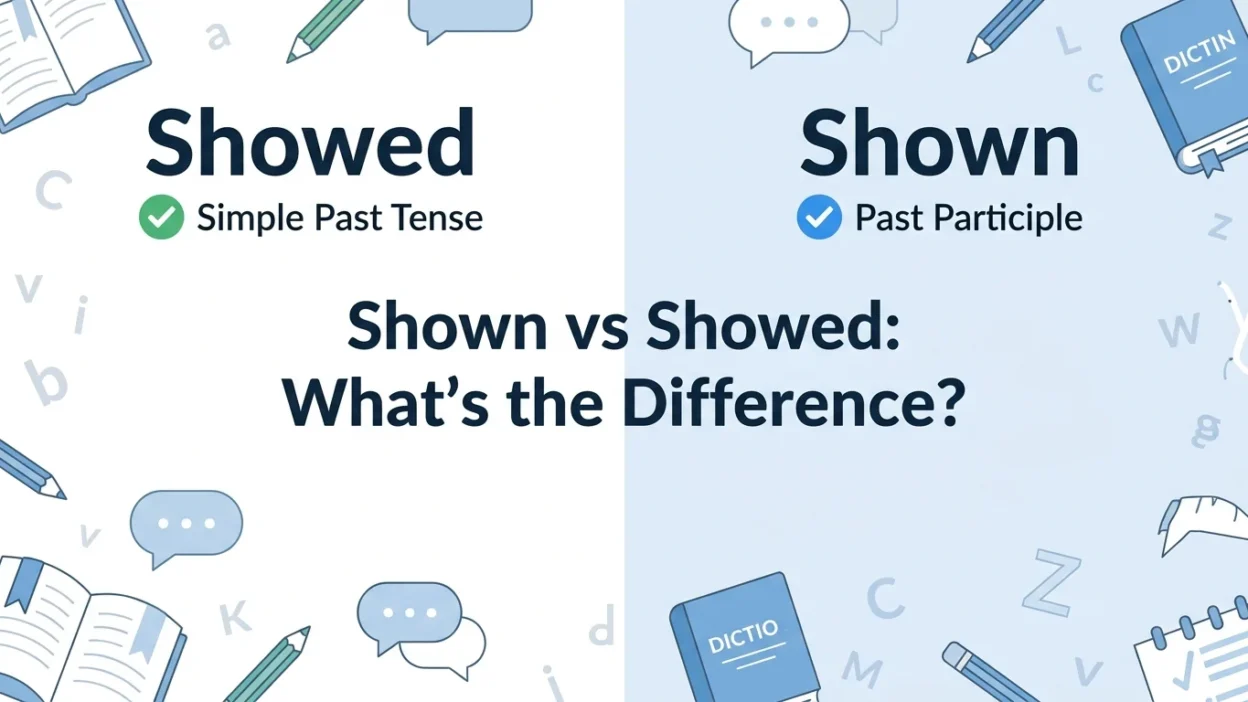
Showed is the simple past tense of show. Shown is the past participle and is usually used with helping verbs like has, have, had, is, was, were, or been. If there is no helping verb, showed is usually the correct choice.
Why People Confuse It
People often confuse shown and showed because both are forms of the same verb.
Here are the main reasons:
- Both describe actions that happened in the past.
- They look and sound similar.
- Many irregular English verbs have different past and past participle forms.
- Some learners think shown is simply a more formal version of showed, but it is not.
- English grammar lessons often introduce both forms at the same time, making them easy to mix up.
The key is to remember that they have different grammatical roles.
What Does “Showed” Mean?
Showed is the simple past tense of the verb show.
Use it when talking about something that happened and finished in the past.
Examples
- She showed me her new phone.
- The teacher showed the class a science experiment.
- He showed us the way home.
- They showed great kindness.
- My brother showed me how to ride a bike.
In each example, the action happened in the past and does not need a helping verb.
What Does “Shown” Mean?
Shown is the past participle of show.
It is normally used with helping verbs such as:
- has
- have
- had
- was
- were
- is
- are
- been
- being
Examples
- She has shown great improvement.
- The results were shown on the screen.
- I have shown the document to my manager.
- The movie has been shown many times.
- His work was shown in the exhibition.
Notice that every sentence includes a helping verb.
Shown vs Showed Comparison Table
| Feature | Showed | Shown |
| Verb form | Simple past | Past participle |
| Used alone | Yes | Usually no |
| Needs a helping verb | No | Yes |
| Example | I showed him the report. | I have shown him the report. |
| Common in everyday speech | Yes | Yes, with helping verbs |
When to Use Each
Use Showed When:
- Talking about a completed past action.
- There is no helping verb.
- Writing simple past tense sentences.
Examples:
- She showed me the answer.
- We showed our tickets.
- The guide showed us the museum.
Use Shown When:
- Using perfect tenses.
- Writing passive voice.
- Following helping verbs.
Examples:
- She has shown real progress.
- The picture was shown yesterday.
- They had shown interest before.
Examples of Shown vs Showed
Here are more everyday examples.
- He showed me his passport.
- I showed my homework to the teacher.
- They showed everyone the new design.
- She showed confidence during the interview.
- We showed our support.
- The results have been shown online.
- I have shown you this video before.
- The winner was shown on television.
- She had shown remarkable patience.
- The report has shown positive results.
- His artwork was shown at the local gallery.
- They have shown great teamwork.
Common Mistakes
Many learners make mistakes like these.
❌ I have showed you already.
✅ I have shown you already.
❌ The picture was showed yesterday.
✅ The picture was shown yesterday.
❌ She shown me her notebook.
✅ She showed me her notebook.
Always check whether your sentence contains a helping verb.
Memory Trick
A simple way to remember the difference is:
- Showed works by itself.
- Shown likes company.
If you see words like has, have, had, was, were, or been, shown is probably the correct choice.
If there is no helping verb, use showed.
American vs British English
Both American English and British English follow the same grammar rules.
In both varieties:
- Showed is the simple past tense.
- Shown is the past participle.
Examples:
- American English: She showed me the report.
- British English: She showed me the report.
- American English: The results have been shown.
- British English: The results have been shown.
There is no difference between the two forms in American and British English.
Similar Words
Many English verbs follow the same pattern.
| Base Verb | Past Tense | Past Participle |
| Show | Showed | Shown |
| Write | Wrote | Written |
| Speak | Spoke | Spoken |
| Break | Broke | Broken |
| Drive | Drove | Driven |
| Choose | Chose | Chosen |
| Give | Gave | Given |
| Take | Took | Taken |
Learning these patterns makes English grammar much easier.
Final Verdict
The difference between shown and showed is based on grammar, not meaning.
Choose showed when you need the simple past tense without a helping verb.
Choose shown when the sentence includes a helping verb or uses the passive voice.
Once you remember this rule, choosing the correct word becomes much easier.
Frequently Asked Questions
Is “shown” grammatically correct?
Yes. Shown is the correct past participle of show and is used with helping verbs.
Is “showed” a real word?
Yes. Showed is the simple past tense of show.
Can I say “I have showed”?
No. The correct form is I have shown.
Which is more common, shown or showed?
Both are common because they are used in different grammar structures.
Is “was shown” correct?
Yes. Was shown is correct because shown is the past participle used with the helping verb was.
Why can’t I use “shown” by itself?
Because shown is a past participle and usually needs a helping verb to form a complete verb phrase.
Is there any difference in meaning?
No. They express the same basic idea, but they are used in different grammatical forms.
Remember This
Showed = simple past
Shown = past participle with a helping verb
If your sentence includes has, have, had, was, were, or been, choose shown. Otherwise, showed is usually the correct choice.
Conclusion
Understanding the difference between shown and showed is easier than many people think. The important thing is to remember that showed is the simple past tense, while shown is the past participle. They are both correct, but they belong in different sentence structures.
The more you read, write, and practice these forms, the more natural they will become. When you are unsure, look for a helping verb. If one is present, shown is usually the right choice. If not, showed is likely the word you need. Mastering this small grammar rule will make your English sound more accurate and confident.

Adam Aaron writes engaging mystery and adventure novels featuring intelligent characters, unexpected twists, and emotional storytelling. His creative imagination and compelling narratives have earned admiration from readers across generations.