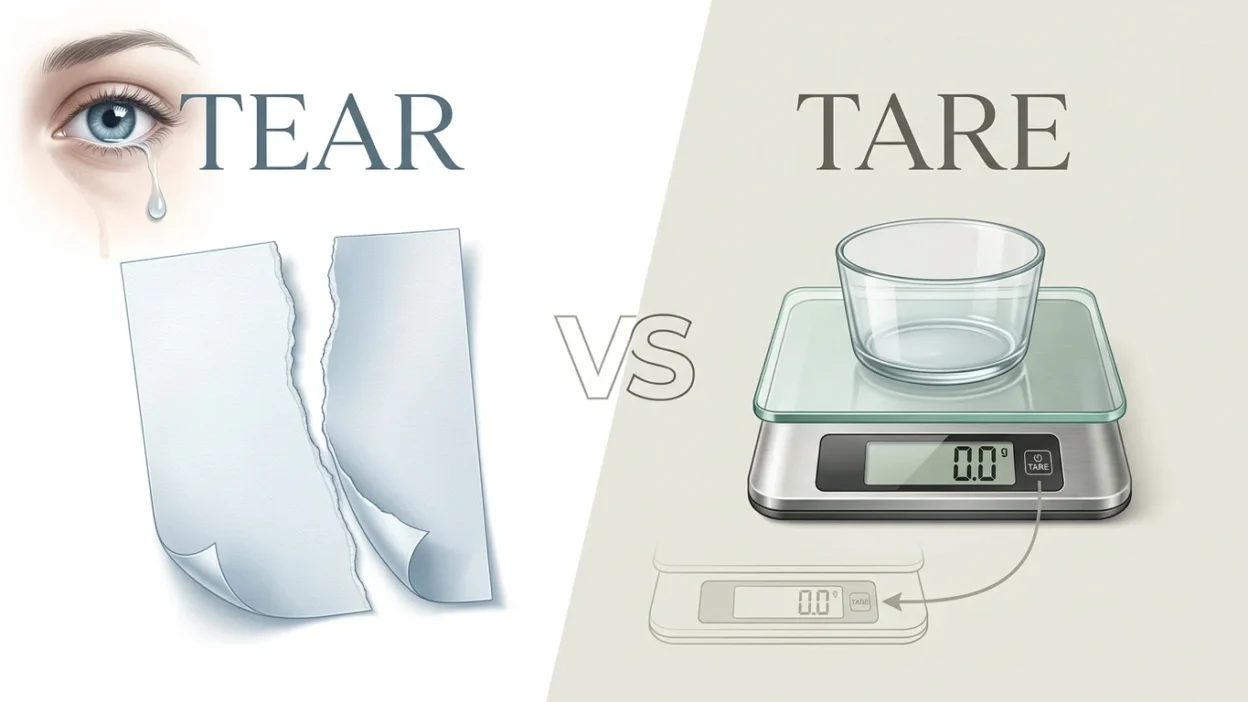
If you have ever written “tear” and “tare” and wondered which one belongs in your sentence, you are not alone. These two words are pronounced differently in most contexts and have completely different meanings, yet they can easily cause confusion when you are learning English or relying on spelling alone. Tear is a common English word with several meanings, while tare is a more specialized term that you will often encounter in weighing, packaging, and measurement.
Understanding the difference between tear vs tare is easier once you connect each word with its meaning and typical context. Tear can refer to a drop of liquid from your eye, the act of ripping something, or moving very quickly. Tare, on the other hand, commonly refers to the weight of an empty container or packaging that must be deducted from the total weight of its contents. Let’s look at both words, their uses, examples, and a simple memory trick to keep them straight.
Quick Answer
Tear is the common word used for ripping something, a drop from the eye, or moving rapidly. Tare usually refers to the weight of an empty container or packaging. If you mean “rip” or “eye liquid,” use tear; for weighing, use tare.
Why People Confuse It
The main reason people confuse tear and tare is that they look and sound somewhat similar, especially in certain pronunciations.
However, their meanings are quite different:
- Tear has several everyday meanings.
- Tare is mainly associated with weight, scales, and packaging.
- Tear can be pronounced in different ways depending on its meaning.
- Tare is pronounced like “tair.”
Another source of confusion is that tear and tare are both short words, so a spelling mistake can easily go unnoticed.
The best solution is not to memorize their spellings in isolation. Instead, associate each word with its most common meaning.
First Word: Tear
Tear is a versatile English word with several meanings.
1. Tear as a noun: liquid from the eye
A tear is a drop of liquid produced by your eye.
Examples:
- A tear rolled down her cheek.
- He wiped a tear from his eye.
- She had tears in her eyes after hearing the news.
In this meaning, tear is pronounced like “teer.”
2. Tear as a verb: rip or damage
To tear something means to pull it apart or damage it by ripping it.
Examples:
- Be careful not to tear the paper.
- I accidentally tore my shirt.
- She tore the envelope open.
In this meaning, tear is pronounced like “tair.”
Its common forms include:
- tear
- tore
- torn
- tearing
3. Tear as a verb: move very quickly
Informally, tear can also mean to move somewhere very quickly.
For example:
The car tore down the highway.
Here, the meaning is similar to rush, speed, or race.
Second Word: Tare
Tare is a less common word in everyday conversation. You are more likely to see it in contexts involving weighing, commerce, shipping, cooking scales, laboratories, or packaging.
Tare as a noun
Tare can mean the weight of an empty container or packaging.
For example, imagine a box containing 10 kilograms of flour.
- Total weight of box + flour = 10 kg
- Empty box = 1 kg
- Flour alone = 9 kg
The 1 kg weight of the empty box is the tare.
So:
Gross weight − tare weight = net weight
This distinction is especially useful when products are weighed together with their containers.
Tare as a verb
Tare can also be used as a verb meaning to set a weighing scale to account for the weight of an empty container.
For example:
- Tare the scale before adding the ingredients.
- She tared the container before weighing the powder.
This usage is common with digital kitchen and laboratory scales.
Comparison Table
| Word | Part of Speech | Main Meaning | Example |
| tear | noun | A drop of liquid from the eye | A tear fell from her eye. |
| tear | verb | To rip or damage | Don’t tear the paper. |
| tear | verb | To move very quickly | The dog tore across the yard. |
| tare | noun | Weight of an empty container | The box has a tare of 500 grams. |
| tare | verb | Adjust a scale for container weight | Tare the scale before weighing. |
When to Use Each
Use tear when you are talking about:
- Ripping paper, cloth, or another material
- Damaging something by pulling it apart
- Liquid produced by the eyes
- Moving quickly or suddenly
Use tare when you are talking about:
- The weight of an empty container
- Packaging weight
- Scales and weighing
- Adjusting a scale before measuring contents
A simple rule
If the context involves emotions, ripping, or speed → tear.
If the context involves scales or container weight → tare.
Examples
Here are some examples that show the difference naturally.
- A tear appeared in her eye when she heard the news.
- Please don’t tear the page.
- He tore his jacket while climbing the fence.
- The children tore across the playground.
- She tried not to tear the wrapping paper.
- One tear rolled down his cheek.
- The package has a tare weight of 200 grams.
- Please tare the scale before adding the flour.
- The technician recorded the container’s tare.
- The scale automatically calculates the tare weight.
- He tore the old letter into several pieces.
- The baker tared the bowl before measuring the ingredients.
- The empty bottle contributes to the product’s tare weight.
- She wiped away a tear before continuing her speech.
Notice how the surrounding words provide a strong clue. Tare frequently appears with words such as weight, container, scale, gross, and net. Tear is much more likely to appear with words such as paper, cloth, eye, cheek, or apart.
Common Mistakes
Mistake 1: Using “tare” when you mean “tear”
Incorrect:
Don’t tare the paper.
Correct:
Don’t tear the paper.
Ripping something has nothing to do with tare.
Mistake 2: Using “tear” for container weight
Incorrect:
The tear weight of the box is 500 grams.
Correct:
The tare weight of the box is 500 grams.
When discussing the weight of packaging, tare is the correct word.
Mistake 3: Confusing “tare” with “tear” in weighing instructions
If a recipe says to place an empty bowl on a digital scale and reset it to zero, the instruction is to tare the scale.
For example:
Tare the scale, then add 250 grams of sugar.
Mistake 4: Forgetting that “tear” has two common pronunciations
This is an especially interesting feature of English.
- tear = liquid from the eye → sounds like “teer”
- tear = rip → sounds like “tair”
The spelling is identical, but the pronunciation and meaning change.
Memory Trick
Try this simple association:
TARE = TARE weight
Think of the A in tare as standing for “accounting for the container.”
When you are weighing a container, tare helps you account for the container’s weight.
For tear, think of:
Tear = rip or cry
If you’re ripping something or crying, you probably need tear.
Another quick trick:
Tare → scale
Tear → eye or rip
That two word association is usually enough to remember the difference.
American vs British English
There is essentially no major spelling difference between American and British English for tear and tare.
Both varieties use:
- tear for ripping
- tear for liquid from the eye
- tare for container weight
- tare for adjusting a weighing scale
The pronunciation of tear still changes according to meaning in both varieties of English.
In technical contexts, tare is particularly useful because weighing systems need to distinguish between gross weight, tare weight, and net weight.
Similar Words
Several words can be related to the meanings of tear and tare, but they are not interchangeable.
Words similar to “tear”
Depending on the meaning, alternatives include:
- rip
- split
- shred
- damage
- weep
- cry
- race
- rush
For example:
She tore the paper.
can become:
She ripped the paper.
Words related to “tare”
In weighing contexts, you may encounter:
- gross weight
- net weight
- container weight
- packaging weight
- scale
- weigh
- deduct
Remember that these words describe related concepts, but they don’t necessarily replace tare grammatically.
FAQs
1. Is it “tear weight” or “tare weight”?
The correct term is tare weight. It refers to the weight of an empty container or packaging.
2. Is “tare” a real English word?
Yes. Tare is a legitimate English word, especially common in weighing and measurement contexts.
3. What does “tear” mean?
Tear has several meanings. It can mean a drop of liquid from the eye, to rip something, or, informally, to move very quickly.
4. What does “tare the scale” mean?
To tare the scale means to reset or adjust the scale so the weight of the empty container is excluded from the measurement.
5. Are “tear” and “tare” pronounced the same?
Not always. Tare is pronounced like “tair.” Tear meaning “rip” also sounds like “tair,” while tear meaning liquid from the eye sounds like “teer.”
6. Which is correct: “tear the paper” or “tare the paper”?
Tear the paper is correct because you mean to rip the paper.
7. What is the difference between tare weight and net weight?
Tare weight is the weight of the empty container. Net weight is the weight of the contents alone.
Final Verdict
The difference between tear vs tare becomes simple once you focus on context. Tear is the everyday word connected with ripping, crying, or moving rapidly. Tare is mainly a measurement term connected with the weight of an empty container or the adjustment of a scale.
When in doubt, ask yourself what you are talking about. An eye or something being ripped? Choose tear. A weighing scale or container? Choose tare. This small distinction will help you avoid one of those spelling and vocabulary mistakes that can otherwise be surprisingly easy to make.
Remember This
TEAR = rip, cry, or move quickly.
TARE = container weight or scale adjustment.
A quick mental shortcut: tear belongs with “rip”; tare belongs with “scale.”
Conclusion
Although tear and tare look and sound similar in some situations, their meanings are clearly different. Tear is a common everyday word with several meanings, while tare has a more specialized role in weighing and measurement. Learning the typical context for each word is more effective than simply memorizing their spellings.
The next time you see tare, think about a scale and an empty container. When you see tear, think about ripping, tears in your eyes, or rapid movement. With that simple distinction, choosing between tear and tare becomes much easier.

Willow Evans writes uplifting fantasy stories filled with magical worlds, courageous heroes, and meaningful life lessons. Her imaginative books encourage creativity, kindness, and hope in readers of all ages.