People often get confused about in front and infront because both look like they could be correct. English has many words that changed from two words into one over time, such as everyone or inside. This makes many learners wonder if infront is another accepted spelling.
The good news is that this question has a simple answer. Once you understand how these words are used, you’ll avoid a very common writing mistake. Whether you’re writing an email, a school assignment, a social media post, or a business message, using the correct form will make your writing clearer and more professional.
Quick Answer
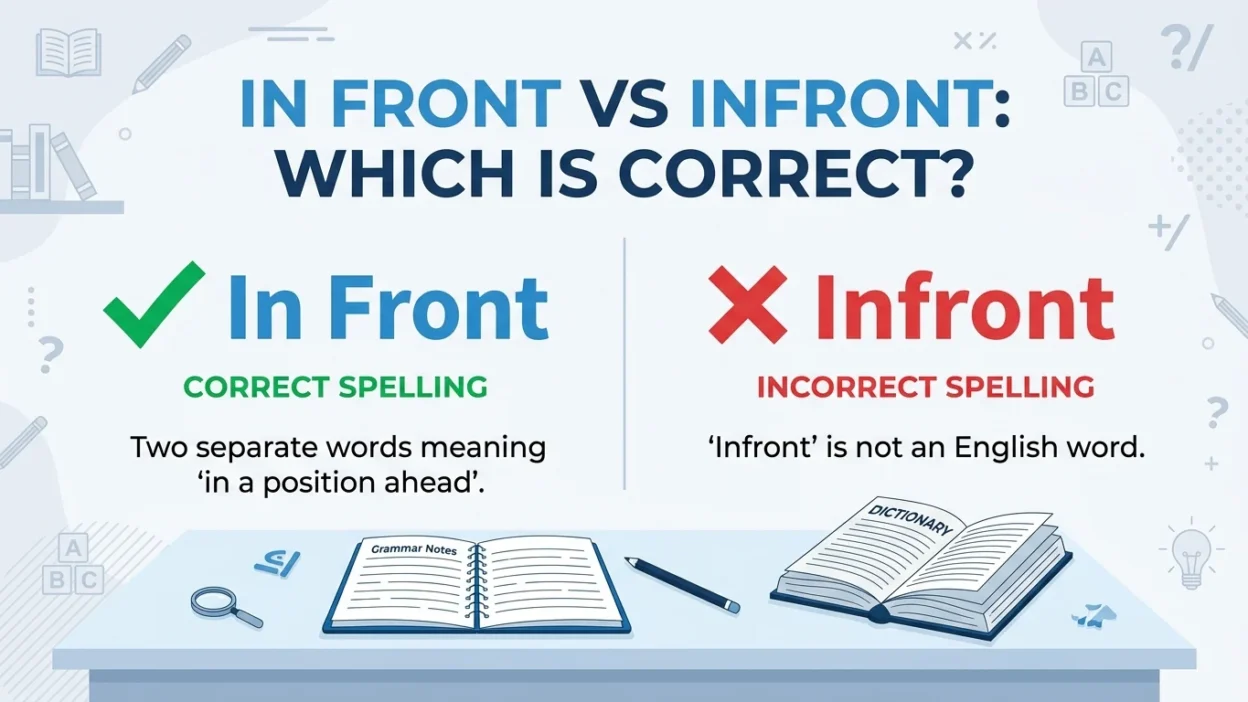
“In front” is the correct spelling. It is a two word phrase that means ahead of, before, or facing something or someone. “Infront” is not a standard English word and should be avoided in formal and everyday writing.
Why People Confuse It
Many English words that were once written as two words eventually became one word. Examples include today, inside, and everyone. Because of this, people naturally assume that infront follows the same pattern.
Another reason is fast typing. When people write quickly on phones or computers, they may accidentally remove the space. Spellcheck does not always catch this mistake, especially in informal apps.
In Front
In front is the correct English expression.
It means:
- Ahead of someone or something
- Facing another person or object
- At the front position
Examples:
- The car stopped in front of the school.
- Please stand in front of the camera.
- She parked in front of our house.
This phrase is accepted in schools, workplaces, books, newspapers, and professional writing.
Infront
Infront is generally considered incorrect in standard English.
Although you may see it in text messages, online comments, or typing mistakes, dictionaries and grammar guides do not recognize it as the standard spelling.
- ❌ He stood infront of the door.
- ❌ Put the chair infront of the desk.
Correct versions:
- ✅ He stood in front of the door.
- ✅ Put the chair in front of the desk.
Comparison Table
| Feature | In Front | Infront |
| Correct spelling | ✅ Yes | ❌ No |
| Number of words | Two | One |
| Standard English | Yes | No |
| Used in formal writing | Yes | No |
| Accepted by dictionaries | Yes | No |
| Recommended for school and work | Yes | No |
When to Use Each
Use in front when you want to describe the position of a person or object.
Use it for:
- School assignments
- Emails
- Business documents
- Books
- News articles
- Everyday conversations
Avoid infront because it is considered a spelling mistake in standard English.
Examples
Here are some everyday examples:
- The bus stopped in front of the station.
- Please stand in front of the class.
- She parked in front of the restaurant.
- A tall tree grows in front of our house.
- The children waited in front of the gate.
- He walked in front of his friends.
- My seat is in front of yours.
- Don’t stand in front of the television.
- The police car stopped in front of the building.
- The teacher asked everyone to come in front of the room.
- We took a family photo in front of the museum.
- The dog sat in front of its owner.
Common Mistakes
People often make these mistakes:
- ❌ Writing infront as one word.
- ❌ Forgetting the space between in and front.
- ❌ Assuming both spellings are acceptable.
- ❌ Copying incorrect spelling from social media.
Always remember that the standard form is in front.
Memory Trick
Think of this simple sentence:
There is always space when something is in front of you.
Since there is space between you and the object, there should also be a space between in and front.
In + Front = In Front
American vs British English
There is no difference between American and British English for this expression.
| English Variety | Preferred Form |
| American English | In front |
| British English | In front |
| Canadian English | In front |
| Australian English | In front |
The spelling infront is not considered standard in any major variety of English.
Similar Words
These pairs often cause similar confusion:
- Everyday vs Every day
- Into vs In to
- Maybe vs May be
- Anyone vs Any one
- Already vs All ready
- Altogether vs All together
- Inside vs In side
- Outside vs Out side
Learning these pairs helps improve your spelling and writing accuracy.
Final Verdict
If you’re choosing between in front and infront, the answer is easy.
Always use in front.
It is the correct spelling in standard English and is accepted everywhere from classrooms and offices to books and official documents.
Avoid infront, as it is simply a spelling error in modern English.
Frequently Asked Questions
Is “infront” a real English word?
No. Infront is not accepted as a standard English word.
Which spelling is correct: “in front” or “infront”?
In front is the correct spelling.
Is “in front” one word?
No. It is a two word phrase.
Do American and British English use different spellings?
No. Both use in front.
Can I write “infront” in an email?
No. You should always write in front in emails and other formal writing.
Why do people write “infront”?
Usually because they type quickly or mistakenly think it has become one word.
Will teachers mark “infront” as incorrect?
Yes. Most teachers and editors consider it a spelling mistake.
Conclusion
The difference between in front and infront is simple once you know the rule. In front is the only correct spelling in standard English. It works in every type of writing, from casual conversations to professional documents.
Whenever you’re describing something that is ahead of another person or object, remember to use two separate words. Building this habit will make your writing more accurate, natural, and easier for others to understand.
Remember This
Always write “in front” as two words.
- ✅ In front of the house
- ✅ In front of the class
- ✅ In front of the car
- ❌ Infront

Quinn Mitchell is celebrated for historical fiction that combines authentic settings, unforgettable characters, and compelling narratives. His thoughtful writing brings history alive while inspiring curiosity and deeper understanding among readers.