The phrases he is risen and he has risen often appear in religious discussions, Easter greetings, and Bible studies. While they look similar and both refer to someone rising, they aren’t used in exactly the same way. This difference leaves many English learners wondering which phrase is grammatically correct and when each should be used.
The answer depends on modern English grammar and historical usage. Today, he has risen is the standard grammatical form, while he is risen survives mainly as a traditional, biblical, and liturgical expression. Understanding why these two forms exist will help you use them naturally and confidently in the right context.
Quick Answer
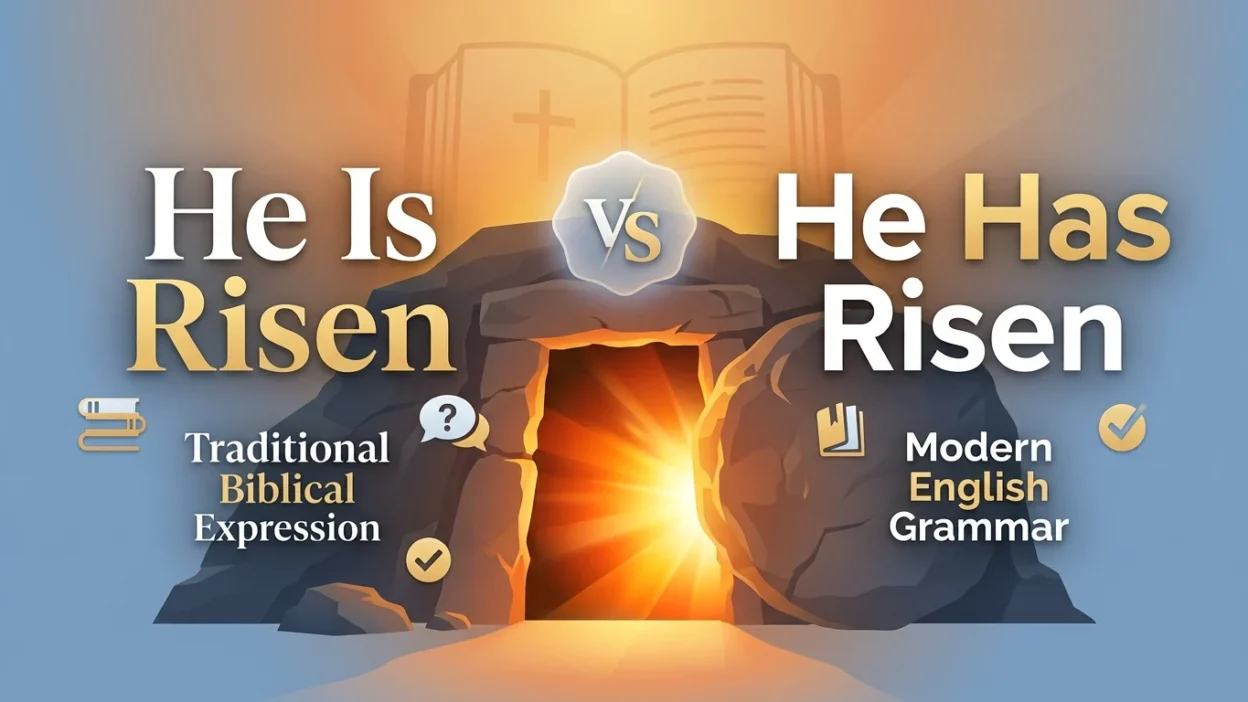
He has risen is the grammatically correct form in modern English because it uses the present perfect tense. He is risen is an older English expression that remains common in Christian worship, Easter greetings, hymns, and traditional Bible translations. For everyday English, use he has risen unless you’re intentionally using the traditional religious phrase.
Why People Confuse It
Many people assume these phrases mean exactly the same thing because they both refer to Jesus’ resurrection.
The confusion comes from several factors:
- Both appear in Christian writings.
- Older English sometimes used be instead of have as the helping verb.
- Traditional Easter greetings still say “He is risen!”
- Modern grammar teaches has risen, making the older form seem incorrect.
Both expressions communicate the same event, but they belong to different stages of English usage.
He Is Risen
He is risen is a traditional religious expression dating back to older forms of English.
Historically, English often used be as an auxiliary verb with verbs of movement or change of state, such as:
- Christ is risen.
- The sun is set.
- He is gone.
Today, this structure is considered archaic outside fixed expressions.
When you’ll see “He is risen”
- Easter greetings
- Church services
- Hymns
- Liturgical readings
- Traditional Bible quotations
- Religious artwork and inscriptions
Meaning
It means:
He has risen from the dead.
The phrase carries a solemn, celebratory, and deeply traditional tone.
He Has Risen
He has risen follows modern English grammar.
It uses the present perfect tense:
Subject + has + past participle
Example:
- He has risen from the dead.
This is the form you’d normally use in:
- Everyday English
- Academic writing
- Modern Bible translations
- Grammar exercises
- English language learning
Examples
- Jesus has risen from the dead.
- The hero has risen above every challenge.
- He has risen to become a respected leader.
Comparison Table
| Feature | He Is Risen | He Has Risen |
| Grammar | Archaic construction | Modern present perfect |
| Common today | Mainly religious | Standard English |
| Sounds | Traditional and biblical | Neutral and contemporary |
| Used in Easter greeting | ✅ Yes | Rarely |
| Used in everyday English | No | Yes |
| Formal religious writing | Very common | Sometimes |
| Modern grammar | Archaic | Correct standard usage |
When to Use Each
Choose he is risen when:
- Writing about Easter traditions
- Quoting Scripture
- Using traditional Christian greetings
- Writing hymns or liturgy
- Referring to historical religious language
Choose he has risen when:
- Writing essays
- Teaching English grammar
- Using modern English
- Writing articles
- Speaking in everyday conversations
Quick rule
- Traditional Christian expression → He is risen
- Modern English grammar → He has risen
Examples
Here are examples showing both phrases in context.
Using “He is risen”
- He is risen! Alleluia!
- The church displayed a banner reading, He is risen.
- Christians around the world proclaim, He is risen indeed!
- The hymn begins with the words He is risen.
- The pastor joyfully declared, He is risen.
- Easter cards often feature the phrase He is risen.
Using “He has risen”
- According to the Gospel, he has risen from the dead.
- She believes that Christ has risen.
- The teacher explained why he has risen is modern grammar.
- He has risen to the top of his profession.
- The athlete has risen above every obstacle.
- The company has risen in global rankings.
Common Mistakes
Here are mistakes learners frequently make.
Mistake 1
❌ He is risen from poverty.
✅ He has risen from poverty.
Reason: This is ordinary modern English.
Mistake 2
❌ He has risen indeed! (during a traditional Easter greeting)
✅ He is risen indeed!
Reason: The traditional response preserves the historic wording.
Mistake 3
❌ He is risen to become CEO.
✅ He has risen to become CEO.
Reason: This uses the present perfect, not the historical religious expression.
Memory Trick
Remember this simple tip:
- Has = modern grammar
- Is = historic church phrase
Think of it this way:
If you’re writing an English essay, choose he has risen.
If you’re celebrating Easter with the traditional greeting, say He is risen!
American vs British English
There is no significant difference between American and British English regarding these expressions.
In both varieties:
- He has risen is the normal grammatical form.
- He is risen survives as a traditional Christian expression.
Both American and British churches commonly use the Easter greeting:
He is risen!
Response:
He is risen indeed!
Similar Words
If you’re learning related expressions, these may also help:
- Rise vs Raise
- Rose vs Risen
- Has gone vs Is gone
- Has come vs Is come (archaic)
- Has arrived vs Is arrived (archaic)
- Resurrection vs Ascension
- Arisen vs Risen
- Rise up vs Rise
Final Verdict
The difference between he is risen and he has risen is mostly one of historical grammar and modern usage.
Use he has risen whenever you’re writing or speaking in standard modern English. It follows today’s grammatical rules and sounds natural in everyday communication.
Reserve he is risen for traditional Christian contexts, Easter celebrations, church services, hymns, or quotations where preserving the historic wording is appropriate. Both expressions refer to the same event, but each belongs to a different linguistic tradition.
Frequently Asked Questions (FAQs)
Is “He is risen” grammatically correct?
Yes, but only as an archaic or traditional expression. In modern grammar, he has risen is the standard form.
Why do Christians say “He is risen”?
The phrase comes from older English translations and Christian liturgical tradition, where be was once used as the auxiliary verb with certain verbs.
Which phrase should English learners use?
Use he has risen in everyday English unless you’re quoting the traditional Easter greeting.
Is “He has risen” wrong in Christianity?
No. It is grammatically correct and appears in many modern Bible translations and Christian writings.
What is the traditional Easter response?
The traditional exchange is:
He is risen!
He is risen indeed!
Can I use “He is risen” outside religious contexts?
Generally, no. Outside fixed religious expressions, he has risen is the appropriate choice.
Why doesn’t modern English use “is risen” anymore?
Modern English gradually replaced be with have as the standard auxiliary for verbs like rise, come, and go, leaving expressions such as he is risen as historical remnants.
Conclusion
Although he is risen and he has risen express the same central idea, they belong to different periods of English. He has risen follows modern grammar and should be your default choice for writing, speaking, and learning English.
Meanwhile, he is risen remains a cherished phrase in Christian tradition, especially during Easter. Recognising the distinction allows you to respect both grammatical accuracy and historical usage, ensuring your English is appropriate for every context.
Remember This
Use he has risen for modern English. Use He is risen! when quoting or participating in the traditional Christian Easter greeting and other liturgical contexts.

Hadley Price creates heartfelt contemporary fiction exploring relationships, hope, resilience, and personal growth. Her emotionally rich storytelling connects with readers through memorable characters and inspiring life experiences worldwide.