English spelling can be confusing, especially when prefixes combine with existing words. One common question writers ask is whether they should write reevaluation as one word or separate it into re evaluation. While both forms may occasionally appear, they are not equally accepted in modern English.
If you’re writing an email, academic paper, business report, or blog post, choosing the correct spelling improves clarity and professionalism. In this guide, you’ll learn the difference between reevaluation and re evaluation, why people confuse them, when each form is appropriate, and how major style guides treat these spellings. By the end, you’ll know exactly which version to use with confidence.
Quick Answer
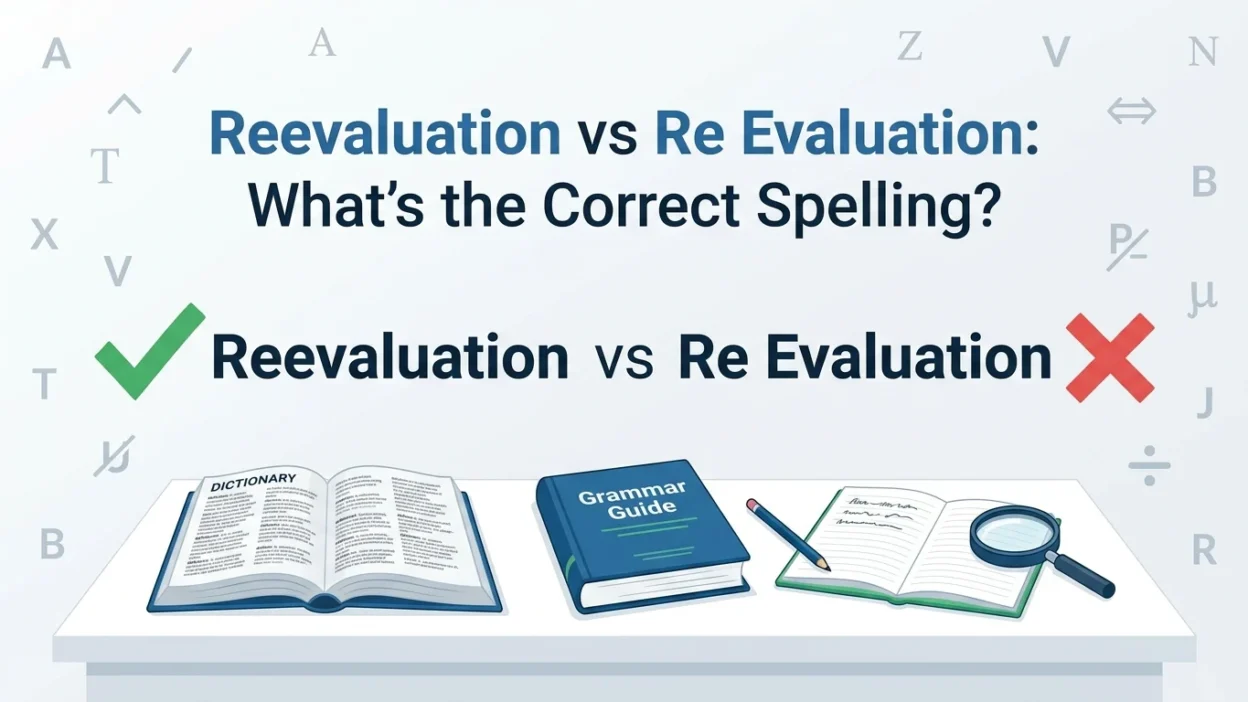
Reevaluation is the correct and standard spelling in modern English. It combines the prefix re- (meaning “again”) with evaluation into one word. Re evaluation is generally considered incorrect unless a specific formatting or editorial reason requires separating the words.
Why People Confuse It
Many English words beginning with re- create uncertainty because the prefix is attached to another word.
People become confused because:
- The base word already starts with e, creating a double vowel (reevaluation).
- Some older publications occasionally inserted a space.
- Hyphenated forms like re evaluate are more common than reevaluate, making people expect a similar pattern.
- Spell checkers sometimes fail to flag spacing errors.
Although the double ee may look unusual, it is perfectly correct.
Reevaluation
Reevaluation is a noun that means the act of evaluating something again after reviewing new information, evidence, or circumstances.
Meaning
A fresh assessment or renewed judgment.
Examples
- The company announced a reevaluation of its hiring policy.
- Doctors recommended a reevaluation after six months.
- The teacher completed a reevaluation of the student’s progress.
- Market conditions required a full reevaluation of the investment strategy.
Why It’s Correct
The prefix re- is attached directly to the noun evaluation, forming one standard compound word recognized by modern dictionaries.
Re Evaluation
Re evaluation consists of two separate words.
In standard English, this spelling is not recommended.
You may occasionally encounter it in:
- Older printed documents
- Poorly edited websites
- Formatting errors
- Rare situations where re is intentionally separated for emphasis
For everyday writing, academic work, business communication, and professional publishing, avoid this form.
Comparison Table
| Feature | Reevaluation | Re Evaluation |
| Standard spelling | ✅ Yes | ❌ No |
| Dictionary accepted | ✅ Yes | Rarely |
| Professional writing | ✅ Recommended | ❌ Avoid |
| Academic writing | ✅ Preferred | ❌ Incorrect |
| Business documents | ✅ Correct | ❌ Not recommended |
| SEO writing | ✅ Best choice | ❌ Avoid |
When to Use Each
Choose reevaluation when writing:
- Academic papers
- Business reports
- Medical documents
- Legal writing
- School assignments
- Professional emails
- Articles and blogs
- Research papers
Avoid re evaluation unless you’re intentionally separating the prefix for a special editorial purpose, which is uncommon.
Examples
Here are practical examples showing the correct usage of reevaluation:
- The manager ordered a reevaluation of employee performance.
- Our travel plans require another reevaluation.
- Scientists completed a reevaluation of the data.
- The policy is under reevaluation this year.
- Financial experts suggested a reevaluation of the budget.
- The insurance company requested a reevaluation of the claim.
- The school conducted a reevaluation of its curriculum.
- Customer feedback prompted a reevaluation of the product.
- Doctors recommended a medical reevaluation before surgery.
- The project entered the reevaluation stage after unexpected delays.
- Continuous reevaluation helps improve long term decisions.
- The committee approved a reevaluation of environmental policies.
Common Mistakes
Many writers make these errors:
❌ Re evaluation is scheduled tomorrow.
✅ Reevaluation is scheduled tomorrow.
❌ We need a re evaluation of the proposal.
✅ We need a reevaluation of the proposal.
❌ The report recommends re evaluation.
✅ The report recommends reevaluation.
Memory Trick
Think of reevaluation as doing an evaluation again.
The prefix re- almost always joins directly with the base noun.
Re + evaluation = reevaluation
Even though the double ee looks unusual, it is completely correct.
American vs British English
Both American English and British English use reevaluation as the preferred spelling.
There is no meaningful regional difference between the two varieties of English.
Some publishers may choose re evaluation for readability in certain style guides, but re evaluation with a space is generally avoided.
Similar Words
If you’re learning English spelling, these words follow similar patterns:
- Reexamination
- Reeducation
- Reemployment
- Reenactment
- Reentry (or re entry depending on style guide)
- Reassessment
- Reconsideration
- Reanalysis
- Reinspection
- Review
Notice that many words beginning with re- either become one word or occasionally use a hyphen depending on editorial style but they are rarely written as two separate words.
Final Verdict
The correct spelling is reevaluation.
Use reevaluation whenever you mean evaluating something again. It is the accepted spelling in dictionaries, professional writing, academic work, and everyday English.
Avoid re evaluation because it is generally considered a spacing error rather than an accepted alternative.
Frequently Asked Questions (FAQs)
Is reevaluation one word?
Yes. Reevaluation is one word and is the standard spelling in modern English.
Is re evaluation correct?
Generally, no. Standard English treats reevaluation as one word.
Why does reevaluation have two “e”s?
Because the prefix re- joins the word evaluation, naturally creating a double ee.
Is re evaluation correct?
Some publishers and style guides allow re evaluation with a hyphen for readability, but reevaluation is more common in modern usage.
Which spelling should I use in academic writing?
Use reevaluation unless your institution follows a style guide that specifically requires the hyphenated form.
Do American and British English use different spellings?
No. Both generally prefer reevaluation, though editorial styles may occasionally favor re evaluation.
Can spell check miss “re evaluation”?
Yes. Since both words exist individually, some spell checkers may not identify the spacing mistake.
Conclusion
Choosing the correct spelling becomes much easier once you understand how English prefixes work. Reevaluation is the standard, dictionary approved spelling used across professional, academic, and everyday writing. Although the double ee may look unusual at first glance, it is grammatically correct and widely accepted.
Whenever you need to describe assessing something again, write reevaluation with confidence. Avoid re evaluation, as separating the prefix from the noun is considered incorrect in standard English. Consistent spelling not only improves readability but also strengthens your credibility as a writer.
Remember This
✅ Reevaluation = Correct
❌ Re evaluation = Incorrect in standard English
If you’re ever unsure, remember this simple rule: the prefix “re-” normally stays attached to “evaluation,” forming the single word “reevaluation.”

Willow Evans writes uplifting fantasy stories filled with magical worlds, courageous heroes, and meaningful life lessons. Her imaginative books encourage creativity, kindness, and hope in readers of all ages.