
English is full of words that sound alike but have completely different meanings. Heard, herd, and Hurd are excellent examples. They are pronounced similarly in most English accents, making them easy to confuse when speaking or writing. While heard and herd are common dictionary words, Hurd is usually a surname or proper noun rather than a standard English vocabulary word.
Understanding the difference between these terms will help you write more accurately and communicate with confidence. In this guide, you’ll learn the meaning of each word, when to use it, common mistakes to avoid, practical examples, and simple memory tricks. Whether you’re an English learner, student, or professional writer, this article will help you master heard vs herd vs Hurd with ease.
Quick Answer
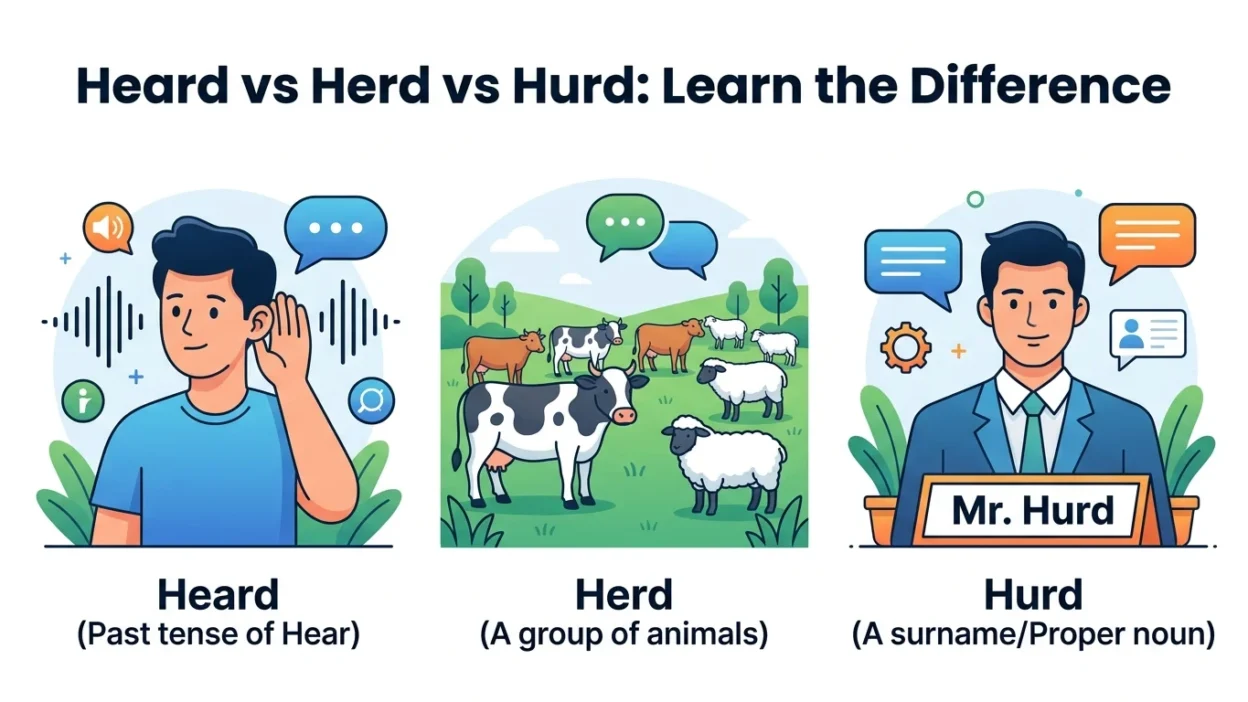
Heard is the past tense of hear and relates to listening. Herd refers to a group of animals or the act of gathering them together. Hurd is generally a proper noun, most commonly used as a surname, and is not interchangeable with the other two words.
Why People Confuse It
These words are often confused because they are homophones—words that sound the same but have different spellings and meanings.
Several factors contribute to the confusion:
- They share nearly identical pronunciation.
- Spell checkers won’t always catch the mistake because each spelling is valid.
- Beginners often rely on sound instead of meaning.
- Proper nouns like Hurd can be mistaken for common vocabulary.
The key is understanding the context of the sentence.
Heard
Heard is the past tense and past participle of the verb “hear.”
Meaning
It means someone listened to or became aware of a sound, voice, announcement, or information.
Examples
- I heard the doorbell this morning.
- She heard the baby crying.
- Have you heard the latest news?
- We heard birds singing outside.
- He heard his name being called.
Common Phrases
- Heard enough
- Heard from someone
- Heard about
- Heard clearly
- Heard the news
Herd
Herd is usually a noun, although it can also be used as a verb.
Meaning (Noun)
A group of animals that live or move together.
Examples include:
- a herd of cows
- a herd of elephants
- a herd of deer
Meaning (Verb)
To gather or move animals—or sometimes people—in a group.
Examples
- A herd of sheep crossed the road.
- The farmer counted every herd carefully.
- Cowboys herd cattle across the ranch.
- Rangers protected the elephant herd.
- The dogs helped herd the sheep.
Hurd
Hurd is primarily a proper noun, not a regular English word.
Meaning
It is commonly used as:
- A family name (surname)
- Part of company names
- Place names in some regions
Examples
- Senator Hurd attended the meeting.
- Professor Hurd published a new book.
- Emma Hurd won the scholarship.
- Mr. Hurd greeted the guests.
- The award was presented by Dr. Hurd.
Unless you’re referring to a person’s name or a specific title, Hurd is usually not the word you need.
Comparison Table
| Word | Part of Speech | Meaning | Example |
| Heard | Verb (past tense) | Listened to or became aware of a sound | I heard the music. |
| Herd | Noun / Verb | A group of animals or to gather animals | A herd of buffalo crossed the field. |
| Hurd | Proper noun | Usually a surname or name | Ms. Hurd gave the presentation. |
When to Use Each
Use heard when talking about:
- Listening
- Sounds
- Music
- News
- Conversations
- Information received
Use herd when referring to:
- Groups of animals
- Farming
- Wildlife
- Gathering animals
- Moving livestock
Use Hurd when:
- Writing someone’s surname
- Referring to a business or place with that name
- Mentioning a specific person named Hurd
Examples
Here are more examples showing the correct usage.
- I heard thunder last night.
- She heard every word of the speech.
- We heard the teacher’s instructions.
- A herd of deer ran across the highway.
- The herd stayed close together.
- Farmers herd sheep into the barn.
- The elephant herd migrated north.
- Mr. Hurd teaches history.
- Sarah Hurd received an award.
- Everyone heard the exciting announcement.
- Rangers monitored the buffalo herd.
- I have never heard that expression before.
Common Mistakes
Many learners accidentally substitute one word for another.
Incorrect
- I herd a strange noise.
- We heard of cows in the field.
- Professor heard wrote the article.
Correct
- I heard a strange noise.
- We saw a herd of cows in the field.
- Professor Hurd wrote the article.
Always ask yourself:
- Am I talking about listening? → heard
- Am I talking about animals together? → herd
- Am I referring to someone’s name? → Hurd
Memory Trick
Here’s an easy way to remember:
- Heard contains hear, so it relates to listening.
- Herd reminds you of a herd of animals.
- Hurd starts with a capital letter when it’s a surname.
Think:
- Hear → Heard
- Animals → Herd
- Name → Hurd
American vs British English
There is no significant difference between American and British English for heard and herd.
Both varieties:
- Spell heard the same.
- Spell herd the same.
- Use the same meanings.
Hurd also remains the same as a surname in both forms of English.
The only slight difference may be pronunciation depending on regional accents, but the meanings stay identical.
Similar Words
If you’re studying commonly confused English words, you may also find these useful:
- Hear vs Listen
- Heard vs Hard
- Here vs Hear
- Bare vs Bear
- Their vs There vs They’re
- Principal vs Principle
- Affect vs Effect
- Compliment vs Complement
Learning these pairs improves both writing accuracy and spoken English.
Final Verdict
Heard, herd, and Hurd may sound alike, but they serve completely different purposes.
- Heard is about hearing or listening.
- Herd refers to a group of animals or gathering them.
- Hurd is usually a person’s surname or another proper noun.
Choosing the correct word depends entirely on the context. Once you connect each spelling with its meaning, you’ll avoid one of the most common homophone mistakes in English.
Frequently Asked Questions
Is “heard” the past tense of hear?
Yes. Heard is both the past tense and past participle of hear.
What does herd mean?
A herd is a group of animals living or moving together. It can also mean to gather animals into a group.
Is Hurd a real English word?
It is mainly used as a proper noun, especially as a surname.
Are heard and herd pronounced the same?
Yes. In most English accents, they are pronounced the same, making them homophones.
Can I use Hurd instead of herd?
No. Hurd is generally a name, while herd refers to animals or grouping them.
How do I remember the difference?
Remember:
- Hear → Heard
- Animals → Herd
- Surname → Hurd
Is herd only used for animals?
Mostly yes, although it can also be used as a verb for guiding animals or, figuratively, moving groups of people.
Conclusion
Although heard, herd, and Hurd sound almost identical, their meanings are entirely different. Heard belongs to the verb hear, herd relates to groups of animals or gathering them, and Hurd is typically a proper noun used as a surname. Paying attention to context makes choosing the correct word straightforward.
The more you read and practise these words in real sentences, the more natural they will become. By understanding their unique roles, you’ll improve your grammar, writing clarity, and overall confidence in English communication.
Remember This
Hear sounds → Heard
Animals together → Herd
Person’s surname → Hurd

Adam Aaron writes engaging mystery and adventure novels featuring intelligent characters, unexpected twists, and emotional storytelling. His creative imagination and compelling narratives have earned admiration from readers across generations.