English contains many words that look similar, making it easy to choose the wrong spelling. One common example is involved vs envolved. Many learners and even native speakers occasionally type envolved, especially when writing quickly or relying on pronunciation instead of spelling.
If you’ve ever wondered whether envolved is a real English word, you’re not alone. This guide explains the difference, provides practical examples, and shares simple memory tricks so you’ll always know which spelling is correct. By the end, you’ll confidently use the right word in both formal and everyday writing.
Quick Answer
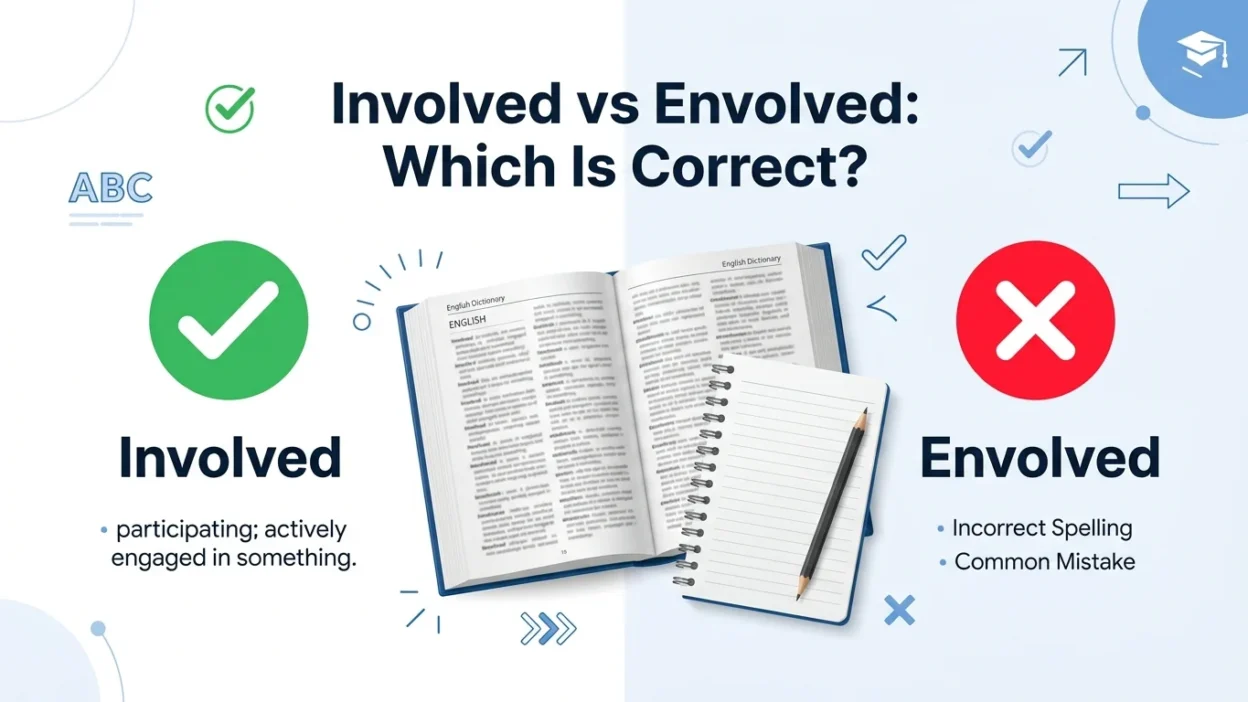
Involved is the correct English word. It means taking part in something, being included, or becoming complicated. Envolved is a misspelling and is not recognised in standard English dictionaries. Always use involved in writing, emails, academic work, and professional communication.
Why People Confuse It
The confusion usually happens because:
- The prefixes in- and en- appear in many English words.
- Words like enable, encourage, and enclose begin with en-, leading people to assume envolved follows the same pattern.
- Fast typing and autocorrect errors can also create the incorrect spelling.
Fortunately, the rule is simple: only “involved” is correct.
Involved
Involved is the past tense and past participle of involve.
Meaning
It can mean:
- Taking part in an activity
- Including someone or something
- Becoming complicated or difficult
- Being emotionally connected
Examples
- She was involved in organising the conference.
- Everyone involved received a certificate.
- The project became more involved than expected.
- He is deeply involved with the local community.
- Several departments were involved in the decision.
Envolved
Envolved is not a correct English word.
Although it sometimes appears online due to spelling mistakes, it does not exist in standard English dictionaries and should never be used in formal or informal writing.
Incorrect examples:
- ❌ She was envolved in the meeting.
- ❌ Everyone envolved agreed.
Correct versions:
- ✅ She was involved in the meeting.
- ✅ Everyone involved agreed.
Involved vs Envolved Comparison Table
| Feature | Involved | Envolved |
| Correct spelling | ✅ Yes | ❌ No |
| Dictionary word | ✅ Yes | ❌ No |
| Part of speech | Adjective / Verb form | None |
| Suitable for formal writing | ✅ Yes | ❌ No |
| Suitable for academic writing | ✅ Yes | ❌ Never |
When to Use Each
Use involved when you mean:
- Participating in something
- Being included
- Becoming complicated
- Having a close connection
Never use envolved, because it is simply a spelling mistake.
Quick rule
If you’re unsure, remember:
Only “involved” belongs in English dictionaries.
Examples
Here are practical examples using the correct word.
- She was involved in every stage of the project.
- Many volunteers were involved in the charity event.
- The investigation involved several witnesses.
- I don’t want to become involved in the argument.
- They were heavily involved in community work.
- Everyone involved deserves recognition.
- The process became more involved over time.
- He stayed involved throughout the campaign.
- The teacher involved every student in the discussion.
- Several experts were involved in developing the report.
- Her parents became involved after hearing the news.
- We appreciate everyone involved in making the event successful.
Common Mistakes
Many writers accidentally write:
- ❌ Envolved
- ❌ Envolve
- ❌ Envolvement
Correct forms are:
- ✅ Involved
- ✅ Involve
- ✅ Involvement
Always proofread your work to catch these spelling errors.
Memory Trick
Here’s an easy way to remember it:
Think of “IN” as being “inside” an activity.
If someone is involved, they are in the activity.
IN → INVOLVED
There is no English word beginning with envolve, so avoid adding en-.
American vs British English
There is no difference between American and British English.
Both varieties use:
- Involved ✅
- Involve ✅
- Involvement ✅
Neither American nor British English recognises envolved as a correct spelling.
Similar Words
If you’re learning English, you may also confuse these pairs:
- Affect vs Effect
- Advice vs Advise
- Accept vs Except
- Lose vs Loose
- Principal vs Principle
- Ensure vs Insure
- Then vs Than
- Its vs It’s
Learning these commonly confused words will strengthen your writing accuracy.
Final Verdict
The answer is straightforward:
- ✅ Involved is the correct spelling.
- ❌ Envolved is incorrect.
Whether you’re writing an email, school assignment, business report, or social media post, always choose involved. Using the correct spelling improves clarity, professionalism, and credibility.
Frequently Asked Questions
Is “envolved” a real English word?
No. Envolved is a misspelling and is not recognised in standard English.
Which spelling is correct: involved or envolved?
Involved is always the correct spelling.
Why do people write “envolved”?
People often confuse the prefixes in- and en-, or make typing mistakes.
Can I use “envolved” in formal writing?
No. It should never appear in formal, academic, or professional writing.
Is “involved” a verb or an adjective?
It can be both. It is the past tense and past participle of involve, and it also functions as an adjective.
Is the spelling different in British English?
No. Both British and American English use involved.
Conclusion
Choosing between involved and envolved is easier than it first appears. Involved is the only correct spelling in English and is accepted across dictionaries, educational materials, and professional writing. Envolved is simply a common spelling error that should always be corrected.
As your English vocabulary grows, paying attention to commonly confused spellings like this will improve your writing and communication. When proofreading, take an extra moment to check words that begin with prefixes such as in- and en-. Small improvements like these make your writing more polished, accurate, and professional.
Remember This
✅ Involved = Correct
❌ Envolved = Incorrect
Whenever someone takes part, is included, or has a connection to something, the word you need is involved.

Quinn Mitchell is celebrated for historical fiction that combines authentic settings, unforgettable characters, and compelling narratives. His thoughtful writing brings history alive while inspiring curiosity and deeper understanding among readers.