
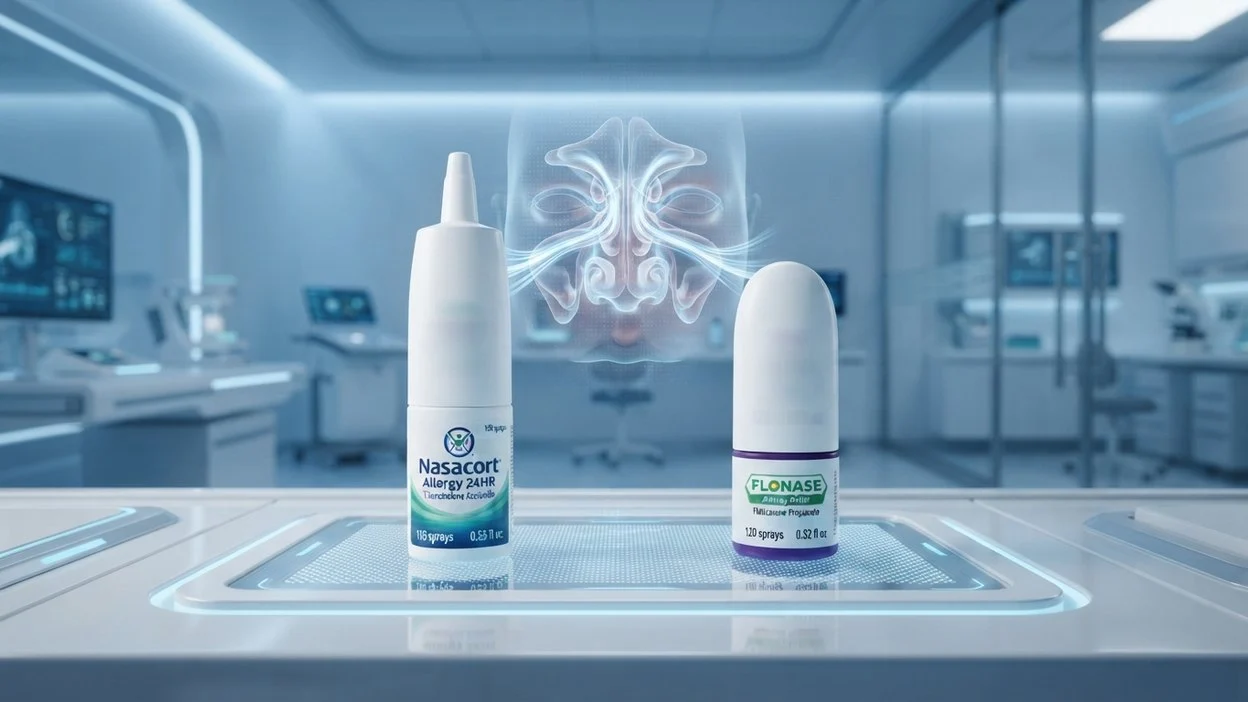
Nasacort and Flonase are both steroid nasal sprays used to relieve allergy symptoms such as a stuffy or runny nose, sneezing, and nasal itching. They work in similar ways, but they contain different active ingredients. Nasacort Allergy 24HR contains triamcinolone acetonide, while Flonase Allergy Relief contains fluticasone propionate. Both are corticosteroid nasal sprays designed for once-daily use.
The main difference between Nasacort and Flonase is therefore not that one is a completely different type of medicine. Both reduce inflammation caused by allergies. The differences involve the active steroid, approved age ranges for the over-the-counter products, dosing instructions, formulation, and individual response. For many people, either can be an appropriate allergy treatment when used according to its label. If you have persistent symptoms, frequent nosebleeds, vision changes, or questions about long-term use, speak with a healthcare professional.
Quick Answer
Nasacort and Flonase are both corticosteroid nasal sprays for allergy symptoms. Nasacort contains triamcinolone acetonide, while Flonase Allergy Relief contains fluticasone propionate. Both are used once daily and can relieve nasal allergy symptoms. Flonase Allergy Relief is labeled for children age 4 and older, while Nasacort Allergy 24HR is labeled for children age 2 and older.
Why Do People Confuse Nasacort and Flonase?
People often compare Nasacort and Flonase because both are:
- Nasal sprays
- Corticosteroid medicines
- Used for allergy symptoms
- Available without a prescription in the United States
- Intended for regular, once-daily use
- Designed to reduce inflammation in the nose
They also treat many of the same symptoms, including congestion, sneezing, and an itchy or runny nose. Flonase Allergy Relief also specifically lists relief of itchy, watery eyes among its allergy benefits.
The biggest distinction is their active ingredient:
- Nasacort: triamcinolone acetonide
- Flonase Allergy Relief: fluticasone propionate
Because the two medicines are different corticosteroids, their doses should not be compared simply by looking at the number of micrograms on the package.
Nasacort: What Is It?
Nasacort Allergy 24HR is a nasal allergy spray containing triamcinolone acetonide. Each spray delivers 55 micrograms of triamcinolone acetonide.
It is used for symptoms associated with hay fever and other nasal allergies. The product label includes symptoms such as congestion, runny nose, sneezing, and nasal itching.
How is Nasacort used?
For adults and children 12 years and older, the current consumer directions state:
- Use once daily.
- Start with 2 sprays in each nostril.
- After symptoms improve, reduce to 1 spray in each nostril daily.
For children, the labeled directions differ by age. Nasacort Allergy 24HR is labeled for children 2 years and older, with adult supervision required for younger children.
Nasacort should not be used in children younger than 2 years according to the product labeling.
Flonase: What Is It?
Flonase Allergy Relief contains fluticasone propionate, another corticosteroid used as a nasal spray for allergy symptoms.
The product is intended to reduce allergy-related nasal inflammation and relieve symptoms such as nasal congestion, sneezing, and itchy or runny nose. Its labeling also includes relief of itchy, watery eyes associated with allergies.
How is Flonase used?
For adults and children 12 years and older, the consumer directions state:
- During the first week, use 2 sprays in each nostril once daily.
- From week 2 through 6 months, use 1 or 2 sprays in each nostril once daily as needed.
- After 6 months of daily use, ask a doctor whether continued use is appropriate.
Flonase Allergy Relief is labeled for children 4 to 11 years old, with adult supervision. Children younger than 4 should not use the product according to its labeling.
Nasacort vs Flonase: Comparison Table
| Feature | Nasacort Allergy 24HR | Flonase Allergy Relief |
|---|---|---|
| Active ingredient | Triamcinolone acetonide | Fluticasone propionate |
| Drug type | Corticosteroid nasal spray | Corticosteroid nasal spray |
| Strength per spray | 55 mcg | 50 mcg |
| Typical use | Once daily | Once daily |
| OTC pediatric labeling | Age 2+ | Age 4+ |
| Allergy symptoms | Nasal congestion, runny nose, sneezing, nasal itching | Nasal congestion, runny nose, sneezing, nasal itching; also itchy/watery eyes |
| First-week adult dosing | 2 sprays per nostril daily | 2 sprays per nostril daily |
| Long-term label instructions | Reduce after symptoms improve | Reduce as symptoms are controlled; consult a doctor after 6 months of daily use |
Product directions can vary by specific formulation and manufacturer, so always check the label on the product you have.
When Should You Use Nasacort?
Nasacort may be considered when you want a once-daily corticosteroid nasal spray for allergy symptoms and its labeling fits your age and situation.
It may be useful for symptoms such as:
- Stuffy nose
- Runny nose
- Sneezing
- Itchy nose
- Seasonal allergy symptoms
- Other nasal allergy symptoms
The labeled age range for Nasacort Allergy 24HR extends down to age 2, which is an important difference from Flonase Allergy Relief.
When Should You Use Flonase?
Flonase Allergy Relief may be considered when you want a once-daily corticosteroid nasal spray for allergy symptoms.
Its labeling covers symptoms including:
- Nasal congestion
- Runny nose
- Sneezing
- Itchy nose
- Itchy, watery eyes associated with allergies
Flonase Allergy Relief is labeled for adults and children 4 years and older.
Neither medicine should automatically be considered “stronger” simply because its package lists a different microgram amount. They contain different active corticosteroids, so the numbers are not directly interchangeable.
Nasacort vs Flonase: 12 Practical Examples
Example 1: Seasonal allergies
If pollen causes sneezing and nasal congestion, either product may be used according to its label.
Example 2: Daily allergy symptoms
If symptoms occur regularly, both products are designed for once-daily use.
Example 3: A child age 3
Nasacort Allergy 24HR is labeled for children age 2 and older, while Flonase Allergy Relief is not labeled for children younger than 4.
Example 4: A child age 6
Both products have pediatric directions for this age group, but the exact dosing instructions differ, so the package directions should be followed.
Example 5: Severe nasal congestion
Both are corticosteroid nasal sprays that can address allergy-related nasal inflammation. Persistent or severe symptoms should be discussed with a healthcare professional.
Example 6: Sneezing
Both products are labeled for relief of sneezing associated with nasal allergies.
Example 7: Itchy nose
Both products can be used for allergy-related nasal itching according to their labeling.
Example 8: Itchy, watery eyes
Flonase Allergy Relief specifically lists itchy, watery eyes among the symptoms it relieves.
Example 9: Frequent nosebleeds
Frequent or severe nosebleeds are a reason to stop self-treatment and seek medical advice according to the product labeling.
Example 10: Vision changes
New vision changes after starting a nasal corticosteroid should be discussed with a healthcare professional.
Example 11: Pregnancy or breastfeeding
Both product labels advise people who are pregnant or breastfeeding to ask a healthcare professional before use.
Example 12: Symptoms that do not improve
The Nasacort consumer labeling says to stop use and talk to a doctor if allergy symptoms do not improve after one week. Always follow the specific instructions on your product’s label.
Common Mistakes When Comparing Nasacort and Flonase
Mistake 1: Assuming one is automatically stronger
Nasacort contains 55 micrograms per spray and Flonase contains 50 micrograms per spray, but those numbers should not be used to decide which medicine is stronger. The active corticosteroids are different.
Mistake 2: Using both together without medical advice
Both are corticosteroid nasal sprays. Using them together is not something you should do simply because one seems to work differently. Ask a healthcare professional before combining or switching treatments.
Mistake 3: Expecting instant maximum relief
These sprays are intended for regular use. Flonase labeling says some people may begin to feel relief on the first day, with the full effect occurring after several days of regular once-daily use.
Mistake 4: Spraying toward the nasal septum
Both products provide instructions to aim the spray away from the septum, the wall separating the nostrils. Proper technique can help reduce irritation and nosebleeds.
Mistake 5: Ignoring age-specific directions
Nasacort and Flonase have different labeled pediatric age ranges. Do not assume that a dose for one product can be transferred to the other.
Memory Trick: Nasacort vs Flonase
Remember:
Nasacort = triamcinolone
Flonase = fluticasone
A useful way to remember the main difference is:
Nasa-cort → nasal corticosteroid with triamcinolone.
Flonase → fluticasone nasal spray.
Both are allergy sprays, but their active ingredients are different.
American vs British English
The names Nasacort and Flonase are brand names, so the main difference between American and British English is not spelling.
Drug availability, brand names, formulations, and labeling can differ between countries. Therefore, information on a U.S. over-the-counter product should not automatically be applied to a product sold under the same or a similar name elsewhere.
If you live outside the United States, check the local package information or ask a pharmacist about the exact product available in your country.
Similar Words and Related Allergy Medicines
Corticosteroid nasal spray
A nasal corticosteroid is a medicine sprayed into the nose to reduce inflammation. Nasacort and Flonase belong to this category.
Antihistamine nasal spray
Antihistamine sprays work differently from corticosteroid sprays. They target histamine-related allergy symptoms rather than primarily reducing nasal inflammation.
Saline nasal spray
Saline sprays contain salt water rather than a corticosteroid. They can help moisturize and rinse the nasal passages but work differently from allergy steroid sprays.
Decongestant nasal spray
Decongestant sprays are a different category of medicine. Some should only be used for a short period because prolonged use can cause rebound congestion.
Generic fluticasone
Fluticasone propionate nasal spray is available in generic forms. A generic product may contain the same active ingredient as Flonase Allergy Relief, but inactive ingredients, packaging, and labeling can differ.
Final Verdict: Nasacort or Flonase?
Nasacort and Flonase are similar in purpose but not identical medicines. Both are corticosteroid nasal sprays used for allergy symptoms, but Nasacort contains triamcinolone acetonide and Flonase Allergy Relief contains fluticasone propionate.
For adults, the choice can depend on factors such as symptom pattern, individual response, cost, product availability, formulation preferences, and advice from a healthcare professional. For children, age labeling is especially important: Nasacort Allergy 24HR is labeled for ages 2 and older, while Flonase Allergy Relief is labeled for ages 4 and older.
FAQs:
Is Nasacort better than Flonase?
There is no universal answer that one is better for everyone. Both are corticosteroid nasal sprays, but they contain different active ingredients. Individual response, age, symptoms, formulation, and other health considerations can affect which product is appropriate.
Can you use Nasacort and Flonase together?
Do not combine two corticosteroid nasal sprays unless a healthcare professional specifically tells you to. Using two similar medicines may increase unnecessary corticosteroid exposure without providing additional benefit.
Is Nasacort a steroid?
Yes. Nasacort Allergy 24HR contains triamcinolone acetonide, a corticosteroid used as a nasal spray to reduce allergy-related inflammation.
Is Flonase a steroid?
Yes. Flonase Allergy Relief contains fluticasone propionate, a corticosteroid nasal spray used to treat allergy symptoms.
Which works faster, Nasacort or Flonase?
The exact response varies between individuals. Flonase labeling states that some users may feel relief on the first day, while full effect can take several days of regular once-daily use. Nasacort is also intended for regular use rather than occasional, immediate relief.
Can children use Nasacort or Flonase?
The labeled age ranges differ. Nasacort Allergy 24HR is labeled for children age 2 and older, while Flonase Allergy Relief is labeled for children age 4 and older. Pediatric dosing and supervision requirements should be followed carefully.
Can Nasacort or Flonase cause nosebleeds?
Nosebleeds can occur with nasal corticosteroid sprays. Both labels specifically advise seeking medical advice for severe or frequent nosebleeds. Correct spray technique, including aiming away from the nasal septum, is important.
Can I switch from Nasacort to Flonase?
A person may be able to switch between products, but the correct approach depends on the individual and the exact products involved. Follow the new product’s directions rather than transferring the dose from one spray to the other.
Remember This
- Nasacort = triamcinolone acetonide.
- Flonase = fluticasone propionate.
- Both are corticosteroid nasal sprays.
- Both are used for nasal allergy symptoms.
- Both are generally used once daily according to their OTC labels.
- Nasacort Allergy 24HR is labeled for ages 2+.
- Flonase Allergy Relief is labeled for ages 4+.
- Do not compare their microgram numbers as though they were equivalent doses.
- Use the spray correctly and follow the label.
- Seek medical advice for severe or frequent nosebleeds, vision changes, or persistent symptoms.
Conclusion:
Nasacort and Flonase are two closely related options for treating allergy symptoms with a nasal corticosteroid. Their purpose is similar, but their active ingredients are different: Nasacort contains triamcinolone acetonide, while Flonase contains fluticasone propionate. Both can help control allergy-related nasal symptoms when used consistently and according to their directions.
The most important differences to remember are the active ingredients, age labeling, dosing instructions, and individual response. Neither product should be judged simply by its microgram strength. If you are choosing between them, especially for a child, during pregnancy or breastfeeding, or for long-term use, check the specific product label and ask a pharmacist or doctor when appropriate.

Nova Turner specializes in imaginative science fiction blending futuristic technology, thrilling adventures, and powerful human emotions. Her innovative storytelling inspires curiosity, creativity, and exploration among readers of every age.