
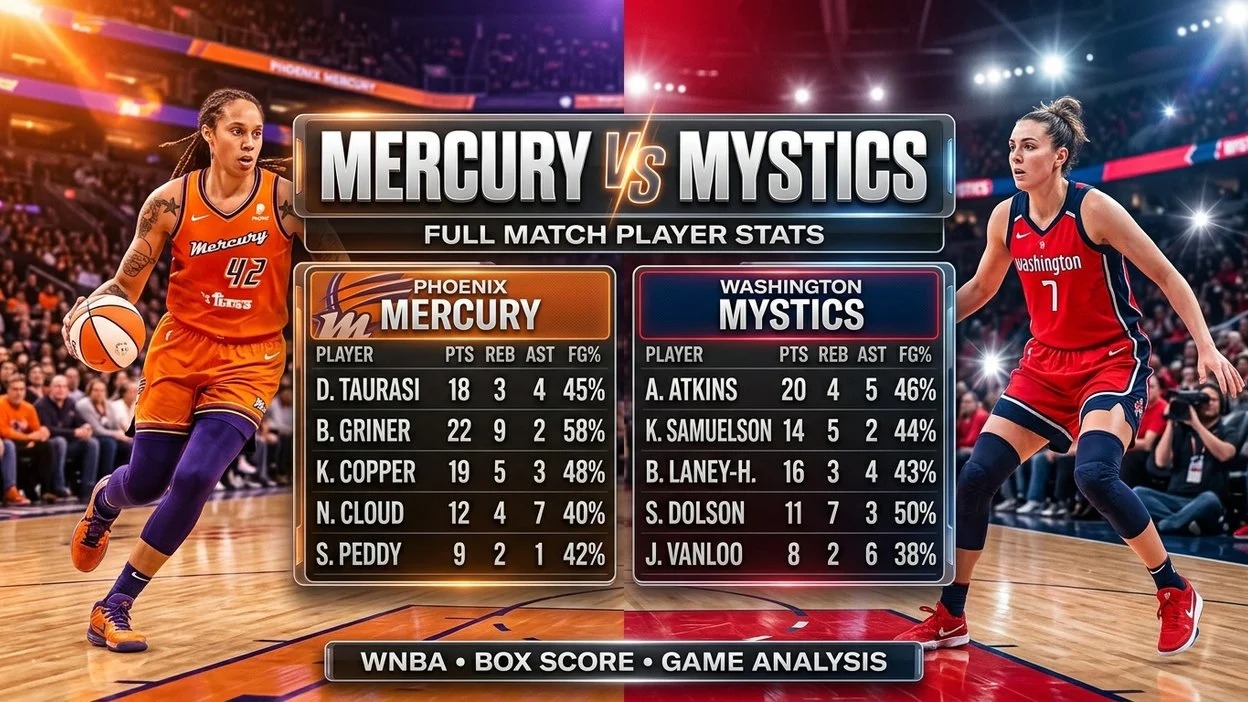
The Phoenix Mercury vs Washington Mystics match player stats help basketball fans understand how individual players perform when these two WNBA teams meet. Player statistics show who scores the most points, controls rebounds, creates scoring chances, records assists, and contributes on defense. They also help readers understand how a game develops beyond the final score.
Whether you are a WNBA fan, a student learning English, or a beginner exploring basketball statistics, understanding these numbers makes every matchup easier to follow. However, player stats depend on the specific game date and season. Without a confirmed game date or official box score, exact points, rebounds, assists, and shooting percentages should not be presented as verified results. This guide explains the main statistics to check, how to compare Phoenix Mercury and Washington Mystics players, and how to interpret a box score accurately. It also provides a simple comparison table, practical examples, and answers to common questions about individual player performance.
Quick Answer
Phoenix Mercury vs Washington Mystics match player stats include points, rebounds, assists, steals, blocks, turnovers, minutes played, and shooting percentages. These figures explain each player’s contribution to the game. To identify the actual leading scorer or best performer, check the official box score for the specific matchup and season.
Why Do People Confuse Phoenix Mercury vs Washington Mystics Player Stats?
Fans sometimes confuse team statistics with individual player statistics. Although both describe the same game, they answer different questions.
- Team stats show the combined performance of Phoenix Mercury or Washington Mystics.
- Player stats show what each individual athlete contributes.
- Season stats summarize a player’s performance across multiple games.
- Match stats describe performance in one specific game.
For example, Phoenix might score more total points than Washington, but that does not automatically mean a Phoenix player recorded the highest individual score. Similarly, a player who scores fewer points may contribute more rebounds, assists, steals, or defensive stops.
Another source of confusion is the game date. A player’s statistics from one season should not be treated as their performance in another season.
First Word: Phoenix Mercury
The Phoenix Mercury are a professional women’s basketball team in the Women’s National Basketball Association (WNBA). The team represents Phoenix, Arizona.
When examining Phoenix Mercury match player stats, readers should focus on the following categories:
- Points (PTS): The total number of points a player scores.
- Rebounds (REB): The number of times a player collects the ball after a missed shot.
- Assists (AST): Passes that directly lead to a made basket.
- Steals (STL): Possessions gained by taking the ball from an opponent.
- Blocks (BLK): Defensive actions that stop or alter an opponent’s shot.
- Turnovers (TO): Times a player loses possession in a way that gives the ball to the opposing team.
These figures help explain whether a Mercury player contributes mainly through scoring, playmaking, rebounding, or defense.
Second Word: Washington Mystics
The Washington Mystics are a professional women’s basketball team in the WNBA, based in Washington, D.C.
Washington Mystics player statistics can be evaluated using the same categories as Phoenix Mercury statistics. Using the same measures makes a fair comparison possible.
For example, if a Mystics player records eight assists, that suggests a strong playmaking contribution. If another player records several blocks and rebounds, her performance may be especially valuable defensively.
Important measures include:
- Total points and field goals made
- Three-point shooting accuracy
- Free throws made and attempted
- Offensive and defensive rebounds
- Assists and turnovers
- Steals and blocks
- Minutes played
A complete box score provides a more accurate picture than points alone.
Phoenix Mercury vs Washington Mystics: Player Stats Comparison Table
The following table explains how to compare both teams without assuming unverified match results.
| Statistic | Phoenix Mercury | Washington Mystics | What It Shows |
| Points | Check individual box score | Check individual box score | Scoring contribution |
| Rebounds | Check player totals | Check player totals | Ball recovery after missed shots |
| Assists | Check player totals | Check player totals | Passing and playmaking |
| Steals | Check player totals | Check player totals | Defensive pressure |
| Blocks | Check player totals | Check player totals | Shot protection |
| Turnovers | Check player totals | Check player totals | Lost possessions |
| Field-goal percentage | Calculate or verify | Calculate or verify | Accuracy on field-goal attempts |
| Three-point percentage | Calculate or verify | Calculate or verify | Accuracy from beyond the arc |
| Free-throw percentage | Calculate or verify | Calculate or verify | Accuracy from the free-throw line |
| Minutes played | Check player totals | Check player totals | Time spent on court |
This is a comparison framework, not a record of a particular completed game. Actual statistics must come from the correct game’s box score.
When Should You Use Each Type of Player Statistic?
Different basketball statistics are useful for different questions.
Use points to compare scoring
Points help identify which player scored most effectively in a game. However, points alone do not measure passing, defense, or overall efficiency.
Use rebounds to understand possession control
Rebounds show how often a player collects a missed shot. Offensive rebounds can create additional scoring opportunities, while defensive rebounds help a team regain possession.
Use assists to evaluate playmaking
Assists help show how players create scoring opportunities for teammates. A player with fewer points but many assists may still have a major influence on the offense.
Use shooting percentages to measure accuracy
Shooting percentages explain how successfully a player converts attempts into baskets. They are especially useful when two players score similar numbers of points.
Use defensive statistics to assess impact
Steals and blocks provide information about defensive activity. They should be considered alongside positioning, defensive assignments, and other contributions that may not appear in a box score.
12 Examples of How to Read Phoenix Mercury vs Washington Mystics Match Player Stats
The following examples use hypothetical numbers to explain basketball statistics. They are not actual results from a Phoenix Mercury vs Washington Mystics game.
- Highest scorer: If a Phoenix player scores 28 points and a Washington player scores 22, the Phoenix player has the higher individual scoring total.
- Rebounding leader: If a Mystics player collects 12 rebounds and a Mercury player collects seven, the Mystics player leads in rebounds.
- Best playmaker: A player with nine assists records more assists than a player with four, even if the second player scores more points.
- Three-point accuracy: A player who makes four of eight three-point attempts has a 50% three-point percentage.
- Free-throw accuracy: A player who makes six of eight free throws has a 75% free-throw percentage.
- Field-goal accuracy: A player who makes 10 of 18 field-goal attempts has a field-goal percentage of approximately 55.6%.
- Defensive contribution: A player with three steals has recorded three steals, but that figure alone does not prove she was the game’s best defender.
- Shot protection: A player with four blocks has blocked four opponent shots according to the official box score.
- Ball security: If one player commits two turnovers and another commits six, the first has fewer turnovers.
- Playing time: A player who plays 34 minutes spends more time on the court than a player who plays 18 minutes.
- Efficient scoring: If two players each score 20 points, but one needs fewer field-goal attempts, that player may have greater shooting efficiency. Free throws and three-point shots also affect scoring efficiency.
- All-around performance: A player who records 18 points, eight rebounds, and seven assists contributes in three major statistical categories. That balanced performance may be more informative than points alone.
These examples show why a complete player comparison should include several statistics rather than a single number.
Common Mistakes When Reading WNBA Player Stats
Basketball statistics are easier to understand when common errors are avoided.
- Confusing team totals with individual totals: A team’s points are not the same as its leading player’s points.
- Mixing games or seasons: Always confirm the date and season before comparing performances.
- Ignoring shooting attempts: A player’s scoring total does not reveal how many attempts were needed.
- Treating assists as points: An assist helps create a basket, but the credited points belong to the scorer.
- Overlooking turnovers: Turnovers can reduce a player’s offensive contribution.
- Assuming rebounds are all the same: Offensive and defensive rebounds serve different purposes.
- Calling someone the best player based only on points: Rebounding, passing, defense, efficiency, and playing time also matter.
- Confusing percentages with totals: A player can have a high shooting percentage on relatively few attempts.
For a reliable comparison, use statistics from the same game and consider the context behind each number.
Memory Trick: How to Remember the Main Stats
Use this simple memory guide:
- P = Points: Who scored?
- R = Rebounds: Who collected missed shots?
- A = Assists: Who helped teammates score?
- S = Steals: Who took possession away?
- B = Blocks: Who stopped or altered shots?
- T = Turnovers: Who lost possession?
Remember PRASBT as a checklist when reading a basketball box score. It is a learning aid rather than an official basketball term.
American vs British English: Basketball Statistics
Basketball vocabulary is largely shared between American and British English, although some general sports terms and spelling conventions differ.
| Term | American English | British English |
| Points | Points | Points |
| Rebounds | Rebounds | Rebounds |
| Assists | Assists | Assists |
| Defense | Defense | Defence |
| Offense | Offense | Offence |
| Center | Center | Centre |
| Statistics | Stats | Stats |
WNBA coverage commonly uses American basketball terminology. Readers using British English may see spellings such as defence and centre, but the underlying basketball concepts remain the same.
Similar Words and Related Basketball Terms
Understanding related terms makes player statistics easier to interpret.
- Box score: A statistical summary of a completed game.
- Player performance: An individual’s contribution during a game.
- Game log: A record of a player’s statistics across individual games.
- Season averages: The average number of points, rebounds, assists, or other statistics recorded over a season.
- Field-goal percentage: The percentage of field-goal attempts that result in made baskets.
- Three-point percentage: The percentage of three-point attempts that are successful.
- Free-throw percentage: The percentage of free-throw attempts that are successful.
- Double-double: A performance with at least 10 in two of five major statistical categories: points, rebounds, assists, steals, or blocks.
- Triple-double: A performance with at least 10 in three of those five categories.
- Plus-minus: The point difference while a player is on the court, based on the scoring totals of both teams during that time.
These terms help readers move beyond basic scoring figures and understand the different ways a player influences a basketball game.
Final Verdict: How Should You Compare the Two Teams?
The best way to evaluate Phoenix Mercury vs Washington Mystics match player stats is to compare points, rebounds, assists, shooting percentages, turnovers, and defensive contributions from the same game.
The leading scorer is not automatically the most efficient player or the strongest all-around contributor. A useful evaluation considers the complete box score, the player’s minutes, and the role she performs for her team.
For exact match results, the specific game date and official statistics are essential. Without those details, presenting named players with precise numbers would risk confusing actual results with examples.
FAQs:
1. Where can I find Phoenix Mercury vs Washington Mystics match player stats?
Look for the matchup’s box score on the official WNBA website or the teams’ official websites. Confirm the game date and season before reviewing the player statistics.
2. Who scored the most points in the Phoenix Mercury vs Washington Mystics game?
The answer depends on the specific game. Check the individual points column in the official box score to identify the leading scorer. Without a confirmed game date and verified results, naming a player would be unreliable.
3. Which player had the most rebounds in the matchup?
The player with the highest individual rebound total led that statistical category. Check both offensive and defensive rebounds if you want a more detailed comparison.
4. What do PTS, REB, and AST mean in basketball stats?
PTS means points, REB means rebounds, and AST means assists. These are three of the most commonly used statistics in a basketball box score.
5. How do I compare shooting percentages between the teams?
Compare field-goal, three-point, and free-throw percentages for players from the same game. Check the number of attempts as well, because a percentage based on very few attempts may provide limited evidence.
6. What is the difference between player stats and team stats?
Player stats describe an individual athlete’s performance. Team stats combine the contributions of the players who represent that team in the game.
7. Can a player perform well without scoring many points?
Yes. A player can contribute through rebounds, assists, steals, blocks, defensive work, and effective passing. Points are important, but they do not capture every aspect of basketball performance.
8. Why is the match date important when checking player statistics?
Player rosters, playing time, and individual performances can change from game to game and season to season. The date helps ensure that the statistics refer to the correct matchup.
Remember This
When reading Phoenix Mercury vs Washington Mystics match player stats, remember these five points:
- Check the exact game date and season.
- Compare individual players using the same statistical categories.
- Look beyond points to rebounds, assists, and defense.
- Consider shooting percentages alongside attempts.
- Use an official box score for verified results.
Conclusion:
Phoenix Mercury vs Washington Mystics match player stats provide a clear way to understand individual performances in WNBA basketball. Points reveal scoring output, rebounds show possession recovery, assists measure playmaking, and defensive statistics help explain how players challenge their opponents. Together, these numbers offer a fuller picture of the game.
For the most accurate comparison, use the official box score for the exact matchup rather than relying on unverified figures. Once you understand the main statistics and how they relate to each other, you can identify scoring leaders, compare efficiency, and appreciate the different contributions that help a team compete.

Willow Evans writes uplifting fantasy stories filled with magical worlds, courageous heroes, and meaningful life lessons. Her imaginative books encourage creativity, kindness, and hope in readers of all ages.