If you have ever hesitated between separate and seperate, you are not alone. These two spellings look remarkably similar, and the pronunciation of separate can make the spelling even more confusing. However, there is an important difference: separate is the correct English spelling, while seperate is a common misspelling. You may see seperate frequently in informal writing, online posts, or even occasional typos in professional documents, but it is not considered standard English.
Learning the correct spelling becomes much easier when you understand how the word is formed and how it is used. Separate can function as a verb, adjective, or noun depending on the sentence. It can describe things that are apart, the action of moving things apart, or something distinct from another thing. In this guide, we will compare separate vs seperate, explain why the mistake happens, provide practical examples, and give you a simple memory trick that can help you spell separate correctly every time.
Quick Answer
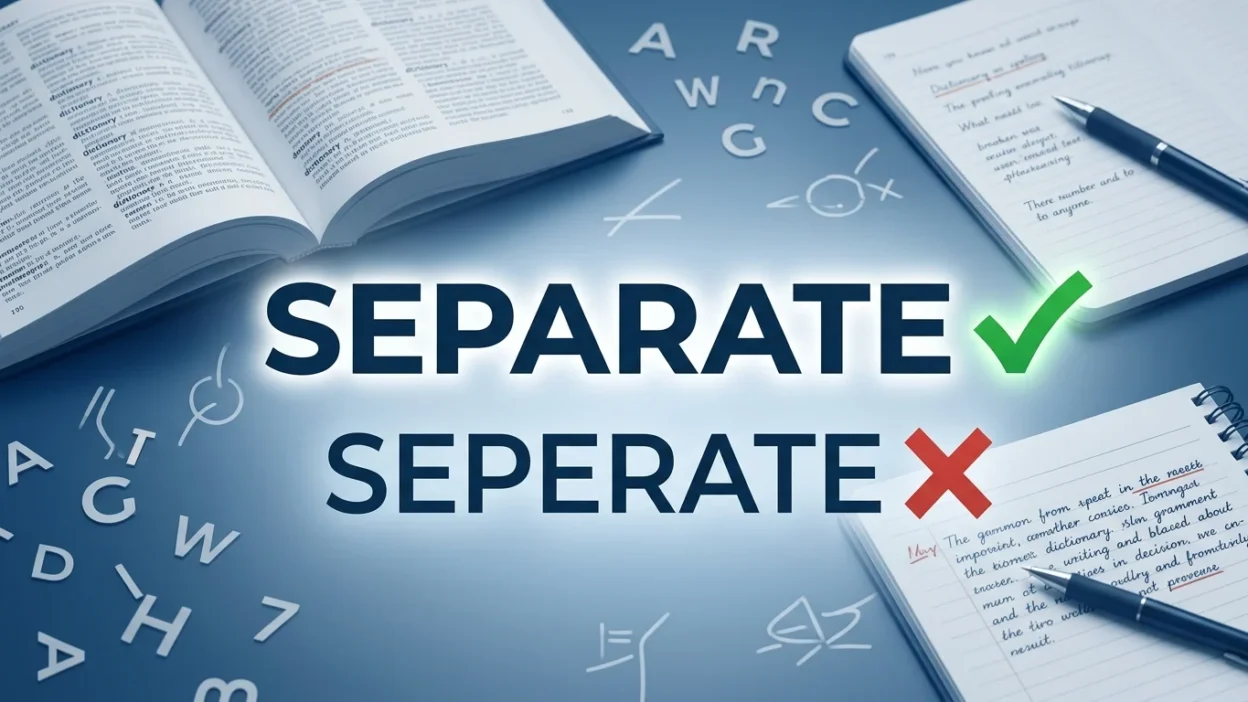
Separate is the correct spelling. Seperate is incorrect and should not be used in standard English. The word separate contains “par” in the middle: sep-par-ate. Remembering “there is a par in separate” can help you avoid this common spelling mistake.
Why People Confuse It
The confusion between separate and seperate mainly comes from pronunciation.
In many contexts, the middle vowel in separate is pronounced weakly, so it can sound closer to an unstressed “uh” sound. As a result, people sometimes spell the word based on how they hear it.
There is also a visual reason for the mistake. English contains many familiar words with -perate patterns, and writers may naturally assume that separate follows the same spelling pattern.
Another factor is that separate can be pronounced differently depending on whether it is used as an adjective or verb.
For example:
- Adjective: “They live in separate houses.”
- Verb: “Please separate the documents.”
Regardless of pronunciation, the spelling remains separate.
First Word: Separate
Separate is the correct spelling.
It can be used in several ways.
Separate as an adjective
As an adjective, separate means apart, distinct, or not together.
Examples:
- We have separate bedrooms.
- The two companies operate as separate businesses.
- Please put the clean clothes in a separate basket.
Separate as a verb
As a verb, separate means to divide, move apart, or keep things apart.
Examples:
- Separate the white shirts from the colored ones.
- The teacher separated the two students.
- We need to separate fact from opinion.
Separate as a noun
As a noun, separate can refer to an individual item, especially one piece of clothing considered separately from another.
Example:
- The store sells matching separates.
The important point is simple: separate is always spelled with “par” in the middle.
Second Word: Seperate
Seperate is not the standard English spelling.
It is a common spelling error for separate. Although you may encounter it online or in casual writing, dictionaries and standard English usage recognize separate as the correct form.
For example:
❌ Please keep the files in seperate folders.
✅ Please keep the files in separate folders.
The incorrect spelling often appears because people pronounce the word without clearly hearing the middle a.
If you are writing an essay, email, report, application, article, or other formal text, always use separate.
Comparison Table
| Word | Correct? | Meaning | Example |
| Separate | ✅ Yes | Apart or distinct; to divide | Keep the two documents separate. |
| Seperate | ❌ No | Common misspelling of separate | ❌ Keep the documents seperate. |
The easiest rule
Separate = correct
Seperate = incorrect
If you remember only one thing, remember the “par” in separate.
When to Use Each
There is really only one standard spelling to use: separate.
Use separate when you mean that people or things are apart, distinct, or divided.
Use “separate” as an adjective
- We need separate rooms.
- They have separate accounts.
- The children attend separate schools.
Use “separate” as a verb
- Separate the papers into three groups.
- The wall separates the kitchen from the dining room.
- Please separate the recyclable materials.
What about “seperate”?
Do not use seperate in standard English.
If you see it in someone else’s writing, it is almost certainly intended to be separate.
Examples
Here are practical examples showing how separate works in everyday English:
- Please keep the receipts in a separate folder.
- The twins have separate bedrooms.
- The river separates the two towns.
- We decided to separate the discussion into two parts.
- These are separate issues and should be treated independently.
- The teacher asked the students to separate into groups.
- Keep raw meat separate from cooked food.
- The company has separate departments for sales and marketing.
- Their personal and professional lives are completely separate.
- A glass wall separates the office from the reception area.
- Please separate the documents according to date.
- The two friends went their separate ways after graduation.
- We need a separate table for the guests.
- The instructions contain separate sections for beginners and advanced users.
These examples demonstrate why separate is such a versatile word. It can describe physical distance, differences between ideas, organizational divisions, and the act of dividing something.
Common Mistakes
1. Writing “seperate”
This is the most common error.
❌ seperate
✅ separate
2. Spelling according to pronunciation
English spelling does not always match pronunciation perfectly. Even if the middle vowel sounds weak, the spelling still contains a.
3. Assuming “seperate” is an alternative spelling
It is not a standard British or American spelling. It is simply a misspelling.
4. Forgetting the middle “par”
Writers sometimes remember the beginning and ending but lose the a in the middle.
Think:
sep + ar + ate
5. Using the wrong spelling in formal writing
A spelling mistake may be overlooked in a text message, but it can make an essay, résumé, report, or business document look less polished.
Memory Trick
Here is the easiest memory trick for separate:
There is a “par” in separate.
Look at the word:
sep + par + ate = separate
You can also associate par with the idea of two things being apart. If you remember that separate has “par” inside it, you are much less likely to write seperate.
Another useful visual trick is:
SEP-A-RATE
Notice the A after “sep.”
When you are unsure, pause and spell it mentally:
S-E-P-A-R-A-T-E
That quick check can prevent the mistake.
American vs British English
There is no spelling difference between American and British English for this word.
Both varieties use:
separate
American English:
- Keep the files separate.
British English:
- Keep the files separate.
Seperate is not the standard spelling in either variety.
This is useful to remember because some English words do have different American and British spellings, such as color/colour and center/centre. However, separate is spelled the same in both.
Similar Words
Several words are related to separate and can help you understand its meaning and usage.
Apart
Means at a distance from one another.
- The houses are several miles apart.
Distinct
Means clearly different or separate.
- The two concepts are distinct.
Divide
Means to split something into parts.
- Divide the cake into six pieces.
Isolate
Means to keep something or someone apart from others.
- The patient was isolated from other people.
Segregate
Means to separate people or things into different groups.
- The materials were segregated by type.
Split
Means to divide or break into parts.
- They split the bill equally.
Although these words can overlap with separate, they are not always interchangeable. The exact choice depends on the context.
Frequently Asked Questions
Is “seperate” a word?
No. Seperate is generally considered a misspelling of separate in standard English.
Is it “separate” or “seperate”?
The correct spelling is separate. The spelling seperate is incorrect.
How do you spell separate correctly?
The correct spelling is S-E-P-A-R-A-T-E.
Why do people spell separate as seperate?
The mistake is often caused by pronunciation. The middle vowel can sound weak or unclear, causing people to write what they think they hear.
What is a synonym for separate?
Depending on the context, possible synonyms include apart, distinct, divide, isolate, split, and segregate.
Is “separate” the same in British and American English?
Yes. Separate has the same spelling in both British and American English.
What is the best way to remember the spelling of separate?
Remember: “There is a par in separate.” The middle par helps you avoid writing seperate.
Remember This
Separate = correct ✅
Seperate = incorrect ❌
The best memory trick is:
sep + PAR + ate = separate
If you can remember the “par” in the middle, you will have a simple way to avoid this common spelling mistake.
Final Verdict
When choosing between separate vs seperate, there is no difficult grammar decision to make. Separate is the only correct standard spelling. It can work as an adjective, verb, or noun, depending on the sentence, while seperate is simply a common misspelling.
If you frequently make this mistake, focus on the middle of the word rather than its pronunciation. Remember “par” in separate, and mentally spell it as sep-a-rate when you are unsure. With a little practice, this common spelling problem should quickly disappear from your writing.
Conclusion
The difference between separate and seperate is straightforward once you know the rule. Separate is correct in both American and British English, while seperate should be avoided in standard writing. The confusion usually comes from the way the word is pronounced rather than from any genuine spelling variation.
Whether you are writing an academic assignment, professional email, website content, or everyday message, choosing the correct spelling helps make your writing clearer and more credible. Keep the simple memory trick in mind “there is a par in separate” and you will be far less likely to make this mistake again.

Willow Evans writes uplifting fantasy stories filled with magical worlds, courageous heroes, and meaningful life lessons. Her imaginative books encourage creativity, kindness, and hope in readers of all ages.