
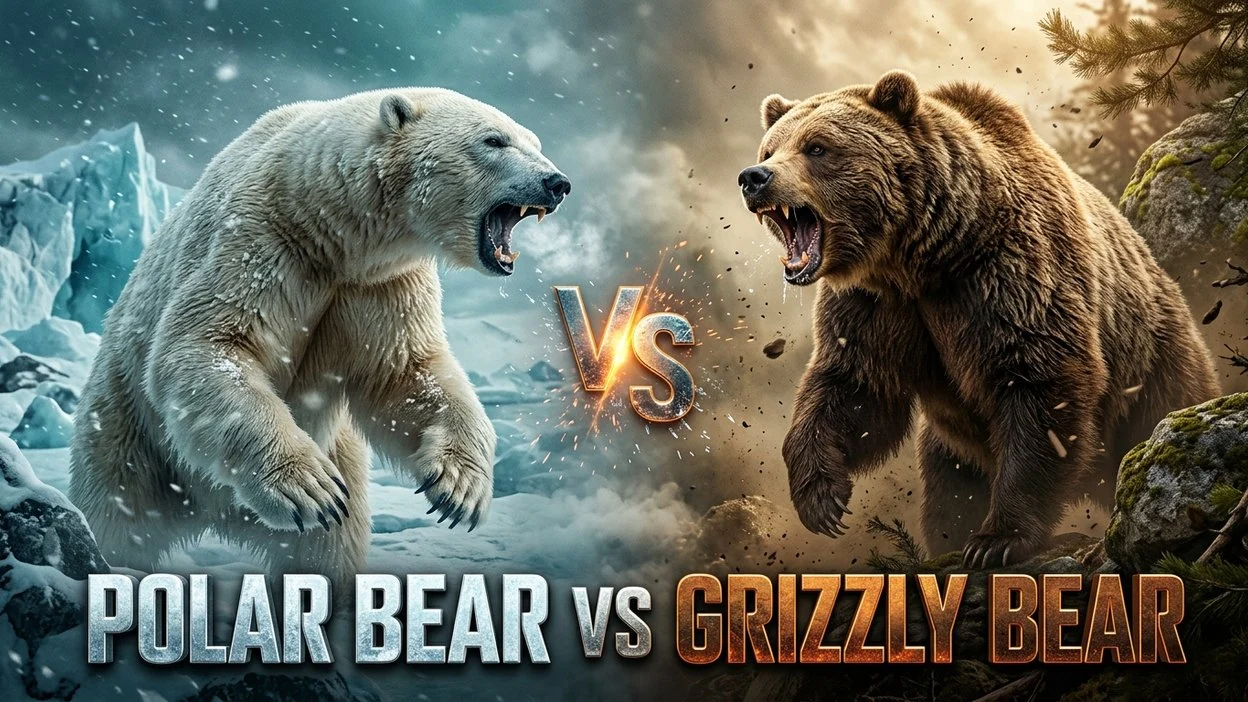
Polar bears and grizzly bears are two powerful wild animals, but they live in different environments and have different physical features, diets, and behaviors. When comparing a polar bear vs grizzly bear, the most noticeable differences are their fur color, body shape, habitat, and hunting methods. Polar bears usually have creamy-white fur and live in the Arctic, while grizzly bears have brown fur and mainly live in forests, mountains, and other areas of North America.
Both animals belong to the bear family, Ursidae, and are closely related. However, they have adapted to different living conditions. Polar bears are excellent swimmers that depend heavily on sea ice to hunt seals. Grizzly bears are highly adaptable animals that eat plants, insects, fish, and other available foods. Understanding these differences helps students and general readers identify each bear and learn how wildlife adapts to its environment.
Quick Answer: Polar Bear vs Grizzly Bear
A polar bear is a large, mostly carnivorous bear adapted to the Arctic, with pale fur, a long neck, and broad paws for swimming and walking on ice. A grizzly bear is a brown bear found in parts of North America, with a shoulder hump, powerful forelimbs, and a varied diet. Both are strong wild animals.
Why Do People Confuse Polar Bears and Grizzly Bears?
People often compare polar bears and grizzly bears because both are large mammals with thick fur, strong jaws, sharp claws, and powerful bodies. They also belong to the same biological family.
However, several important differences make them easier to recognize.
- Color: Polar bears have white or cream-colored fur, while grizzly bears usually have brown, grayish-brown, or golden-brown fur.
- Habitat: Polar bears live mainly in Arctic regions, while grizzly bears occupy a range of habitats in North America.
- Body shape: Polar bears have a long neck and a more streamlined body. Grizzly bears have a prominent shoulder hump.
- Diet: Polar bears depend heavily on seals, while grizzly bears eat a wide variety of foods.
- Lifestyle: Polar bears are closely associated with sea ice, while grizzly bears often spend the warmer months feeding and building fat reserves before winter.
These similarities and differences explain why the two animals are often discussed together.
First Word: Polar Bear
A polar bear is a large bear species scientifically known as Ursus maritimus. Its name refers to its association with the polar regions, especially the Arctic.
What Is a Polar Bear?
Polar bears are marine mammals because they depend on the ocean for much of their food and spend considerable time swimming. They are specially adapted to cold conditions.
Their main characteristics include:
- White-looking fur that helps them blend into snowy surroundings.
- Black skin beneath their fur, which absorbs sunlight.
- A thick layer of body fat that helps keep them warm.
- Broad paws that help them swim and distribute their weight on snow and ice.
- A diet based mainly on seals, especially ringed and bearded seals.
Polar bears are found across Arctic regions, including parts of Canada, Alaska, Greenland, Russia, and Norway’s Svalbard archipelago.
Example Sentence
“The polar bear swam through the icy water in search of seals.”
This sentence describes the polar bear’s natural habitat and its hunting behavior.
Second Word: Grizzly Bear
A grizzly bear is a North American form of the brown bear, scientifically known as Ursus arctos. The name commonly refers to brown bears living in inland parts of North America.
What Is a Grizzly Bear?
Grizzly bears are adaptable mammals that can live in forests, mountain ranges, meadows, and tundra. Their appearance and diet can vary depending on where they live.
Their main characteristics include:
- Brown fur that may appear blond, reddish, dark brown, or grayish.
- A prominent muscular hump over the shoulders.
- Long front claws that help them dig for roots, insects, and small animals.
- Strong jaws and teeth for eating different types of food.
- A varied diet that may include berries, grasses, roots, insects, fish, and mammals.
Grizzly bears are found in parts of Alaska, western Canada, and the northwestern United States.
Example Sentence
“The grizzly bear searched the forest floor for berries and insects.”
This sentence illustrates the grizzly bear’s ability to find different kinds of food.
Polar Bear vs Grizzly Bear: Comparison Table
| Feature | Polar Bear | Grizzly Bear |
| Scientific name | Ursus maritimus | Ursus arctos |
| Animal family | Ursidae | Ursidae |
| Typical fur color | White or cream | Brown, blond, or grayish-brown |
| Main habitat | Arctic coastal areas and sea ice | Forests, mountains, meadows, and tundra |
| Geographic range | Arctic regions | Parts of North America |
| Main food | Seals | Plants, insects, fish, and animals |
| Body shape | Longer neck and streamlined body | Prominent shoulder hump |
| Paws | Broad, adapted for swimming and ice | Strong paws with long claws for digging |
| Swimming | Excellent swimmer | Can swim well |
| Winter behavior | Does not generally hibernate; pregnant females den | Many populations enter winter dens |
| Main hunting strategy | Often hunts seals near breathing holes and ice edges | Uses varied feeding and hunting methods |
| Relationship | Distinct bear species | North American form of the brown bear |
When Should You Use Each Term?
Use polar bear when talking about the white-looking bear that lives in the Arctic and relies heavily on sea ice to hunt seals.
Examples:
- “The polar bear is adapted to life in the Arctic.”
- “Polar bears depend on sea ice to reach important hunting areas.”
Use grizzly bear when referring to the North American brown bear commonly associated with inland forests, mountains, and open landscapes.
Examples:
- “The grizzly bear dug for roots and insects.”
- “Hikers in grizzly bear country should follow local wildlife safety guidance.”
The terms are not interchangeable because they refer to different kinds of bears with different ecological adaptations.
12 Examples of Polar Bear vs Grizzly Bear in Sentences
These examples show how to use the two terms naturally in English.
- Polar bear: The polar bear searched for seals on the sea ice.
- Grizzly bear: A grizzly bear walked through the mountain valley.
- Habitat: Polar bears live in Arctic regions, while grizzly bears inhabit parts of North America farther south as well.
- Appearance: The polar bear had pale fur, while the grizzly bear had dark brown fur.
- Diet: A polar bear hunted seals, whereas a grizzly bear ate berries and insects.
- Swimming: The polar bear swam across a stretch of icy water.
- Digging: The grizzly bear used its powerful front claws to dig for food.
- Wildlife research: Researchers studied how polar bears find food as Arctic sea ice changes.
- Animal comparison: The class compared the polar bear’s long neck with the grizzly bear’s shoulder hump.
- Winter: A pregnant polar bear entered a maternity den, while many grizzly bears spent winter in dens.
- Conservation: Protecting Arctic sea ice is important for polar bear survival.
- Safety: The hikers followed local guidance about avoiding encounters with grizzly bears.
Common Mistakes When Comparing Polar Bears and Grizzly Bears
1. Assuming Every Brown Bear Is a Grizzly
Not every brown bear is a grizzly bear. The grizzly is a form of brown bear found in North America. Brown bears also include populations in other regions, such as coastal Alaska.
2. Thinking Polar Bears Have White Skin
Polar bears have black skin beneath their fur. Their individual hairs are translucent and scatter visible light, which makes the coat appear white.
3. Believing Grizzly Bears Only Eat Meat
Grizzly bears are omnivores. They eat both plant and animal foods, and plant material can make up a large part of their diet in many areas.
4. Assuming Polar Bears Always Live on Land
Polar bears are strongly associated with sea ice and marine environments. They may travel over land, but sea ice provides important access to their main prey.
5. Believing One Bear Is Always Larger
Polar bears are generally among the largest living bear species, but size varies by sex, age, season, and population. Large brown bears can overlap in size with polar bears, so it is inaccurate to claim that every polar bear is bigger than every grizzly.
6. Treating Their Names as Interchangeable
“Polar bear” and “grizzly bear” describe different animals. Using the correct name makes writing clearer and more accurate.
Memory Trick: How to Remember the Difference
Use this simple memory trick:
- Polar = Pole: Think of the Arctic, sea ice, and pale fur.
- Grizzly = Ground and Grub: Think of mountains, forests, digging, berries, and insects.
Picture a polar bear hunting on Arctic sea ice and a grizzly bear searching for food in a forest. These two images make the main differences easier to remember.
American vs British English
The terms polar bear and grizzly bear have the same spelling and meaning in American and British English. There is no standard British alternative for either name.
However, the word grizzly is more closely associated with North American wildlife because grizzly bears are native to parts of North America.
Examples:
- American English: “We learned about grizzly bears in science class.”
- British English: “We learned about grizzly bears in science class.”
- Both varieties: “Polar bears depend heavily on Arctic sea ice.”
The main difference is regional familiarity, not spelling or grammar.
Similar Words and Related Terms
Understanding related bear names can help you describe wildlife more accurately.
- Brown bear: A species, Ursus arctos, that includes grizzly bears and other brown bear populations.
- Black bear: An American bear species, Ursus americanus, found in many forested parts of North America. Despite its name, it can have brown or other color variations.
- Kodiak bear: A large brown bear population native to Alaska’s Kodiak Archipelago.
- Arctic: The region around the North Pole, where polar bears live.
- Omnivore: An animal that eats both plant and animal foods.
- Carnivore: An animal that eats other animals; polar bears are highly specialized carnivores.
- Habitat: The natural environment where an animal lives.
- Hibernation: A period of reduced activity and altered body functions during unfavorable conditions. Bear winter dormancy is not identical to the deep hibernation seen in some smaller mammals.
These terms are useful when reading about animal behavior, wildlife conservation, and natural habitats.
Final Verdict: Polar Bear vs Grizzly Bear
Polar bears and grizzly bears are closely related, but they are adapted to different environments.
The polar bear is a specialized Arctic hunter that depends heavily on seals and sea ice. The grizzly bear is a highly adaptable North American brown bear that eats a wide variety of plant and animal foods.
Their fur color, body shape, habitat, and feeding habits are useful clues for identifying them. Although their size and strength can overlap, neither animal should be considered harmless. Both are powerful wild predators that require respect and distance.
FAQs:
1. Which is bigger, a polar bear or a grizzly bear?
Polar bears are generally among the largest living bears, and adult males often weigh more than typical grizzly bears. However, exceptionally large brown bears can overlap in size with polar bears, so the answer depends on the individuals being compared.
2. Who would win in a fight, a polar bear or a grizzly bear?
There is no reliable universal answer. The outcome would depend on the bears’ size, age, health, circumstances, and behavior. Both have powerful bodies, strong jaws, and sharp claws, and neither should automatically be considered the winner.
3. Do polar bears and grizzly bears live in the same place?
Their ranges are mostly different, but they can overlap in parts of northern Canada and Alaska. Polar bears favor Arctic marine environments, while grizzly bears occupy a broader range of inland habitats.
4. Can polar bears and grizzly bears mate?
Yes. Polar bears and grizzly bears are closely related enough to produce hybrid offspring. These hybrids are sometimes called pizzly bears or grolar bears. Confirmed wild cases have been documented in northern Canada.
5. What is the main difference between a polar bear and a grizzly bear?
The main difference is their adaptation to the environment. Polar bears are specialized for Arctic marine life and seal hunting, while grizzly bears are more generalist feeders that live in a wider variety of habitats.
6. Are polar bears more dangerous than grizzly bears?
Neither species can be labeled universally more dangerous. Risk depends on the circumstances, the animal’s behavior, and the distance between the bear and people. Both can cause fatal injuries, so people should follow local wildlife safety advice.
7. What do polar bears and grizzly bears eat?
Polar bears mainly eat seals, although they may eat other foods when available. Grizzly bears eat a broader diet that can include grasses, roots, berries, insects, fish, and mammals.
8. Why do polar bears have white fur while grizzly bears have brown fur?
Polar bear fur appears white because its translucent hairs scatter visible light. This appearance helps the bear blend into snowy and icy surroundings. Grizzly fur contains pigments that produce different shades of brown, blond, or grayish-brown.
Remember This
- Polar bear: Arctic habitat, pale fur, sea ice, and seal hunting.
- Grizzly bear: North American brown bear, shoulder hump, strong digging claws, and a varied diet.
- Both: Large mammals in the bear family, powerful animals, and capable swimmers.
The easiest way to remember the difference is to connect the polar bear with Arctic ice and the grizzly bear with forests and mountains.
Conclusion:
The comparison between a polar bear and a grizzly bear reveals how animals adapt to their environments. Polar bears have features that help them survive in the Arctic and hunt marine prey, while grizzly bears have flexible feeding habits that allow them to live in many different landscapes. Their appearance, diet, and habitat offer clear clues to their differences.
Learning about these bears also helps us understand wildlife diversity and conservation. Polar bears face challenges linked to the loss of sea ice, while grizzly bears need suitable habitats and safe access to food. By understanding their unique characteristics, students and readers can identify each species more accurately and appreciate the important role both animals play in nature.

Hadley Price creates heartfelt contemporary fiction exploring relationships, hope, resilience, and personal growth. Her emotionally rich storytelling connects with readers through memorable characters and inspiring life experiences worldwide.