
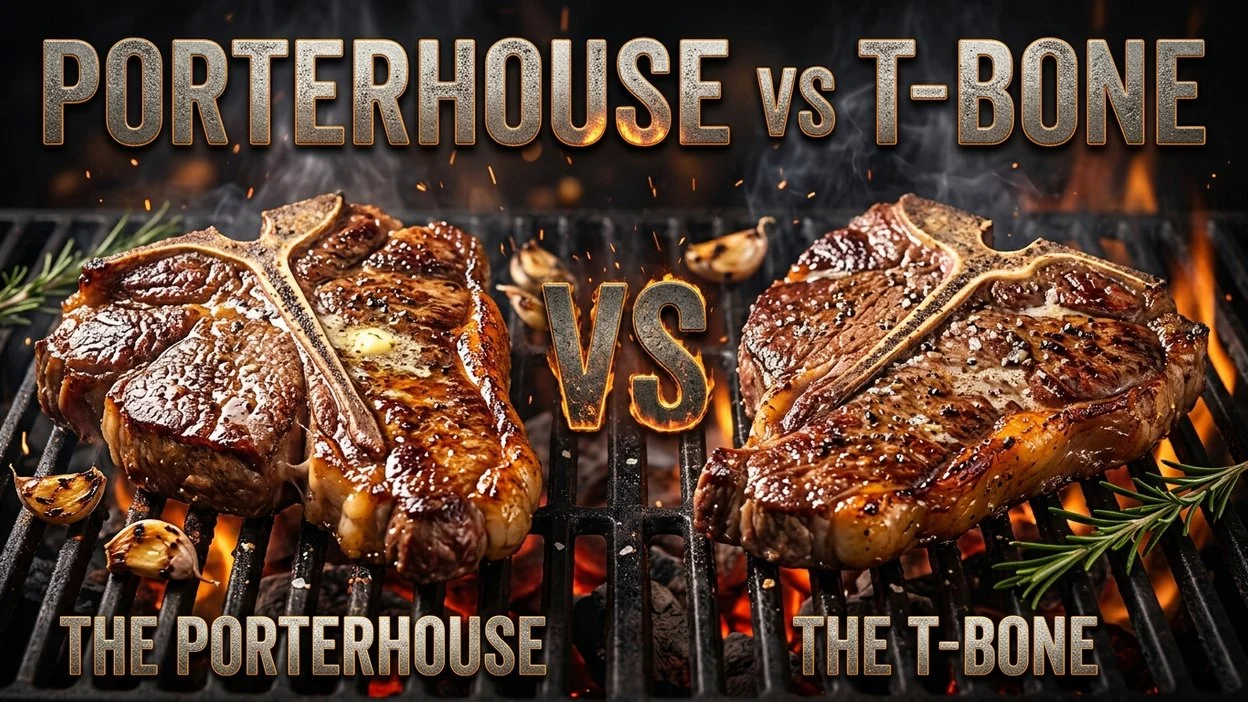
When comparing porterhouse vs T-bone, the main difference is the size of the tenderloin, the soft, tender piece of meat on one side of the bone. Both steaks come from the short loin of a cow and contain two cuts of beef separated by a T-shaped bone. However, a porterhouse has a larger tenderloin section, while a T-bone has a smaller one. This difference affects the amount of tender meat you get, the overall size of the steak, and sometimes its price.
Understanding the difference between these two popular steaks helps you choose the right cut for your meal. Whether you are ordering at a steakhouse, shopping at a butcher’s shop, planning a barbecue, or learning English food vocabulary, knowing what makes each steak special is useful. Both cuts offer a combination of tenderloin and strip steak, giving you two different textures and flavors in one serving. Although they look similar, their size, tenderness, and value can vary. Let’s explore how porterhouse and T-bone steaks differ, when to choose each one, and how to remember their key characteristics.
Quick Answer: Porterhouse vs T-Bone
A porterhouse steak and a T-bone steak both contain strip steak and tenderloin separated by a T-shaped bone. The main difference is the tenderloin size: a porterhouse has a larger tenderloin section, while a T-bone has a smaller one. Choose porterhouse for more tenderloin meat or T-bone for a similar steak experience, often at a lower price.
Why Do People Confuse Porterhouse and T-Bone?
People often confuse porterhouse and T-bone steaks because they share several important features.
- Similar appearance: Both have a T-shaped bone running through the middle.
- Same general location: Both come from the short loin, an area along the back of the cow.
- Two types of meat: Each cut includes strip steak on one side and tenderloin on the other.
- Similar cooking methods: Both are excellent for grilling, broiling, and pan-searing.
The most important difference is not the bone’s shape but the amount of tenderloin attached to it.
In the United States, the porterhouse is distinguished from the T-bone by a larger tenderloin section. Under the USDA’s standard for these cuts, the tenderloin must measure at least 1.25 inches across at its widest point for a steak to qualify as a porterhouse. A T-bone has a tenderloin that measures at least 0.5 inches but less than 1.25 inches across.
First Word: What Does Porterhouse Mean?
A porterhouse is a large, bone-in beef steak that contains two popular cuts: strip steak and tenderloin.
The name is commonly used for this particular steak cut in American English. It is especially popular with people who want a generous portion of beef and a substantial piece of tenderloin.
What Makes a Porterhouse Special?
A porterhouse offers several benefits:
- Larger tenderloin: You get more of the soft, delicate-textured meat.
- Two steak experiences: The strip side is beefy and flavorful, while the tenderloin side is especially tender.
- Generous size: Porterhouse steaks are often large enough to share.
- Versatile cooking: They work well on a grill or in a hot pan, followed by oven cooking when needed.
For example, if two people want to share a large steak and enjoy a generous amount of tenderloin, a porterhouse may be the better choice.
Example sentence: We ordered a porterhouse steak to share at the restaurant.
Second Word: What Does T-Bone Mean?
A T-bone is a bone-in beef steak with a T-shaped bone separating the strip steak from a smaller section of tenderloin.
The name comes directly from the shape of the bone. It is one of the most recognizable steak cuts because the bone forms a clear letter T.
What Makes a T-Bone Special?
A T-bone offers several advantages:
- Two cuts in one: It combines strip steak and tenderloin.
- Balanced flavor and texture: The strip side provides a robust beef flavor, while the tenderloin side offers a softer bite.
- Often more affordable: T-bone steaks can cost less than comparable porterhouse steaks, although prices depend on size, grade, retailer, and location.
- Good for grilling: The bone-in cut is well suited to high-heat cooking when handled carefully.
For example, someone who enjoys both strip steak and tenderloin but does not need a large portion of tenderloin may prefer a T-bone.
Example sentence: He grilled a T-bone steak for dinner.
Porterhouse vs T-Bone: A Complete Comparison Table
| Feature | Porterhouse | T-Bone |
| Main meaning | A bone-in steak with a larger tenderloin section | A bone-in steak with a smaller tenderloin section |
| Bone shape | T-shaped | T-shaped |
| Beef location | Short loin | Short loin |
| Tenderloin size | At least 1.25 inches across under the U.S. standard | At least 0.5 inches but less than 1.25 inches across under the U.S. standard |
| Strip steak | Yes | Yes |
| Tenderloin | Yes, larger portion | Yes, smaller portion |
| Typical size | Often larger | Often smaller |
| Flavor | Beefy strip steak plus mild, tender tenderloin | Beefy strip steak plus mild, tender tenderloin |
| Texture | A combination of firm and very tender meat | A combination of firm and very tender meat |
| Price | Often more expensive | Often less expensive |
| Best for | Sharing or enjoying more tenderloin | A satisfying steak with a smaller tenderloin portion |
| Cooking methods | Grilling, broiling, pan-searing | Grilling, broiling, pan-searing |
The exact size, flavor, and price of either steak depend on the individual cut, its quality, thickness, and preparation.
When Should You Use Each Steak?
Choose a porterhouse or T-bone according to your appetite, budget, and preference for tenderloin.
When to Choose Porterhouse
Choose a porterhouse when:
- You want a larger portion of tenderloin.
- You are preparing a special meal.
- You want to share a substantial steak.
- You enjoy comparing two textures in one cut.
- You do not mind paying more for a larger steak.
Practical example: You are celebrating a birthday at a steakhouse and want a large steak to share. A porterhouse is a sensible option.
When to Choose T-Bone
Choose a T-bone when:
- You want both strip steak and tenderloin.
- You prefer a smaller tenderloin portion.
- You want to compare the two textures without ordering a particularly large steak.
- You find a T-bone that offers better value for your budget.
- You are planning a barbecue with several other dishes.
Practical example: You are grilling steak for dinner and want a classic bone-in cut with two different types of meat. A T-bone is a good choice.
12 Examples of Porterhouse and T-Bone in Sentences
These examples show how to use the two steak names naturally in everyday English.
- We ordered a porterhouse steak for our anniversary dinner.
- My father prefers T-bone steak because he enjoys its rich beef flavor.
- The butcher explained that the porterhouse had a larger tenderloin section.
- She cooked a T-bone steak on the barbecue.
- A porterhouse can be a good choice when two people want to share a large steak.
- He compared the price of a porterhouse with the price of a T-bone.
- The restaurant serves porterhouse steaks with roasted potatoes.
- I learned how to cook a T-bone steak without burning the outside.
- The chef placed the porterhouse in a hot pan to brown the surface.
- We bought two T-bone steaks for the weekend cookout.
- Although both cuts have a T-shaped bone, the porterhouse contains more tenderloin.
- If you prefer a smaller portion of tenderloin, a T-bone may suit you better.
Examples in Everyday Conversations
At a restaurant
Customer: What is the difference between a porterhouse and a T-bone?
Waiter: Both contain strip steak and tenderloin, but the porterhouse has a larger tenderloin section.
At a butcher’s shop
Customer: Which cut should I buy for a special dinner?
Butcher: If you want more tenderloin and a larger steak, consider the porterhouse.
While cooking
Friend A: Is that a T-bone steak?
Friend B: Yes. You can see the T-shaped bone separating the two cuts of meat.
Common Mistakes When Comparing Porterhouse and T-Bone
Mistake 1: Thinking They Come From Different Parts of the Cow
Both steaks come from the short loin. The difference is primarily the size of the tenderloin section.
Correct understanding: A porterhouse is not a completely different type of beef; it is a related cut with a larger tenderloin portion.
Mistake 2: Assuming the Porterhouse Always Tastes Better
A larger tenderloin does not automatically make a porterhouse tastier. Taste depends on personal preference, beef quality, seasoning, and cooking method.
Correct understanding: Choose according to the texture and portion size you enjoy.
Mistake 3: Thinking the T-Bone Has No Tenderloin
A T-bone contains tenderloin, too. It simply has a smaller portion than a porterhouse under the U.S. classification.
Correct understanding: Both cuts include tenderloin and strip steak.
Mistake 4: Assuming Every Porterhouse Is More Expensive
Porterhouse steaks are often more expensive because they tend to be larger and contain more tenderloin. However, prices vary between shops, restaurants, and markets.
Correct understanding: Compare the price, weight, and quality before buying.
Mistake 5: Using Porterhouse and T-Bone as Exact Synonyms
The names describe related but distinct steak cuts in American butchery.
Correct understanding: Use porterhouse for the cut with the larger tenderloin and T-bone for the cut with the smaller tenderloin.
Memory Trick: How to Remember Porterhouse vs T-Bone
Use this simple memory trick:
Porterhouse = More tenderloin. T-bone = T-shaped bone.
- Porterhouse: Think of a larger steak with a larger tenderloin section.
- T-bone: Think of the letter T formed by the bone.
Remember that both steaks have the T-shaped bone. The key distinction is the tenderloin size, not whether the bone resembles a T.
American vs British English: Porterhouse and T-Bone
The terms porterhouse and T-bone are strongly associated with American steak terminology, but steak names can vary between countries and butchery traditions.
American English
In the United States, porterhouse steak and T-bone steak describe distinct cuts. The USDA’s tenderloin-size criteria distinguish the two.
Example: I’d like a porterhouse steak with grilled vegetables.
British English
In Britain, people also use T-bone steak, particularly when referring to the recognizable bone-in cut. The term porterhouse may appear on restaurant menus and in specialist butchers’ descriptions, but terminology and cutting practices can differ.
Example: We ordered a T-bone steak at the restaurant.
Is Porterhouse Used Differently in Other Countries?
Yes. In some countries, the term porterhouse may refer to a different cut or be used according to local butchery conventions. For this reason, it is helpful to check the butcher’s description rather than assume that every country follows the American definition.
Similar Words and Related Steak Terms
Understanding related terms makes steak menus and recipes easier to read.
- Tenderloin: A very tender muscle that forms one side of both steaks.
- Strip steak: The beef cut on the other side of the T-shaped bone. It is also known as a New York strip in American usage.
- Bone-in steak: A steak sold with part of the bone attached.
- Ribeye: A steak cut from the rib section of the cow, known for its marbling and rich flavor.
- Sirloin: A group of beef cuts from the rear portion of the animal, with names and exact boundaries varying by butchery system.
- Filet mignon: A tender steak cut from the tenderloin, usually served without the T-shaped bone.
- Steakhouse: A restaurant that specializes in steak and other grilled or roasted meat dishes.
- Marbling: Small streaks of fat within the muscle that can contribute to flavor and juiciness.
These terms are related to steak selection, but they do not all refer to the same cut.
Final Verdict: Which Is Better, Porterhouse or T-Bone?
Neither steak is automatically better. The right choice depends on how much tenderloin you want, how much you plan to eat, and your budget.
- Choose porterhouse if you want more tenderloin, a generous steak, or a cut to share.
- Choose T-bone if you want the same combination of strip steak and tenderloin with a smaller tenderloin portion.
Both can deliver an excellent steak dinner when you select good-quality beef and cook it properly.
FAQs:
1. What is the main difference between porterhouse and T-bone?
The main difference is the size of the tenderloin section. A porterhouse has a larger tenderloin, while a T-bone has a smaller one. Both cuts contain strip steak and a T-shaped bone.
2. Is porterhouse better than T-bone?
Porterhouse is not always better. It is a good choice for people who want more tenderloin, while T-bone is suitable for people who want a smaller tenderloin portion. Taste and value depend on personal preference and the individual steak.
3. Which steak is more tender, porterhouse or T-bone?
Both contain tenderloin, one of the most tender beef cuts. A porterhouse provides a larger portion of this tender meat, but the tenderness of the strip steak and the overall eating experience also depend on the meat’s quality and cooking.
4. Why is porterhouse usually more expensive than T-bone?
Porterhouse steaks are often larger and contain more tenderloin, which can increase their price. However, prices depend on the steak’s weight, beef grade, location, and seller.
5. Do porterhouse and T-bone come from the same part of the cow?
Yes. Both come from the short loin along the back of the cow. Each includes strip steak and tenderloin separated by a T-shaped bone.
6. Can you cook porterhouse and T-bone steaks the same way?
Yes. Both can be grilled, broiled, or pan-seared. Because the bone and two muscle sections can cook at different rates, use a meat thermometer to check the temperature in the thickest part of the meat without touching the bone.
7. How can you tell whether a steak is a porterhouse or a T-bone?
Look at the tenderloin section on one side of the bone. Under the U.S. standard, a porterhouse has a tenderloin at least 1.25 inches across at its widest point. A T-bone has a tenderloin at least 0.5 inches but less than 1.25 inches across.
8. Which steak is better for sharing?
A porterhouse is often better for sharing because it is generally larger and provides more tenderloin. However, the best choice depends on the steak’s actual weight and the number of people eating.
Remember This
- Porterhouse and T-bone both come from the short loin.
- Both contain strip steak, tenderloin, and a T-shaped bone.
- Porterhouse has a larger tenderloin section.
- T-bone has a smaller tenderloin section.
- Porterhouse is often larger and more expensive.
- Neither is automatically better; choose according to your taste, appetite, and budget.
The easiest way to remember the difference is this: porterhouse means more tenderloin, while T-bone describes the familiar shape of the bone shared by both cuts.
Conclusion:
The difference between porterhouse and T-bone steak is simple once you understand the tenderloin. Both cuts offer two types of beef in one steak, combining the flavorful strip steak with the tender texture of the tenderloin. However, a porterhouse has a larger tenderloin section, which makes it a popular choice for people who want a bigger steak or a meal to share.
A T-bone is an excellent alternative if you enjoy the same combination of textures without needing as much tenderloin. When choosing between the two, consider the steak’s size, quality, price, and cooking method. Whether you are ordering at a steakhouse or preparing dinner at home, understanding these differences will help you make a confident choice.

Nova Turner specializes in imaginative science fiction blending futuristic technology, thrilling adventures, and powerful human emotions. Her innovative storytelling inspires curiosity, creativity, and exploration among readers of every age.