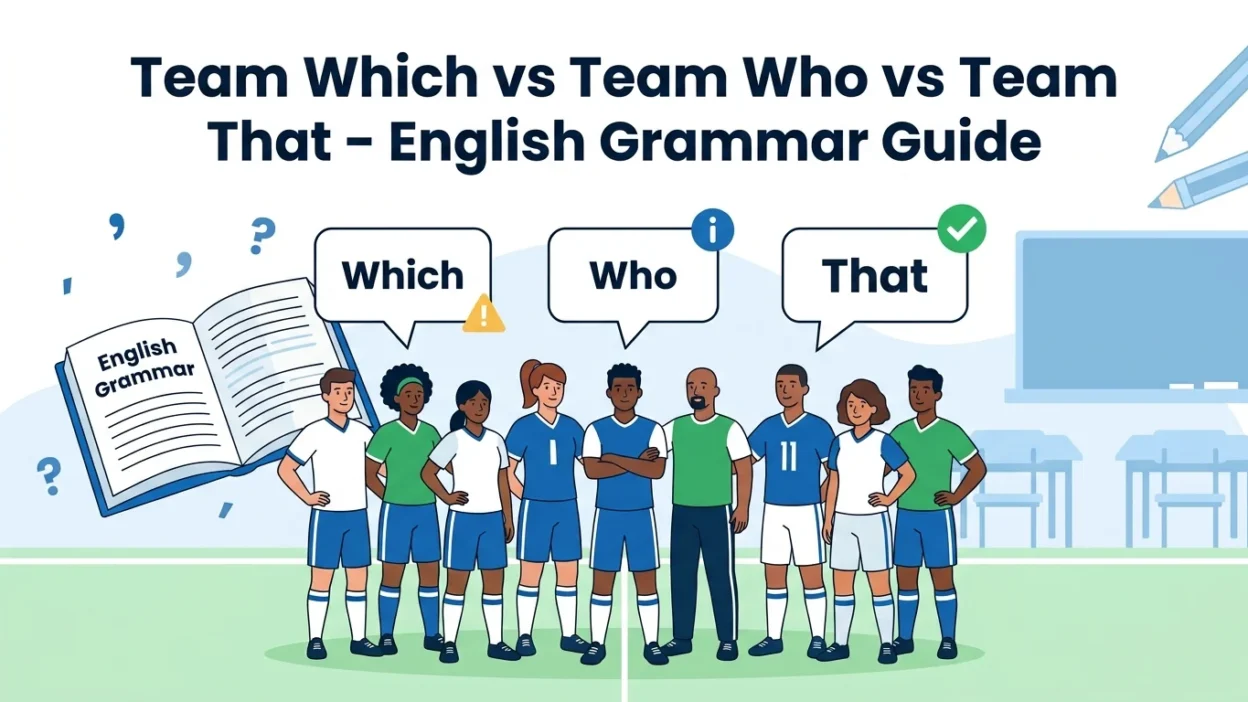
English can be confusing when collective nouns enter the picture. One question that often puzzles learners is whether you should say team which, team who, or team that. Since team refers to a group of people, it may seem logical to use who. However, grammar rules and regional preferences make the answer more interesting.
Understanding the difference helps you write naturally in emails, academic papers, business communication, and everyday conversations. In this guide, you’ll learn exactly when to use which, who, and that after team, along with examples, common mistakes, and memory tricks to make the rule easy to remember.
Quick Answer
Use team that most often in American English because a team is treated as a single unit. Use team who when emphasizing the individual members, especially in British English. Team which is uncommon when referring to sports or work groups and is generally reserved for non human organizations in specific contexts.
Why People Confuse It
The confusion happens because team is a collective noun. A collective noun names a group made up of individual people.
Many learners think:
- A team consists of people, so who should always be correct.
- A team is one unit, so that should always be correct.
- Since a team is technically an organization, maybe which works too.
The truth is that all three can appear in English, but each serves a different purpose and sounds natural in different contexts.
Team That
Team that is the most common and safest choice in modern American English.
Here, the team is viewed as one unit, not as individual members.
Examples
- The team that won the championship celebrated all night.
- We support the team that represents our city.
- The team that developed the software received an award.
- She joined the team that handles customer support.
- The team that scored first eventually won.
This construction is standard in formal writing and everyday American English.
Team Who
Team who focuses on the people within the team rather than the team as a single entity.
It is especially common in British English and in situations where the members’ actions matter more than the group itself.
Examples
- The team who trained every day deserved the victory.
- We thanked the team who organized the event.
- The team who volunteered received certificates.
- The team who worked overnight solved the issue.
- She praised the team who supported the project.
Although acceptable, this form is less common in American English.
Comparison Table
| Phrase | Meaning | Common in American English | Common in British English | Best Use |
| Team that | Team as one unit | ✅ Very common | ✅ Common | Formal and general writing |
| Team who | Individual members | ⚠ Less common | ✅ Very common | When emphasizing people |
| Team which | Team treated as an organization or thing | ❌ Rare | ⚠ Occasionally | Limited, formal, or non-person emphasis |
When to Use Each
Choose team that when:
- Referring to the group as one entity
- Writing in American English
- Using formal or academic English
- Describing achievements or characteristics of the team
Choose team who when:
- Highlighting the members
- Writing in British English
- Talking about individual actions within the group
Choose team which only when:
- Referring to an organization in a highly formal context
- Discussing a team more like an institution than its members
- It fits the style guide you’re following
In everyday English, which is rarely the best choice after team.
Examples
Here are more examples showing correct usage.
- The team that finished first earned a trophy.
- The team that designed the bridge won recognition.
- She’s part of the team that manages our website.
- The team who stayed late completed the project.
- The team who helped us deserves appreciation.
- The team who raised the funds exceeded expectations.
- The football team that plays here is undefeated.
- They’re the team who always support one another.
- The research team that discovered the solution published its findings.
- The rescue team who saved the hikers received awards.
- The team that handles payroll will contact you.
- The team which oversees the archive has updated its records. (Formal but less natural than “that.”)
Common Mistakes
Avoid these frequent errors.
Using “which” for every team
❌ The team which won the match.
✅ The team that won the match.
Assuming “who” is always wrong
❌ Never use who after team.
✅ Use who when emphasizing the people, especially in British English.
Mixing singular and plural agreement
❌ The team that are winning.
✅ American English: The team that is winning.
✅ British English: The team who are winning. (When viewed as individuals.)
Memory Trick
Remember this simple rule:
- That = the team as one group
- Who = the people inside the team
- Which = rarely used for people related teams
If you can replace team with group, that will almost always sound natural.
American vs British English
Regional differences matter.
American English
American English usually treats team as singular.
- The team that is playing tonight looks strong.
- The team that won deserves praise.
Using who is possible but much less common.
British English
British English often treats collective nouns as plural when emphasizing members.
- The team who are preparing for the final look confident.
- The team who trained hardest deserved success.
Both that and who are acceptable, depending on the intended meaning.
Similar Words
If you’re learning collective nouns, you may also wonder about:
- Committee that vs committee who
- Family that vs family who
- Government that vs government who
- Staff that vs staff who
- Company that vs company who
- Class that vs class who
- Audience that vs audience who
These follow similar grammar principles, with meaning and regional usage influencing the best choice.
Final Verdict
For most situations, team that is the correct and most natural choice, especially in American English. It treats the team as one unit and works well in both formal and informal writing.
Use team who when your focus is on the individual members, particularly in British English. Reserve team which for limited formal contexts where the team is viewed more as an organization than as the people within it.
Frequently Asked Questions (FAQs)
Is “team who” grammatically correct?
Yes. It is grammatically correct when emphasizing the people in the team and is especially common in British English.
Is “team that” more common?
Yes. Team that is the standard choice in American English and is widely accepted in formal writing.
Is “team which” wrong?
Not necessarily, but it sounds less natural when referring to sports teams or groups of people. That is usually preferred.
Should a team be singular or plural?
In American English, a team is generally singular. In British English, it may be singular or plural depending on whether the team is viewed as a unit or as individuals.
Can I use “who” after any collective noun?
Sometimes. Collective nouns like family, committee, and team can take who when emphasizing the members.
Which version should English learners use?
If you’re unsure, choose team that. It is the safest and most widely accepted option across most writing contexts.
Conclusion
Choosing between team which, team who, and team that becomes much easier once you understand how collective nouns work. In most cases, team that is the preferred choice because it treats the team as a single unit. It’s the standard option in American English and fits almost every writing situation.
However, team who is equally valid when your focus is on the people who make up the team, especially in British English. While team which is grammatically possible, it is uncommon for people related teams and is generally best avoided in everyday writing. Mastering this distinction will make your English sound more natural, accurate, and professional.
Remember This
Use “team that” for the group, “team who” for the people, and avoid “team which” unless referring to a team as an organization in a rare formal context.

Hadley Price creates heartfelt contemporary fiction exploring relationships, hope, resilience, and personal growth. Her emotionally rich storytelling connects with readers through memorable characters and inspiring life experiences worldwide.