Have you ever stopped while writing a sentence and wondered whether you should say interested in or interested on? It is a common question for English learners because many languages use different prepositions with similar expressions. Even fluent speakers sometimes pause to double check the correct choice.
The good news is that this grammar rule is simple once you understand it. In most situations, English uses interested in, while interested on is almost never correct. Learning this small difference will make your speaking and writing sound much more natural. This guide explains the rule in simple English, shows real life examples, points out common mistakes, and helps you remember the correct phrase with an easy trick.
Quick Answer
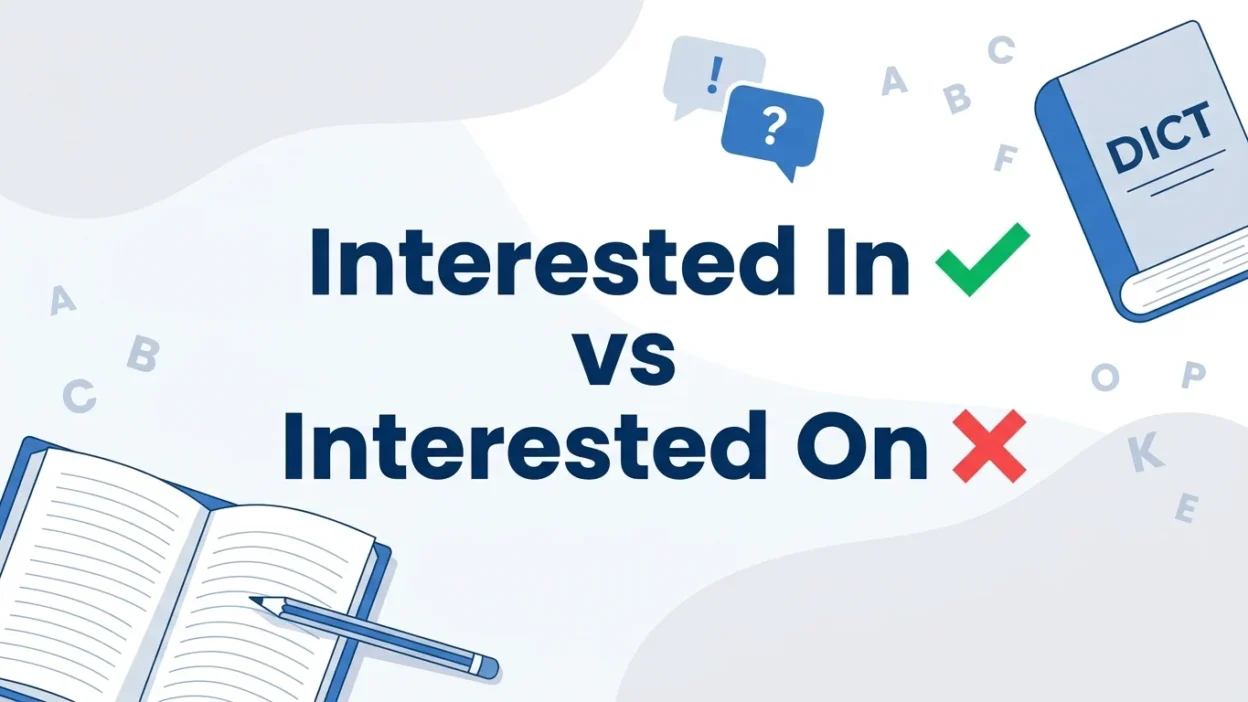
Interested in is the correct and natural English phrase. It means you like, enjoy, want to learn about, or want to take part in something. Interested on is not standard English and is usually considered a grammar mistake. In almost every situation, choose interested in.
Why People Confuse It
Many English learners confuse these phrases because prepositions change from one language to another. In some languages, the equivalent of “on” is used after words that describe interest.
Another reason is that English uses different prepositions with similar expressions, such as:
- Focus on
- Depend on
- Work on
- Interested in
Because these expressions look similar, learners sometimes replace in with on by mistake.
Interested In
Interested in is the correct expression.
It means:
- Wanting to know more about something
- Liking a subject or activity
- Wanting to participate
- Paying attention to something
Examples
- I am interested in science.
- She is interested in learning Spanish.
- They are interested in buying a new house.
- Are you interested in photography?
- He became interested in history after visiting a museum.
This phrase works with:
- Nouns
- Pronouns
- Activities
- Subjects
- People
- Ideas
Interested On
Interested on is generally incorrect in standard English.
Native English speakers rarely use this phrase. If you write or say it, it will usually sound unnatural.
Incorrect Examples
- I am interested on music.
- She is interested on the project.
- We are interested on your offer.
Correct Versions
- I am interested in music.
- She is interested in the project.
- We are interested in your offer.
Comparison Table
| Feature | Interested In | Interested On |
| Grammatically correct | ✅ Yes | ❌ No |
| Common in everyday English | ✅ Yes | ❌ No |
| Used by native speakers | ✅ Very often | ❌ Almost never |
| Suitable for writing | ✅ Yes | ❌ No |
| Suitable for speaking | ✅ Yes | ❌ No |
When to Use Each
Use Interested In when:
- Talking about hobbies
- Discussing school subjects
- Mentioning careers
- Talking about books or movies
- Describing interests
- Showing curiosity
- Explaining what you want to learn
Examples:
- I’m interested in cooking.
- She’s interested in medicine.
- They’re interested in traveling.
- Are you interested in this course?
Use Interested On
There are almost no situations where this phrase is correct in modern English.
If you are talking about your interests, always use interested in.
Examples
Here are everyday examples:
- I am interested in art.
- She is interested in joining the club.
- We’re interested in your proposal.
- Are you interested in football?
- He’s interested in computer programming.
- My sister is interested in fashion.
- They became interested in gardening.
- I’m interested in reading mystery novels.
- She’s interested in environmental science.
- Many students are interested in studying abroad.
- He isn’t interested in politics.
- Are they interested in volunteering?
Common Mistakes
People often make these mistakes:
- ❌ Interested on sports
- ✅ Interested in sports
- ❌ Interested on your idea
- ✅ Interested in your idea
- ❌ Interested on learning English
- ✅ Interested in learning English
- ❌ Interested on this topic
- ✅ Interested in this topic
Memory Trick
Remember this simple sentence:
You are “inside” your interests, so use IN.
Think of your interests as a box. If something is inside that box, you are interested in it.
This easy picture can help you remember the correct preposition every time.
American vs British English
There is no difference between American English and British English for this expression.
Both varieties use:
- Interested in ✅
Neither variety normally uses:
- Interested on ❌
Whether you are writing for an American or British audience, interested in is the correct choice.
Similar Words
These expressions also use in:
- Believe in
- Participate in
- Succeed in
- Specialize in
- Engage in
- Invest in
- Take part in
- Involved in
These expressions use on instead:
- Focus on
- Work on
- Depend on
- Base on (usually “based on”)
- Decide on
Learning these common patterns helps improve your grammar naturally.
Final Verdict
If you are choosing between interested in and interested on, the answer is simple.
Always use interested in when talking about something you like, want to learn, enjoy, or care about.
Interested on is not considered standard English and should be avoided in almost every situation.
Frequently Asked Questions
1. Is “interested on” grammatically correct?
No. Standard English uses interested in.
2. Why do people say “interested on”?
Usually because they translate directly from another language or confuse it with phrases like “focus on.”
3. Can native English speakers say “interested on”?
It is extremely uncommon and generally considered incorrect.
4. Should I write “interested in learning”?
Yes. This is the correct expression.
Example: I’m interested in learning French.
5. Is “interested in” formal or informal?
It works in both formal and informal English.
6. Is this rule the same in American and British English?
Yes. Both use interested in.
7. What comes after “interested in”?
You can use:
- A noun
- A pronoun
- A subject
- A hobby
- A verb ending in -ing
Example: She’s interested in becoming a teacher.
Remember This
If you like something, want to know more about it, or want to take part in it, always say “interested in.” Avoid “interested on” because it is not standard English.
Conclusion
The difference between interested in and interested on is much easier than many learners expect. English almost always pairs the adjective interested with the preposition in. Whether you are talking about hobbies, careers, studies, people, or ideas, interested in is the natural and grammatically correct choice.
The best way to remember this rule is through practice. Read English articles, listen to native speakers, and make your own example sentences using interested in. With a little repetition, choosing the correct phrase will soon become automatic, helping your English sound more accurate and confident.

Willow Evans writes uplifting fantasy stories filled with magical worlds, courageous heroes, and meaningful life lessons. Her imaginative books encourage creativity, kindness, and hope in readers of all ages.