
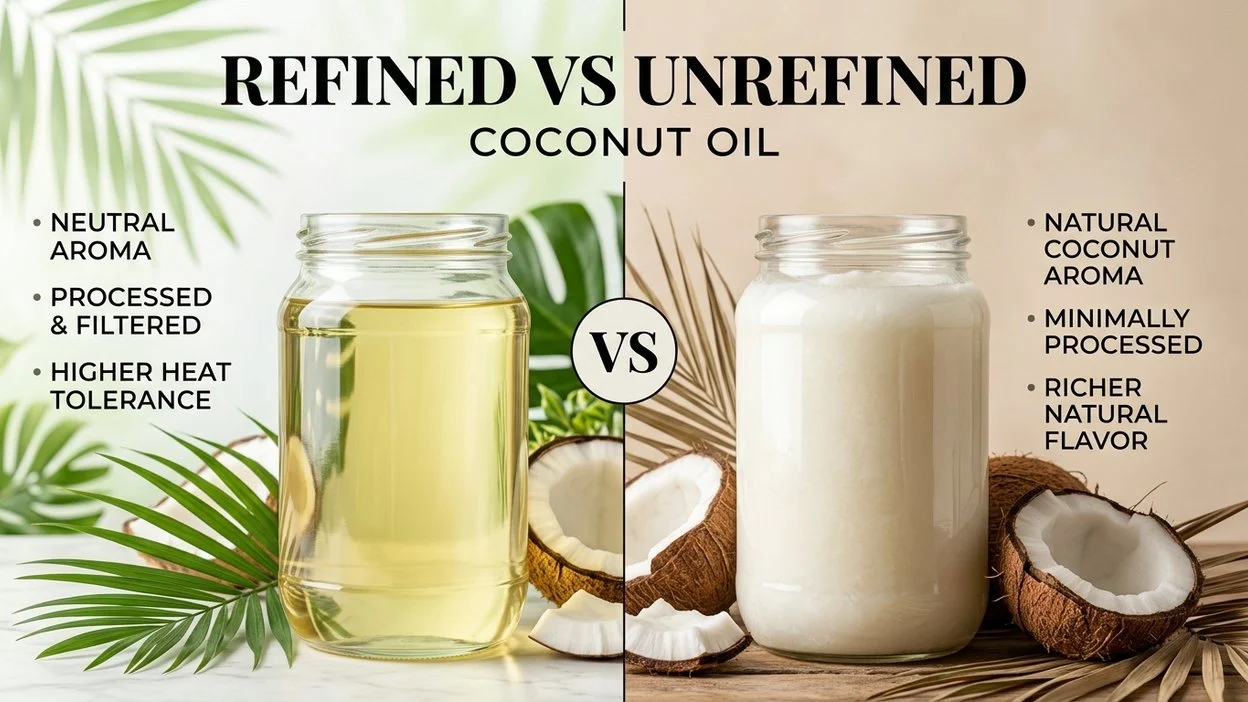
Coconut oil is a popular cooking ingredient used in kitchens, skincare routines, hair care, and homemade beauty products. However, when shopping for coconut oil, you may notice two common types: refined coconut oil and unrefined coconut oil. Although both come from coconut meat, they differ in processing, flavor, smell, and typical uses. Understanding these differences can help you choose the right oil for your needs.
The main difference between refined and unrefined coconut oil is how each oil is processed. Refined coconut oil is treated to remove impurities and usually has a neutral smell and taste. Unrefined coconut oil undergoes less processing and retains more of its natural coconut aroma and flavor. Neither type is automatically the best choice for every situation. Your decision depends on what you plan to cook, whether you enjoy coconut flavor, and how you intend to use the oil. This guide explains each type in simple English, compares its features, provides practical examples, and answers common questions to help you make an informed choice.
Quick Answer: Refined vs Unrefined Coconut Oil
Refined coconut oil is processed to produce a mild-smelling, neutral-tasting oil that works well for high-heat cooking and recipes that should not taste like coconut. Unrefined coconut oil is less processed and keeps its characteristic coconut aroma and flavor. Both contain a high proportion of saturated fat, so neither should be considered automatically healthier. Choose according to your cooking needs, taste preferences, and intended use.
Why Do People Confuse Refined and Unrefined Coconut Oil?
People often confuse these two types because both are made from coconut meat and have similar physical properties. Both can appear white or pale when solid and become clear when warm.
They also share several characteristics:
- Both contain a high proportion of saturated fat.
- Both can be used in cooking.
- Both may be sold in solid or liquid form depending on temperature.
- Both are commonly used in personal care products.
The confusion usually comes from assuming that less processing always means better nutrition or that refined oil is unhealthy simply because it undergoes additional treatment.
In reality, processing affects flavor, aroma, and certain minor components. It does not eliminate the need to consider the oil’s overall nutritional profile.
What Is Refined Coconut Oil?
Refined coconut oil is coconut oil that has undergone additional processing to remove impurities, reduce its natural aroma, and create a more neutral flavor.
Commercial production methods vary, but refining may involve filtering, bleaching with suitable refining materials, and deodorizing with heat or steam. In this context, bleaching generally means removing color and impurities; it does not necessarily mean adding household bleach.
Refined coconut oil is often made from dried coconut meat called copra, although the exact starting material and processing methods depend on the manufacturer.
Main Characteristics of Refined Coconut Oil
- Taste: Usually neutral or very mild.
- Smell: Little to no coconut aroma.
- Processing: Undergoes additional refining.
- Cooking: Useful for frying, sautéing, and baking.
- Smoke point: Often higher than that of unrefined coconut oil, although the exact temperature depends on the product.
- Appearance: Usually white when solid and clear when melted.
When Is Refined Coconut Oil Useful?
Refined coconut oil is useful when you want the cooking properties of coconut oil without a strong coconut taste.
For example, you can use it to fry eggs, roast vegetables, or prepare baked goods in which coconut flavor would be distracting. It can also work well in recipes that call for a neutral-tasting fat.
However, refined coconut oil is not automatically suitable for every high-temperature cooking method. Always check the manufacturer’s instructions and consider the oil’s smoke point.
What Is Unrefined Coconut Oil?
Unrefined coconut oil is coconut oil that receives less processing than refined coconut oil. It is commonly labeled virgin or extra-virgin coconut oil, although naming standards and definitions can vary between producers and markets.
It is often extracted from fresh coconut meat using mechanical methods, sometimes with heat and sometimes without it. Cold-pressed coconut oil is produced using a pressing method designed to limit heat during extraction, but the exact process depends on the producer.
Unrefined coconut oil generally retains more of the characteristic aroma and flavor associated with fresh coconut.
Main Characteristics of Unrefined Coconut Oil
- Taste: Noticeably coconut-like.
- Smell: Distinctive coconut aroma.
- Processing: Usually undergoes less refining.
- Cooking: Useful in recipes where coconut flavor is welcome.
- Smoke point: Commonly lower than that of refined coconut oil, though products vary.
- Appearance: Often white when solid and clear when melted.
When Is Unrefined Coconut Oil Useful?
Unrefined coconut oil is a good option when you want coconut flavor to contribute to the finished dish.
For example, it works well in coconut-based curries, homemade granola, tropical smoothies, and some baked goods. It is also popular in personal care products because of its characteristic aroma and texture.
Remember that unrefined does not mean unprocessed. The oil still needs to be extracted and prepared for sale.
Refined vs Unrefined Coconut Oil: Comparison Table
| Feature | Refined coconut oil | Unrefined coconut oil |
| Processing | More extensive refining | Less refining |
| Taste | Neutral or mild | Distinct coconut flavor |
| Smell | Little coconut aroma | Noticeable coconut aroma |
| Starting material | Often dried coconut meat | Often fresh coconut meat |
| Smoke point | Generally higher | Generally lower |
| Best cooking uses | Frying, sautéing, neutral-flavor baking | Coconut-based dishes and flavorful baking |
| Natural minor compounds | Some may be reduced during refining | Often retains more of certain minor compounds |
| Saturated fat | High | High |
| Appearance | White when solid | White when solid |
| Personal care | Used in some skin and hair products | Also used in skin and hair products |
Important: Smoke points, processing methods, and nutritional details vary by product. Neither type is automatically healthier simply because it is refined or unrefined.
When Should You Use Refined or Unrefined Coconut Oil?
The best choice depends on the result you want.
Choose Refined Coconut Oil When:
- You want to cook without adding coconut flavor.
- You are frying or sautéing and need an oil with a suitable smoke point.
- You are baking cakes or muffins with delicate flavors.
- You prefer a neutral-smelling oil.
- You want coconut oil for a recipe that already contains strong spices or other dominant flavors.
Example: If you are preparing chocolate brownies and do not want a coconut aroma, refined coconut oil may be the more suitable option.
Choose Unrefined Coconut Oil When:
- You enjoy the natural flavor and smell of coconut.
- You are preparing coconut-based curries or tropical dishes.
- You are making granola or coconut-flavored baked goods.
- You prefer an oil produced with less refining.
- You want coconut oil with its characteristic aroma for certain personal care applications.
Example: If you are making coconut cookies, unrefined coconut oil can complement the flavor of the other ingredients.
Which Is Better for Health?
Neither refined nor unrefined coconut oil is clearly superior for overall health based on its processing category alone.
Both are high in saturated fat. Regularly replacing unsaturated fats, such as olive or canola oil, with coconut oil may increase LDL cholesterol, often called bad cholesterol. For everyday heart-healthy cooking, oils richer in unsaturated fats are generally preferable.
Unrefined coconut oil may retain more of certain naturally occurring minor compounds, but this does not establish that it provides greater overall health benefits.
12 Examples of Refined vs Unrefined Coconut Oil
These examples show how the two terms apply to everyday cooking and personal care.
- Frying eggs: Refined coconut oil is useful when you do not want the eggs to taste strongly of coconut.
- Making coconut cookies: Unrefined coconut oil can complement the coconut flavor.
- Baking chocolate brownies: Refined coconut oil is a practical choice when a neutral taste is preferred.
- Preparing coconut curry: Unrefined coconut oil can add a pleasant coconut aroma, although either type can work.
- Roasting vegetables: Refined coconut oil is suitable when you want the vegetables’ natural flavors to stand out.
- Making homemade granola: Unrefined coconut oil works well when a coconut note complements the oats, nuts, and dried fruit.
- Cooking pancakes: Refined coconut oil provides a mild taste, while unrefined coconut oil adds a coconut flavor.
- Baking banana bread: Either type can work. Choose refined oil for a neutral result or unrefined oil for a coconut note.
- Preparing vegan desserts: Both types can replace certain solid fats in suitable recipes, depending on the desired flavor and texture.
- Making homemade energy bites: Unrefined coconut oil can complement ingredients such as coconut flakes, dates, and nuts.
- Making body butter: Either type may be used in a suitable formulation, although fragrance, texture, and skin sensitivity matter.
- Applying oil to hair: Both types are used in hair care. Their suitability depends on hair texture, personal preference, and how the product is applied.
These examples are practical suggestions rather than strict rules. You can often substitute one type for the other without changing the amount, but the flavor and cooking performance may differ.
Common Mistakes When Choosing Coconut Oil
1. Assuming Unrefined Always Means Healthier
Less processing does not automatically make a food healthier in every respect. Unrefined coconut oil may retain more of certain minor compounds, but both varieties remain high in saturated fat.
2. Assuming Refined Coconut Oil Contains Harmful Chemicals
Refining methods differ, and properly manufactured refined coconut oil is a food product. The word refined alone does not mean that the oil is unsafe.
3. Thinking Virgin and Unrefined Are Always Identical Labels
Virgin coconut oil is generally a type of less-refined coconut oil, but labeling conventions can differ. Check the manufacturer’s description and processing information rather than relying on one word alone.
4. Believing Every Coconut Oil Has the Same Smoke Point
Smoke point depends on factors such as refining, product quality, and impurities. Check the product label instead of assuming a universal temperature.
5. Thinking Coconut Oil Is a Low-Saturated-Fat Food
Coconut oil contains a high proportion of saturated fat, including lauric acid. Its plant origin does not make it equivalent to oils rich in unsaturated fats.
6. Confusing Solid and Liquid Coconut Oil
Coconut oil can become solid at cooler temperatures and liquid at warmer temperatures. This physical change is normal and does not, by itself, indicate that the oil has spoiled.
Memory Trick: How to Remember the Difference
Use this simple memory trick:
Refined = Reduced flavor.
Refined coconut oil usually has a mild smell and neutral taste because additional processing removes much of its characteristic aroma.
Unrefined = Understandable coconut flavor.
Unrefined coconut oil generally retains more of its familiar coconut smell and taste.
Remember the short version:
- Refined: Mild flavor, more refining.
- Unrefined: Coconut flavor, less refining.
If you remember these two points, you can usually identify which type is more suitable for your recipe.
American vs British English: Is There a Difference?
There is no major American-versus-British English difference in the terms refined coconut oil and unrefined coconut oil. Both expressions are understood in American English and British English.
The spelling and terminology are also the same:
- American English: refined coconut oil
- British English: refined coconut oil
- American English: unrefined coconut oil
- British English: unrefined coconut oil
Some packaging may use terms such as virgin, cold-pressed, or organic. These describe different aspects of a product and should not automatically be treated as synonyms for unrefined.
For example, cold-pressed describes an extraction method, while organic generally refers to production under an applicable organic certification system. Neither term alone tells you every detail about the finished oil.
Similar Words and Related Terms
Understanding these related terms makes it easier to compare coconut oil products.
Virgin Coconut Oil
Virgin coconut oil is generally produced from coconut meat without the extensive refining associated with conventional refined coconut oil. It usually retains a coconut aroma and flavor.
Extra-Virgin Coconut Oil
Some producers use this label for coconut oil marketed as especially minimally processed. However, there is no universally accepted international grading standard that consistently distinguishes extra-virgin coconut oil from virgin coconut oil.
Cold-Pressed Coconut Oil
Cold-pressed coconut oil is extracted using a pressing process intended to limit heat. The term describes the extraction method rather than guaranteeing a particular nutritional profile.
Organic Coconut Oil
Organic coconut oil comes from coconuts produced and processed according to the requirements of an applicable organic certification system. Organic status does not automatically mean the oil is unrefined or healthier.
Fractionated Coconut Oil
Fractionated coconut oil is processed to separate certain fats, producing an oil that remains liquid at ordinary room temperatures. It is commonly used in cosmetics and massage products. It is different from ordinary solid-at-room-temperature coconut oil and should not automatically be substituted for it in cooking.
Hydrogenated Coconut Oil
Hydrogenated coconut oil has undergone a process that changes the structure of some fatty acids to make the fat harder or more stable. Partial hydrogenation can produce trans fats, so the specific product and its labeling matter.
Final Verdict: Which Coconut Oil Should You Choose?
Refined coconut oil is generally the better choice when you want a neutral flavor and an oil suitable for a range of cooking applications. Unrefined coconut oil is generally the better choice when you want a recognizable coconut taste and aroma.
However, neither type is automatically the healthiest option. Both contain substantial amounts of saturated fat, so your overall dietary pattern matters more than choosing between these two processing categories alone.
For most everyday cooking, consider olive oil, canola oil, or other oils rich in unsaturated fats when appropriate. Keep refined and unrefined coconut oil for recipes in which their texture, flavor, or cooking properties are useful.
FAQs:
1. Is refined or unrefined coconut oil better?
Neither is universally better. Refined coconut oil is useful for neutral-flavor cooking, while unrefined coconut oil is suitable when you want a coconut aroma and taste. Both are high in saturated fat, so neither should automatically be considered the healthier choice.
2. Is unrefined coconut oil healthier than refined coconut oil?
Not necessarily. Unrefined coconut oil may retain more of certain minor naturally occurring compounds, but both varieties contain substantial saturated fat. There is not enough reason to assume that unrefined coconut oil is automatically better for overall health.
3. Can I use refined coconut oil instead of unrefined coconut oil?
Yes, in many recipes. You can generally substitute refined coconut oil for unrefined coconut oil in similar amounts. The main difference is flavor: refined oil contributes little coconut taste, while unrefined oil adds a noticeable coconut aroma.
4. Which coconut oil is better for frying?
Refined coconut oil often has a higher smoke point than unrefined coconut oil, making it useful for frying. However, the exact smoke point depends on the product. Choose an oil suitable for your cooking temperature and avoid heating it until it smokes.
5. Is virgin coconut oil the same as unrefined coconut oil?
Virgin coconut oil is generally a type of unrefined or minimally refined coconut oil. The terms are closely related, but labeling practices and production standards vary. Check the manufacturer’s processing information if the distinction matters to you.
6. Does refined coconut oil have no coconut smell?
Refined coconut oil usually has little or no noticeable coconut smell because refining reduces its characteristic aroma. However, the smell can vary slightly depending on the manufacturing process and product.
7. Can I use refined or unrefined coconut oil on my hair and skin?
Both types are used in personal care. Coconut oil can help reduce protein loss from hair under certain conditions, but results vary. On skin, it may help reduce moisture loss, although it can clog pores or irritate some people. Choose a product intended for your use and discontinue it if irritation occurs.
8. Does unrefined coconut oil have a higher smoke point?
Usually, no. Unrefined coconut oil generally has a lower smoke point than refined coconut oil. Nevertheless, the exact temperature varies by product, so the manufacturer’s guidance is more reliable than a single general number.
Remember This
- Refined coconut oil: More processing, milder smell, neutral taste.
- Unrefined coconut oil: Less refining, stronger coconut aroma, more noticeable flavor.
- Best for neutral cooking: Usually refined coconut oil.
- Best for coconut-flavored recipes: Usually unrefined coconut oil.
- Health consideration: Both are high in saturated fat.
The easiest way to decide is to think about the flavor you want and the cooking method you plan to use.
Conclusion:
Refined and unrefined coconut oil come from the same basic source, but their processing makes them different in flavor, aroma, and typical cooking uses. Refined coconut oil is often preferred for frying and baking when a neutral taste is important. Unrefined coconut oil is popular for coconut-based recipes and dishes that benefit from its distinctive flavor.
When choosing between them, consider your recipe, preferred taste, and intended use. Do not assume that less processing automatically means better health. Both oils contain substantial saturated fat, so using them thoughtfully as part of a balanced diet is more important than choosing one type based on its label alone.

Quinn Mitchell is celebrated for historical fiction that combines authentic settings, unforgettable characters, and compelling narratives. His thoughtful writing brings history alive while inspiring curiosity and deeper understanding among readers.