Have you ever typed “payed” and wondered if your spell checker was wrong? You’re not alone. Many English learners and even native speakers mix up paid and payed because both words look like they could be correct. However, in most everyday writing, only one of them is the right choice.
Understanding the difference between paid vs payed is simple once you know the rule. While paid is the standard past tense of the verb pay, payed is a rare word used only in specific nautical contexts. This guide explains the difference in plain English, provides real life examples, highlights common mistakes, and helps you remember which word to use every time.
Quick Answer
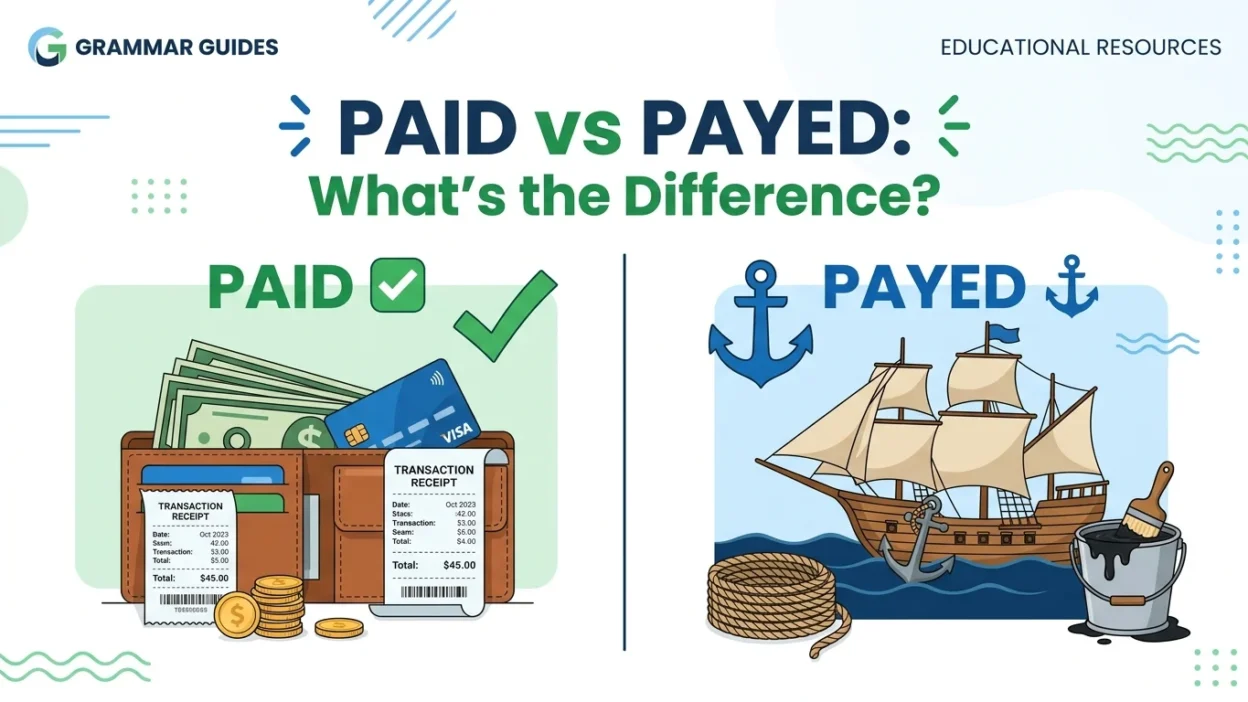
Paid is the correct past tense and past participle of pay in almost every situation, including money, salaries, bills, and attention. Payed is a rare spelling used only in maritime language, where it means to coat a rope or ship with tar or to let out rope. Unless you’re writing about sailing or ships, always use paid.
Why People Confuse It
The confusion between paid and payed happens because English often forms the past tense by adding -ed to verbs.
For example:
- Walk → Walked
- Jump → Jumped
- Play → Played
So, many people naturally assume:
- Pay → Payed ❌
However, pay is an irregular verb, which means it doesn’t follow the usual pattern. Its correct past tense is paid.
Spell checkers may also confuse writers because payed is technically a real word, although it’s extremely uncommon outside maritime writing.
First Word: Paid
Paid is the standard past tense and past participle of the verb pay.
It is used whenever you’re talking about:
- Paying money
- Paying bills
- Receiving wages
- Paying attention
- Paying respect
- Paying a compliment
- Paying for services
Examples
- I paid the electricity bill yesterday.
- She paid for dinner.
- We paid our taxes on time.
- He paid close attention during the meeting.
- They paid the workers every Friday.
Common expressions
- Paid in full
- Paid off
- Paid leave
- Paid vacation
- Paid subscription
- Paid advertisement
Second Word: Payed
Payed is a legitimate English word, but it has a very specialized meaning.
It is mainly used in nautical language to describe:
- Coating ropes or wooden ships with tar or waterproof material.
- Letting a rope, cable, or chain move out gradually.
Examples
- The sailors payed the deck seams with hot tar.
- They carefully payed out the anchor rope.
Outside maritime writing, this spelling is almost never appropriate.
Paid vs Payed Comparison Table
| Feature | Paid | Payed |
| Correct past tense of pay | ✅ Yes | ❌ No |
| Used for money | ✅ Yes | ❌ No |
| Used for salaries | ✅ Yes | ❌ No |
| Used for bills | ✅ Yes | ❌ No |
| Used for attention | ✅ Yes | ❌ No |
| Maritime meaning | ❌ No | ✅ Yes |
| Common in everyday English | ✅ Very common | ❌ Extremely rare |
When to Use Each
Use Paid when talking about:
- Money
- Bills
- Wages
- Shopping
- Tuition fees
- Rent
- Taxes
- Paying attention
- Paying respect
- Paying someone back
Examples:
- I paid my rent.
- She paid the invoice.
- We paid cash.
- They paid us well.
- He paid attention.
Use Payed only when talking about:
- Ships
- Boats
- Rope
- Sailing
- Maritime maintenance
- Nautical equipment
Unless your topic involves ships or sailing, choose paid.
Examples
Here are everyday examples showing the correct usage.
- I paid the phone bill yesterday.
- She paid for everyone’s lunch.
- We paid extra for express delivery.
- He paid attention during class.
- They paid the contractor in advance.
- I finally paid off my loan.
- The company paid bonuses this month.
- She paid him a compliment.
- We paid our respects at the ceremony.
- The sailors payed out the heavy rope slowly.
- The crew payed the seams with waterproof tar.
- He paid the subscription fee online.
Common Mistakes
Here are mistakes many writers make.
❌ I payed the bill yesterday.
✅ I paid the bill yesterday.
❌ She payed attention.
✅ She paid attention.
❌ We payed our employees every Friday.
✅ We paid our employees every Friday.
Remember, if you’re discussing money, services, or attention, paid is always correct.
Memory Trick
A simple way to remember the difference:
Paid = Money, Bills, Attention
Think of the phrase:
“Money gets PAID.”
The spelling payed belongs to ships and ropes—not your paycheck.
American vs British English
Both American English and British English follow the same rule.
In both varieties:
- Paid is the correct past tense of pay.
- Payed appears only in specialized maritime contexts.
There is no regional difference for everyday writing.
Similar Words
English contains several irregular verbs that change spelling instead of simply adding -ed.
| Base Verb | Past Tense |
| Pay | Paid |
| Say | Said |
| Lay | Laid |
| Make | Made |
| Sell | Sold |
| Teach | Taught |
| Think | Thought |
Learning these irregular verbs helps improve both writing and speaking accuracy.
Final Verdict
If you’re writing about money, bills, salaries, shopping, attention, respect, or payments, paid is the only correct spelling.
Reserve payed exclusively for rare nautical situations involving ropes, cables, or waterproofing ships.
When in doubt, choose paid. It is correct in nearly every situation you’ll encounter.
Frequently Asked Questions (FAQs)
Is “payed” ever correct?
Yes. It is correct only in maritime contexts, such as letting out rope or coating ships and ropes with tar.
Which is correct: “paid” or “payed”?
For everyday English, paid is correct.
Why is the past tense of “pay” not “payed”?
Because pay is an irregular verb, its past tense changes to paid instead of following the normal -ed pattern.
Is “I payed the bill” correct?
No. The correct sentence is:
I paid the bill.
Does British English use “payed”?
Only in nautical writing. Everyday British English uses paid, just like American English.
Is “paid attention” correct?
Yes. Paid attention is the correct expression.
What does “payed out a rope” mean?
It means a rope or cable was slowly released or allowed to unwind, usually on a ship.
Remember This
Use “paid” for money, bills, wages, attention, respect, and everyday writing. Use “payed” only when writing about ships, ropes, or other maritime topics. If you’re unsure, “paid” is almost always the correct choice.
Conclusion
The difference between paid vs payed is much easier than it first appears. Although both words exist in English, they serve very different purposes. Paid is the standard past tense of pay and is appropriate in nearly every everyday situation, whether you’re talking about money, work, expenses, or expressions like paid attention.
On the other hand, payed belongs to specialized nautical vocabulary and is rarely encountered outside discussions about ships, ropes, and maritime maintenance. Keeping this distinction in mind will help you avoid one of the most common spelling mistakes in English and make your writing more accurate and professional.

Quinn Mitchell is celebrated for historical fiction that combines authentic settings, unforgettable characters, and compelling narratives. His thoughtful writing brings history alive while inspiring curiosity and deeper understanding among readers.