Choosing between align to and align with can be confusing because both phrases use the same verb align but they don’t always mean the same thing. While many people use them interchangeably in everyday conversation, each expression has its own natural context and preferred usage.
If you’re writing emails, academic papers, business documents, or simply trying to improve your English, understanding this difference will make your writing clearer and more professional. In many cases, native speakers instinctively choose one over the other depending on whether they’re talking about physical positioning, agreement, goals, or ideas.
This guide explains the meanings, differences, examples, and grammar rules in simple English so you’ll know exactly which phrase to use in every situation.
Quick Answer
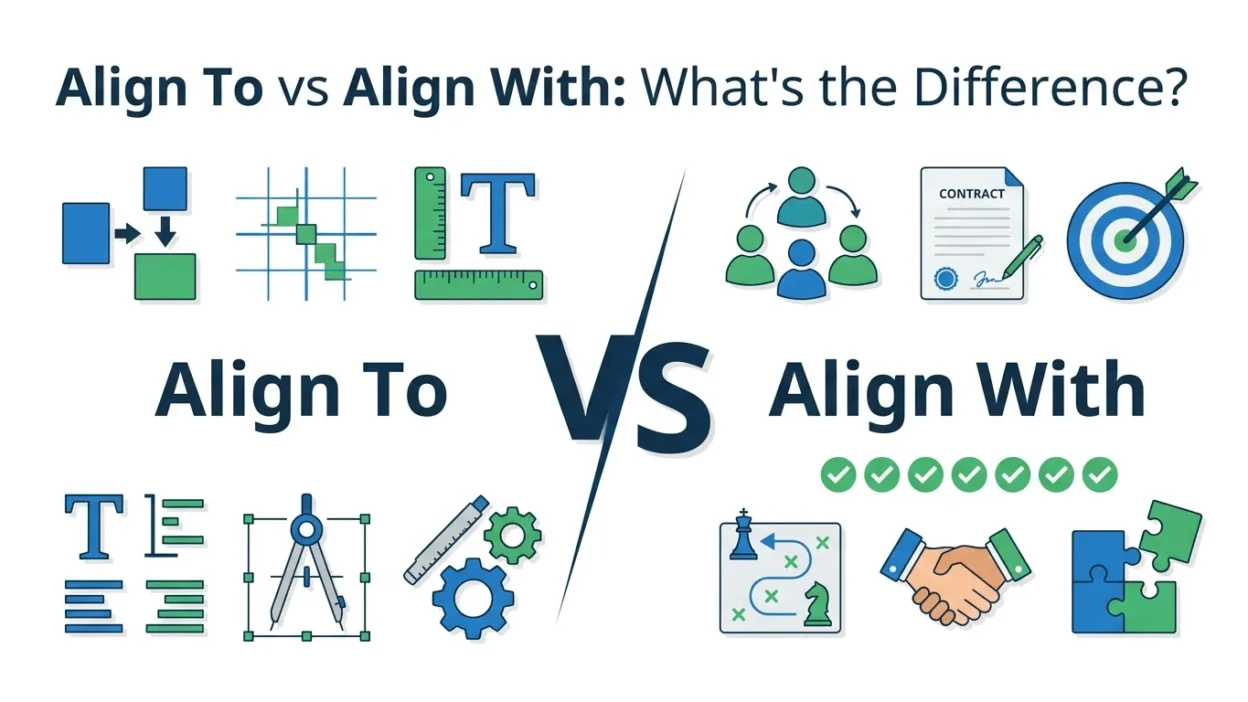
Align to usually means positioning something toward a reference point or standard, especially in technical or physical contexts.
Align with usually means being in agreement, matching, supporting, or corresponding with someone or something. In modern English, align with is far more common when discussing opinions, goals, values, strategies, or ideas.
Why People Confuse It
The confusion comes from the fact that both expressions share the same verb and sometimes appear in similar situations.
For example:
- Align the image to the left.
- Our strategy aligns with company goals.
Both involve the idea of “bringing things into line,” but the object after the preposition changes the meaning.
Another reason is that business writing often overuses both phrases, making them seem interchangeable when they aren’t.
First Word: Align To
Align to generally means to position, adjust, or arrange something according to a specific point, edge, measurement, or standard.
It often appears in:
- Technical writing
- Engineering
- Graphic design
- Manufacturing
- Software documentation
- Formatting instructions
Meaning
To place or adjust something so it matches a reference point or direction.
Examples
- Align the text to the center.
- Please align the shelves to the wall.
- The sensor must align to the reference mark.
- Align the logo to the top margin.
- The wheels should align to the guide rail.
Although “align to” is correct in these contexts, many business writers replace it with align with when discussing goals or strategies.
Second Word: Align With
Align with means to agree, correspond, match, support, or be consistent with something.
This is the preferred expression when discussing:
- Goals
- Values
- Strategies
- Policies
- Beliefs
- Opinions
- Expectations
- Requirements
Meaning
To be in agreement or harmony with someone or something.
Examples
- Our mission aligns with our values.
- Your proposal aligns with company policy.
- His opinion aligns with the research.
- The budget aligns with our priorities.
- Their actions align with their promises.
This is by far the more common expression in modern professional English.
Comparison Table
| Feature | Align To | Align With |
| Main meaning | Position toward a reference | Agree or match |
| Common context | Technical, physical, formatting | Ideas, goals, values, opinions |
| Physical positioning | Yes | Sometimes |
| Agreement | Rare | Yes |
| Business writing | Less common | Very common |
| Natural in everyday English | Limited | Very common |
When to Use Each
Use align to when you are talking about positioning or adjusting something physically.
Examples include:
- Align text to the right.
- Align the camera to the target.
- Align the machine to the calibration mark.
Use align with when discussing agreement or consistency.
Examples include:
- Align with company objectives.
- Align with customer expectations.
- Align with legal requirements.
- Align with industry standards.
- Align with your personal values.
A simple rule is:
- Physical adjustment → Align to
- Agreement or consistency → Align with
Examples
Here are more examples showing both phrases in context.
Align To
- Align the picture to the left edge.
- Align the pipe to the connector.
- The laser aligns to the target.
- Please align the document to the margin.
- The equipment aligns to factory specifications.
Align With
- Our goals align with customer needs.
- This plan aligns with our long term strategy.
- Her beliefs align with mine.
- The new rules align with international standards.
- His comments align with the evidence.
- Your experience aligns with the job requirements.
- Their vision aligns with our mission.
Common Mistakes
Here are mistakes English learners often make.
❌ Our goals align to company values.
✅ Our goals align with company values.
❌ My opinion aligns to yours.
✅ My opinion aligns with yours.
❌ Align your beliefs to mine.
✅ Align your beliefs with mine.
Correct:
✅ Align the image to the center.
This is correct because it refers to physical positioning.
Memory Trick
Remember this simple tip:
To = Toward a position
Think of moving something to a place.
With = Together
If two ideas, people, or goals work together, they align with each other.
This easy association helps you choose the right expression every time.
American vs British English
Both American English and British English recognize align to and align with.
However, in both varieties:
- Align with is much more common in business, education, and everyday writing.
- Align to is mostly used in technical, engineering, design, and formatting contexts.
There is no significant regional difference in meaning. The distinction depends more on context than on dialect.
Similar Words
If you’re looking for alternatives, consider these words depending on your context:
- Match
- Agree with
- Correspond with
- Fit
- Conform to
- Coordinate with
- Support
- Reflect
- Be consistent with
- Harmonize with
Each carries a slightly different nuance, but they often express ideas similar to align with.
Final Verdict
Both align to and align with are correct, but they are not always interchangeable.
Choose align to when referring to physical positioning, formatting, or technical adjustment.
Choose align with when talking about agreement, consistency, goals, values, strategies, opinions, or standards.
If you’re unsure, align with is usually the safer choice in professional and everyday English because it is the more natural expression in most situations.
Frequently Asked Questions
Is “align to” grammatically correct?
Yes. It is grammatically correct, especially when referring to physical positioning, technical adjustments, formatting, or calibration.
Is “align with” more common?
Yes. Align with is much more common in modern English, particularly in business, education, and everyday communication.
Can I use “align to” for goals?
It’s better to use align with. For example:
✔ Our goals align with the company’s mission.
Which phrase sounds more professional?
In most professional writing, align with sounds more natural when discussing plans, strategies, objectives, values, or expectations.
Do native speakers use both?
Yes. Native speakers use both expressions, but they choose them based on context. Align with is far more frequent outside technical fields.
Is “align to” wrong in business writing?
Not necessarily. It is acceptable when discussing technical systems or measurements, but align with is usually preferred for strategies, policies, and objectives.
What’s the easiest way to remember the difference?
Think of align to for moving something to a position, and align with for things working with each other in agreement.
Remember This
- Align to → Position something toward a place, point, or standard.
- Align with → Show agreement, consistency, or harmony with ideas, people, goals, or values.
- When discussing business, education, or relationships, align with is usually the correct and more natural choice.
Conclusion
Understanding the difference between align to and align with is a small grammar improvement that can make a big difference in how natural and professional your English sounds. While both expressions are correct, they serve different purposes depending on whether you’re describing physical positioning or conceptual agreement.
As a practical rule, use align to for technical adjustments and positioning, and use align with for agreement, goals, values, standards, and ideas. Keeping this distinction in mind will help you communicate more clearly and confidently in both spoken and written English.

Hadley Price creates heartfelt contemporary fiction exploring relationships, hope, resilience, and personal growth. Her emotionally rich storytelling connects with readers through memorable characters and inspiring life experiences worldwide.