
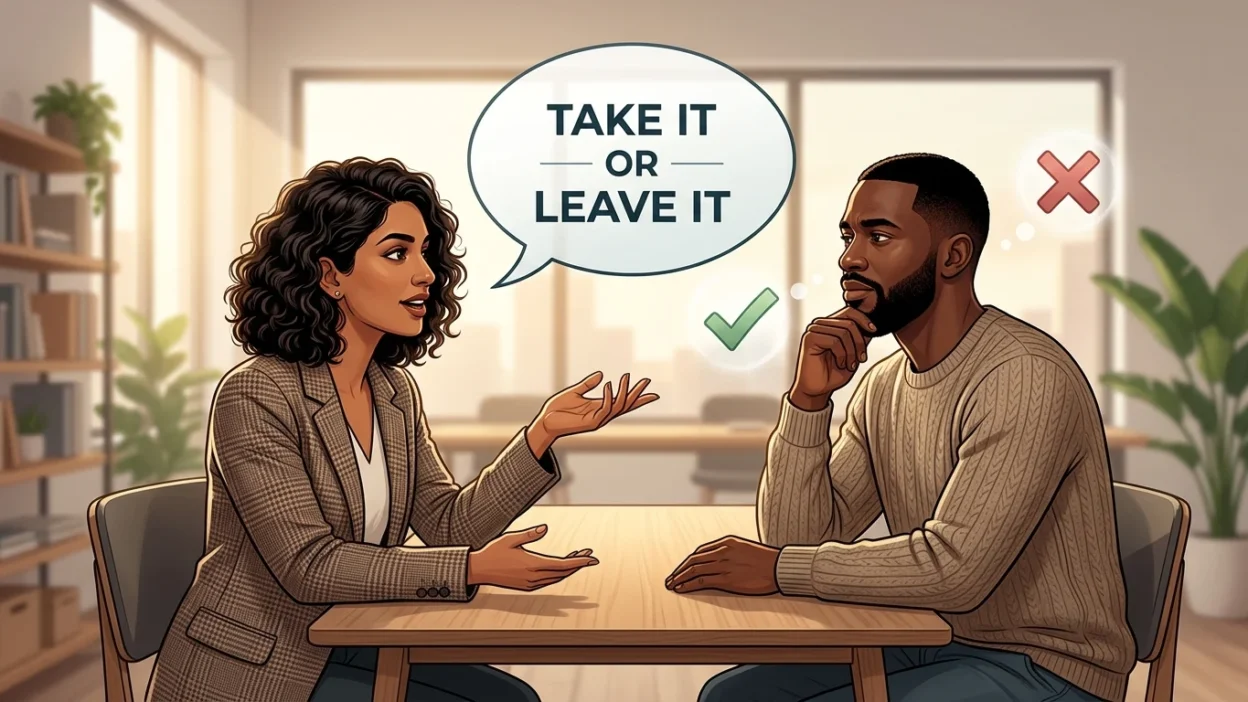
The phrase “take it or leave it” is a common English expression used when someone offers a choice with little or no room for negotiation. It essentially means, “Accept this offer as it is, or reject it.” You may hear it when discussing prices, deals, conditions, invitations, opinions, or proposals. For example, a seller might say, “I’ll sell the bike for $300 take it or leave it.” The speaker is making it clear that the offer is final.
Although “take it or leave it” is easy to understand, learners sometimes wonder whether it sounds rude, informal, or demanding. Its meaning can change slightly depending on the speaker’s tone and situation. In a friendly conversation, it may simply describe a firm choice. In a negotiation, however, it can sound blunt or even confrontational. Understanding its meaning, grammar, and appropriate usage will help you use this idiom naturally and confidently.
Quick Answer
“Take it or leave it” means accept an offer or refuse it; there is little or no possibility of changing the terms. It is commonly used in negotiations, decisions, and situations where someone is presenting a final choice. Depending on tone, it can sound neutral, firm, or slightly rude.
Why People Confuse It
People often misunderstand “take it or leave it” because the literal meanings of take and leave do not explain the idiom completely.
Literally, take it could mean physically taking something, while leave it could mean walking away from it. Together, however, they create a figurative expression meaning accept or reject an offer.
Another reason for confusion is tone. The phrase can be perfectly natural, but it often communicates finality.
For example:
“I can pay you $500 now. Take it or leave it.”
The speaker is not inviting further negotiation. They are saying that $500 is the final offer.
First Word: “Take”
Take is a verb with many meanings in English. In “take it or leave it,” it means accept or agree to something.
Examples:
- “You can take the job if you want.”
- “I offered him $100, but he didn’t take it.”
- “Take it or leave it.”
Here, take it means accept the offer or situation.
The word it refers to whatever is being offered. Depending on context, it could mean a job, price, proposal, deal, invitation, or opportunity.
Second Word: “Leave”
In this expression, leave it means reject it, decline it, or decide not to accept it.
For example:
- “The price is $50. Take it or leave it.”
- “That’s my offer. You can take it or leave it.”
The speaker gives the other person two choices:
- Accept the offer.
- Reject the offer.
There is usually an implied message: “I am not going to change the offer.”
Comparison Table
| Expression | Meaning | Tone | Example |
| Take it or leave it | Accept or reject the offer | Firm | “That’s my final price—take it or leave it.” |
| Take it | Accept something | Neutral | “You can take the job.” |
| Leave it | Reject or abandon something | Neutral | “If you don’t like the deal, leave it.” |
| Accept the offer | Agree to something offered | Formal | “She accepted the offer.” |
| Reject the offer | Refuse something offered | Formal | “He rejected the proposal.” |
| Final offer | No further negotiation | Firm | “This is my final offer.” |
When to Use Each
Use “take it or leave it” when you want to emphasize that an offer or proposal is not negotiable.
Use it when:
- negotiating a price
- making a business offer
- presenting fixed conditions
- giving someone a firm choice
- emphasizing that no changes will be made
Be careful when:
- speaking to customers
- talking to your manager
- communicating in formal situations
- discussing sensitive issues
- speaking with someone you don’t know well
Because of its strong tone, alternatives such as “This is the best I can offer” may sound more polite.
Examples
Here are natural examples of “take it or leave it” in everyday English:
- “I can give you $200 for the table. Take it or leave it.”
- “This is my final offer, so take it or leave it.”
- “The apartment is available for $1,000 a month, take it or leave it.”
- “I don’t have time to negotiate. That’s the price—take it or leave it.”
- “You can join us at seven, but that’s the only time available. Take it or leave it.”
- “I’ll finish the work for $500. Take it or leave it.”
- “That’s the deal. You can take it or leave it.”
- “I offered him a fair salary, but he decided to leave it.”
- “The seller said $750 was the final price—take it or leave it.”
- “You can have the last seat, but you’ll need to decide now. Take it or leave it.”
- “I’m willing to work weekends for an additional $100. Take it or leave it.”
- “This is the only package we have available, so take it or leave it.”
A polite alternative
Instead of:
“Take it or leave it.”
You could say:
“That’s the best offer I can make.”
This communicates the same basic idea without sounding as harsh.
Common Mistakes
1. Taking the phrase literally
Incorrect interpretation: Physically take something or physically leave it.
Correct interpretation: Accept or reject an offer.
2. Assuming it is always rude
The expression is firm, but it is not automatically rude. Tone and context matter.
3. Using it in every negotiation
The phrase can sound aggressive if used unnecessarily. In professional communication, softer wording is often better.
4. Forgetting the implied finality
“Take it or leave it” usually suggests that the terms are final.
5. Confusing it with “take it and leave it”
These expressions are different.
- Take it or leave it = accept it or reject it.
- Take it and leave it = take something and then go away.
Memory Trick
Think:
TAKE = accept
LEAVE = reject
So:
Take it or leave it = Accept it or reject it.
A simple memory sentence is:
“Take the offer, or leave the offer.”
Whenever you hear “take it or leave it,” remember that the speaker is giving you a choice but usually isn’t offering to negotiate further.
American vs British English
“Take it or leave it” is widely understood in both American English and British English.
There is no major difference in its basic meaning. Speakers in both varieties use it when an offer, price, or arrangement is considered final.
However, the expression can sound quite direct in either variety. In formal British or American business communication, speakers may choose softer alternatives such as:
- “That’s the best we can offer.”
- “Those are the terms we’re able to provide.”
- “Unfortunately, we can’t make any further changes.”
Similar Words
Several expressions have a similar meaning to “take it or leave it.”
Accept or reject
A straightforward alternative that works well in formal writing.
Final offer
Used especially during negotiations to show that no further changes are expected.
No room for negotiation
A stronger expression indicating that the terms cannot be changed.
That’s my best offer
A more conversational and often less confrontational alternative.
It’s your choice
A much softer expression that emphasizes personal choice without necessarily implying that the offer is final.
Non negotiable
A formal adjective meaning something cannot be changed through negotiation.
FAQs
What does “take it or leave it” mean?
It means accept an offer as it is or reject it. The expression usually suggests that the person making the offer is unwilling to negotiate further.
Is “take it or leave it” rude?
It can sound rude or blunt depending on the speaker’s tone and situation. It is especially direct in professional or sensitive conversations.
Is “take it or leave it” an idiom?
Yes. It is a common English idiomatic expression meaning accept or reject something without expecting changes to the offer.
What is another way to say “take it or leave it”?
You can say “That’s my final offer,” “That’s the best I can do,” or “Those are the terms.” These alternatives vary in formality and politeness.
Can I use “take it or leave it” in business English?
Yes, but use it carefully. It is grammatically correct, but it can sound overly aggressive. A softer phrase such as “That’s the best offer we can make” may be more appropriate.
What is the opposite of “take it or leave it”?
There is no exact opposite idiom, but “I’m open to negotiation” expresses the opposite idea because it indicates that changes are possible.
Is “take it or leave it” American or British?
It is used in both American and British English and has essentially the same meaning in both varieties.
Final Verdict
“Take it or leave it” is a correct and widely used English expression meaning “accept this offer or reject it.” It is particularly useful when someone wants to make clear that a price, proposal, condition, or arrangement is final.
The most important thing to remember is its tone. The expression is naturally firm and can sometimes sound blunt. Use it confidently in appropriate informal or negotiating situations, but choose a softer alternative when politeness and diplomacy are more important.
Remember This
Take it or leave it = Accept it or reject it.
It usually means: “This is my offer, and I’m not changing it.”

Nova Turner specializes in imaginative science fiction blending futuristic technology, thrilling adventures, and powerful human emotions. Her innovative storytelling inspires curiosity, creativity, and exploration among readers of every age.