English has many word pairs that look or sound similar but have completely different meanings. Savor vs saver is one of them. Although both words are spelled with the letters sav, they belong to different parts of everyday vocabulary. Savor is usually connected with enjoying the taste, smell, or experience of something, while saver refers to a person or thing that saves something from being lost, wasted, or spent. Understanding this distinction can help you avoid spelling mistakes and choose the right word in both casual and formal writing.
The confusion often happens because savor and saver are pronounced similarly in many varieties of English, especially when spoken quickly. However, their meanings are easy to separate once you connect each word with its core idea. In this guide, we’ll explore the definitions, usage, examples, common mistakes, American and British English differences, and a simple memory trick to make the distinction stick.
Quick Answer
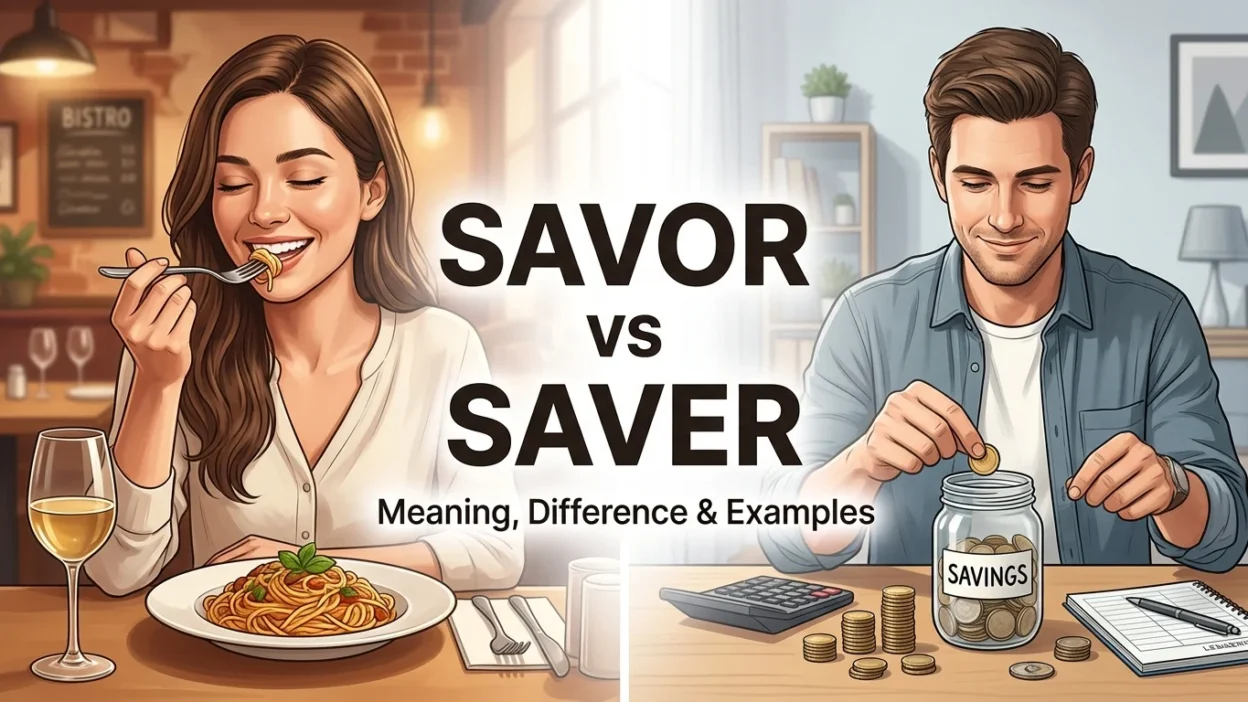
Savor means to enjoy or appreciate something slowly and fully, especially food, flavor, or an experience. Saver means a person or thing that saves something. Remember: you savor a delicious meal, while a saver helps save money, time, or something from danger.
Why People Confuse It
The words savor and saver are easy to mix up because they share several letters and can sound alike in ordinary conversation.
There is also a meaning connection that can make things more confusing. When you savor something, you are taking time to appreciate it. When someone is a saver, they are preserving or protecting something.
The key difference is grammatical and semantic:
- Savor is primarily a verb and can also be a noun.
- Saver is a noun.
- Savor relates to enjoying or appreciating.
- Saver relates to saving or preserving.
A useful question is: Are you enjoying something, or are you saving something?
First Word: Savor
Savor means to enjoy something fully, usually by taking time to appreciate its taste, smell, quality, or experience.
As a verb, it means to enjoy or appreciate something slowly and deliberately.
Examples of “savor” as a verb
- I like to savor every bite of homemade chocolate cake.
- She stopped to savor the beautiful sunset.
- He wanted to savor the moment before leaving.
- Take your time and savor the coffee.
“Savor” can also be a noun, although this use is less common in everyday American English.
As a noun, savor can refer to a distinctive taste or quality, especially in food.
- The soup had a rich, smoky savor.
- The herbs gave the dish an unusual savor.
In most modern writing, however, you are more likely to encounter savor as a verb.
Second Word: Saver
Saver is a noun meaning a person or thing that saves something.
It comes from the verb save and can refer to someone who avoids spending money, something that prevents waste, or a person or device that prevents harm or loss.
Common uses of “saver”
1. A person who saves money
- My brother is a careful saver.
- She became a regular saver after starting her first job.
2. Something that saves time or effort
- This shortcut is a real time saver.
- The new software is a huge labor saver.
3. Something or someone that prevents harm or loss
- The emergency brake was a life saver.
- That backup file was a real saver when the computer crashed.
The word often appears in compounds such as money saver, time saver, space saver, and life saver.
Comparison Table
| Word | Part of Speech | Main Meaning | Example |
| Savor | Verb / noun | To enjoy or appreciate something fully; a distinctive taste | We savor every bite of the meal. |
| Saver | Noun | A person or thing that saves money, time, effort, or something from harm | This tool is a real time saver. |
The simplest distinction is enjoy versus save.
When to Use Each
Use savor when you are talking about enjoying, appreciating, or experiencing something deeply.
Use “savor” for:
- Food and drinks
- Special moments
- Experiences
- Memories
- Beautiful sights
- Pleasant sounds or feelings
Example:
She sat quietly to savor the peaceful morning.
Use saver when referring to someone or something that saves.
Use “saver” for:
- People who save money
- Time saving tools
- Money saving methods
- Devices that prevent waste
- Things that prevent danger or loss
Example:
This shortcut is a huge time saver.
Quick test
If you can replace the word with “enjoy”, choose savor.
If you can replace it with “someone or something that saves”, choose saver.
Examples
Here are clear examples showing the difference between savor and saver:
- I like to savor my morning coffee before starting work.
- She wanted to savor every moment of her vacation.
- We stopped eating for a moment to savor the delicious dessert.
- He tried to savor the final few days of summer.
- They sat outside and savored the peaceful evening.
- My sister is a careful saver who rarely makes unnecessary purchases.
- This washing machine is a major energy saver.
- The new shortcut is a great time saver.
- Wearing a helmet can be a real life saver.
- The coupon is a useful money saver.
- That backup system could be a business saver during an emergency.
- Take a moment to savor the flavor before adding more seasoning.
- He became a disciplined saver after learning about personal finance.
- We should savor this opportunity because it may not come again.
Notice the pattern: savor focuses on appreciation, while saver focuses on preservation, economy, or prevention.
Common Mistakes
Mistake 1: Using “saver” when you mean “savor”
Incorrect:
I want to saver this delicious meal.
Correct:
I want to savor this delicious meal.
You are describing the act of enjoying the meal, so savor is correct.
Mistake 2: Using “savor” for a person who saves money
Incorrect:
She is a careful savor.
Correct:
She is a careful saver.
The person saves money, so the noun saver is required.
Mistake 3: Confusing “savor” with “save”
“Savor” is not simply another spelling of “save.” It has a specific meaning related to appreciation and enjoyment.
- Save = keep, protect, or avoid using.
- Savor = enjoy or appreciate fully.
- Saver = a person or thing that saves.
Mistake 4: Forgetting the spelling difference
A useful spelling clue is the final vowel:
- savOR → think enjoy
- savER → think person or thing that saves
Memory Trick
Here is an easy way to remember savor vs saver:
Savor = enjoy. Saver = saves.
Think of a delicious dessert:
“I savor the flavor.”
Now think about money:
“I am a saver.”
The endings can also help:
- -or → think of the action or experience of enjoying something.
- -er → often identifies a person or thing that performs an action, as in runner, worker, teacher, and saver.
Remember this sentence:
You savor a meal, but a saver saves money.
American vs British English
The main difference is spelling, not meaning.
In American English, the usual spelling is:
savor
In British English, the usual spelling is:
savour
The British spelling adds a u, following the pattern found in other words such as colour/color and favour/favor.
The noun saver, however, is generally spelled the same in both American and British English.
Examples
American English:
We stopped to savor the moment.
British English:
We stopped to savour the moment.
Both forms communicate the same basic idea: enjoying or appreciating something fully.
Similar Words
Understanding related vocabulary can make the distinction even clearer.
Words similar to “savor”
- Enjoy
- Appreciate
- Relish
- Taste
- Experience
- Treasure
- Delight in
For example:
She relished the opportunity.
This is close in meaning to:
She savored the opportunity.
Words related to “saver”
- Save
- Preserve
- Protector
- Economizer
- Conservationist
- Lifesaver
- Time saver
For example:
The shortcut is a time saver.
Here, the word describes something that saves time.
Savor vs relish
These words are especially close when talking about enjoyment.
He savored every bite.
He relished every bite.
Both can mean that he enjoyed the experience greatly.
FAQs
1. What is the difference between savor and saver?
Savor means to enjoy or appreciate something fully, while saver means a person or thing that saves something.
2. Is “savor” a verb or a noun?
Savor can be both a verb and a noun, but it is most commonly used as a verb meaning “to enjoy or appreciate fully.”
3. Is “saver” a noun?
Yes. Saver is a noun that describes someone or something that saves money, time, effort, resources, or something from harm.
4. Do you savor food?
Yes. You can savor food by eating it slowly and appreciating its flavor, smell, and texture.
5. What is an example of a saver?
A person who regularly puts money aside is a saver. A device that reduces electricity use can also be called a saver in an appropriate context.
6. Is “savour” the British spelling of “savor”?
Yes. Savour is the standard British spelling, while savor is the standard American spelling.
7. What is an easy way to remember savor and saver?
Remember: You savor what you enjoy; a saver saves something.
Final Verdict
Savor and saver are not interchangeable. Use savor when you mean to enjoy, appreciate, or experience something fully. Use saver when you mean a person or thing that saves money, time, effort, resources, or something from danger or loss.
If you’re writing about food, a memorable experience, or appreciating a special moment, savor is probably the word you need. If you’re describing someone who saves money or something that reduces waste or effort, choose saver. Once you connect savor = enjoy and saver = saves, this commonly confused pair becomes easy to use correctly.
Remember This
Savor = enjoy or appreciate.
Saver = a person or thing that saves.
Example:
Savor the delicious meal.
Be a smart saver with your money.
Conclusion
Although savor and saver look remarkably similar, their meanings point in different directions. Savor is about slowing down and appreciating something, whether that means food, a beautiful view, or a memorable experience. Saver is about saving, protecting, conserving, or avoiding unnecessary spending. Knowing this difference will make your English more precise and help you avoid a common spelling and vocabulary mistake.
When in doubt, focus on the action behind the word. If someone is enjoying something, use savor. If someone or something is saving something, use saver. Keep the simple rule “savor = enjoy, saver = saves” in mind, and you will have a reliable way to choose the correct word every time.

Adam Aaron writes engaging mystery and adventure novels featuring intelligent characters, unexpected twists, and emotional storytelling. His creative imagination and compelling narratives have earned admiration from readers across generations.