
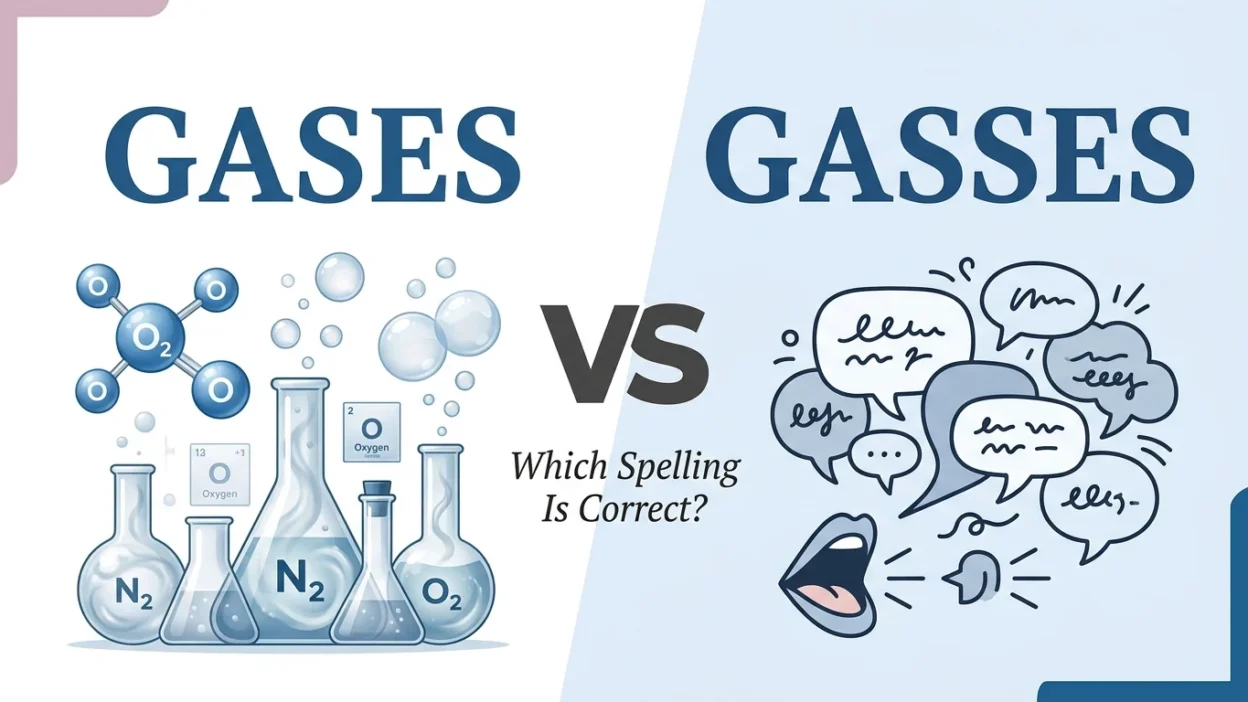
If you have ever hesitated between gases vs gasses, you are not alone. These two spellings look almost identical, but they do not have the same meaning or usage. The confusion usually comes from the word gas, because its plural form can look unusual. Many writers naturally assume that adding another “s” should produce gasses, while standard English generally uses gases when talking about more than one gas.
The good news is that the difference is easy to remember once you understand how each word works. Gases is the standard plural of gas and is used when discussing substances such as oxygen, hydrogen, carbon dioxide, or other gases. Gasses, on the other hand, is a much less common word and is normally the third person singular form of the verb gass, meaning to talk excessively or irritate someone with unnecessary conversation. In everyday writing, gases is almost certainly the spelling you need.
Quick Answer
Gases is the standard plural of gas. For example, “Several gases are present in the atmosphere.” Gasses is a rare verb form of gass, meaning to talk excessively or annoy someone by talking. If you mean more than one gas, always choose gases.
Why People Confuse It
The confusion comes from the unusual looking plural of gas.
Normally, English nouns ending in -s can form plurals by adding -es, so gas becomes gases. However, when spoken aloud, gases can sound different from what learners expect.
People may also assume that gasses follows the same pattern as words such as:
- class → classes
- glass → glasses
- pass → passes
- dress → dresses
That pattern can make gasses look logical. However, gasses has a different grammatical role and is not the normal plural noun.
First Word: Gases
Gases is the plural form of the noun gas.
A gas is a substance that does not have a fixed shape or volume and can expand to fill its container. Oxygen, nitrogen, helium, and carbon dioxide are common examples.
Examples of “gases”
- Different gases have different chemical properties.
- Greenhouse gases contribute to climate change.
- The laboratory stores several compressed gases.
- Certain gases are dangerous when inhaled.
- The atmosphere contains several naturally occurring gases.
Singular vs. plural
- Singular: gas
- Plural: gases
For example:
One gas was detected in the container.
Several gases were detected in the container.
In scientific writing, academic English, and everyday conversation, gases is the correct plural form.
Second Word: Gasses
Gasses is a much rarer word.
It can function as the third person singular form of the verb “gass.” The verb gass means to talk excessively, particularly in a way that annoys or bores someone.
For example:
- He gasses on about his old achievements.
- She gasses everyone with stories that never seem to end.
However, this usage is uncommon compared with gases.
There is another important point: gasses can sometimes appear in specialized or historical usage, but most English learners will rarely need it. If you are talking about oxygen, carbon dioxide, natural gas, or multiple substances in a gaseous state, gases is the word you want.
Comparison Table
| Word | Part of Speech | Meaning | Commonness | Example |
| gases | Plural noun | More than one gas | Very common | Several gases are present. |
| gasses | Verb | Talks excessively or annoyingly | Rare | He gasses on about the subject. |
The easiest rule
Gas → gases
Not:
Gas → gasses
when you are simply making the noun plural.
When to Use Each
Use “gases” when talking about multiple gases
Use gases when the word refers to more than one gaseous substance.
Common contexts include:
- Chemistry
- Physics
- Environmental science
- Medicine
- Industry
- Cooking
- Everyday conversation
Examples:
Scientists are studying atmospheric gases.
The machine releases several gases.
Different gases react differently under pressure.
Use “gasses” only when the verb “gass” is intended
Gasses is appropriate when someone or something is performing the action described by the rare verb gass.
Example:
He gasses about his accomplishments whenever we meet.
If you are unsure which form to use, ask yourself:
“Am I talking about more than one gas?”
If the answer is yes, use gases.
Examples
Here are practical examples showing the difference:
- The atmosphere contains several different gases.
- Oxygen and nitrogen are important gases.
- Some gases can be harmful to humans.
- Scientists measured the gases inside the container.
- Greenhouse gases affect Earth’s climate.
- The experiment produced several gases.
- Certain industrial gases must be stored carefully.
- The planet’s atmosphere contains different gases.
- The technician checked the pressure of the compressed gases.
- Several gases were released during the reaction.
- He gasses on about his expensive car whenever someone asks about it.
- She gasses about her achievements instead of listening to others.
The first ten examples use gases as a plural noun. The final two use gasses as a rare verb form.
Common Mistakes
Mistake 1: Using “gasses” as the plural of gas
❌ The experiment involved three different gasses.
✅ The experiment involved three different gases.
Mistake 2: Assuming “gasses” is always wrong
While gasses is unusual, it is not simply a misspelling in every context. It can be a legitimate verb form of gass.
For example:
He gasses on for hours.
However, this word is uncommon, so context matters.
Mistake 3: Confusing pronunciation with spelling
English pronunciation can make gases seem less intuitive. Don’t choose the spelling based only on how the word sounds.
Remember the grammatical relationship:
gas → gases
Mistake 4: Using “gases” when describing someone talking too much
If you mean someone talks excessively and are intentionally using the verb gass, gasses may be appropriate.
For example:
He gasses on about sports.
Memory Trick
Here’s a simple way to remember the difference:
One gas, two gases.
Think:
Gas + es = gases
The extra e helps you remember the standard plural.
For gasses, remember that it is connected to the uncommon verb gass, not the ordinary plural of gas.
Quick memory formula
More than one gas → GASES
Someone talks excessively → GASSES
American vs British English
The standard plural gases is used in both American English and British English.
There is no major American versus British spelling difference here.
Whether you are writing for a U.S. audience, a British audience, or an international English speaking audience, use:
gases
when referring to multiple gases.
The rare verb gass/gasses may appear less frequently in ordinary modern writing, so it is best to use it only when the intended meaning is clear.
Similar Words
Understanding a few related words can make the distinction easier.
Gas
Gas is the singular noun.
The balloon contains helium gas.
Gases
Gases is the plural noun.
The laboratory studies different gases.
Gassy
Gassy is an adjective commonly used to describe something containing or producing a lot of gas.
The drink made me feel gassy.
Gasify
Gasify is a verb meaning to convert something into gas or a gaseous form.
The process can gasify certain materials.
Gass
Gass is a rare verb associated with talking excessively or boring someone with conversation.
He tends to gass about the same topic repeatedly.
The key distinction is that gases is by far the most common word among the pair.
FAQs
Is “gasses” the plural of “gas”?
No. The standard plural of gas is gases. Gasses can be a verb form of the uncommon verb gass, but it is not the normal plural noun.
Is “gases” grammatically correct?
Yes. Gases is the standard and grammatically correct plural form of gas.
What is the plural of gas?
The plural of gas is gases.
One gas → two gases
Why does gas become “gases”?
The noun gas forms its plural by adding -es, giving gases. This spelling reflects standard English pluralization.
Is “gasses” a real word?
Yes, but it is uncommon. Gasses can be the third person singular form of the rare verb gass, meaning to talk excessively or annoy someone through excessive talking.
Should I write “greenhouse gasses” or “greenhouse gases”?
You should write greenhouse gases. This is the standard expression for the gases that contribute to the greenhouse effect.
Which is correct: “different gases” or “different gasses”?
Different gases is correct when you mean different gaseous substances.
Final Verdict
When choosing between gases vs gasses, the correct spelling depends on meaning. If you are talking about more than one gas such as oxygen, nitrogen, carbon dioxide, or other gaseous substances gases is the correct plural form.
Gasses is a legitimate but uncommon verb form related to gass, meaning to talk excessively or bore someone with conversation. For almost all scientific, academic, professional, and everyday references to multiple gases, choose gases.
Remember This
Gas → Gases when you mean more than one gas.
Gass → Gasses only when you mean the rare verb related to excessive talking.
If you’re writing about chemistry, environmental science, physics, air pollution, or the atmosphere, gases is almost certainly the spelling you need.
Conclusion
The difference between gases and gasses becomes straightforward once you separate their grammatical roles. Gases is the standard plural of gas, and it is the form you will encounter in scientific texts, news articles, textbooks, and everyday English. Whenever you are referring to multiple gaseous substances, use gases.
Gasses is much less common and has a specialized grammatical use as a verb form of gass. Because the two words look so similar, it is easy to make a spelling mistake, but the memory rule is simple: one gas, two gases. Keep that pattern in mind, and you will rarely confuse these two words again.

Hadley Price creates heartfelt contemporary fiction exploring relationships, hope, resilience, and personal growth. Her emotionally rich storytelling connects with readers through memorable characters and inspiring life experiences worldwide.