English word order can be confusing, especially when you’re asking questions or joining ideas in the same sentence. One of the most common mistakes learners make is choosing between “when I can” and “when can I.” Although these phrases contain the same words, they serve different grammatical purposes.
Understanding this small difference can make your English sound much more natural and fluent. Whether you’re writing emails, chatting with friends, or preparing for an English exam, knowing when to use each phrase helps you avoid awkward sentences. In this guide, you’ll learn the grammar behind both expressions, see practical examples, compare them side by side, and discover an easy memory trick you’ll never forget.
Quick Answer
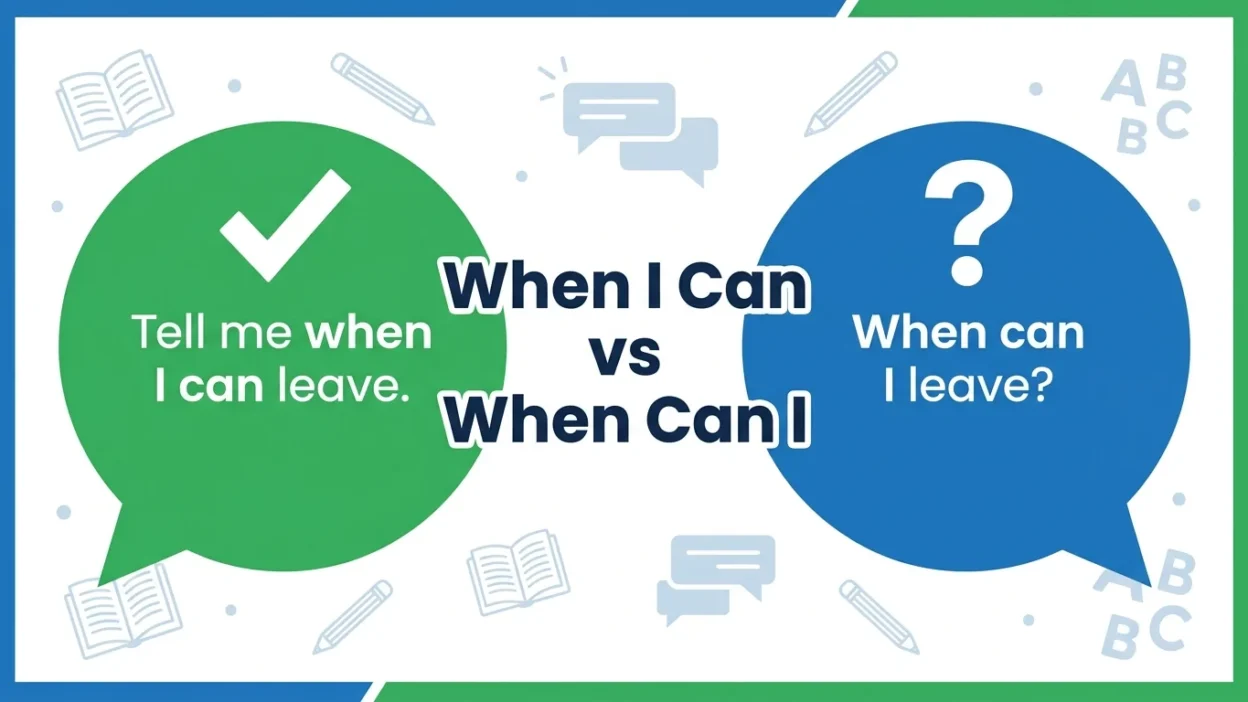
“When I can” is used inside a statement or dependent clause, while “when can I” is used to ask a direct question. The key difference is word order: statements use subject + verb, while questions use question word + auxiliary verb + subject.
Why People Confuse It
Many English learners assume that if the words are the same, the order does not matter. However, English follows different word orders for statements and questions.
People often make mistakes because:
- Both phrases begin with when.
- They contain the same words.
- Some languages don’t change word order for questions.
- Indirect questions follow statement word order, not question word order.
For example:
❌ Can you tell me when can I leave?
✅ Can you tell me when I can leave?
This is one of the most common grammar errors among English learners.
When I Can
“When I can” is a dependent clause used within a larger sentence. It follows statement word order:
When + Subject + Modal Verb
Structure
When + I + can + verb
Use “When I Can” When:
- Giving information
- Reporting a question
- Writing indirect questions
- Explaining future plans
- Talking about possibility
Examples
- I’ll call you when I can.
- I’ll visit when I can.
- I don’t know when I can finish.
- She asked when I can help.
- Tell me when I can start.
- We’ll leave when I can arrange everything.
Notice that I comes before can because this is not a direct question.
When Can I
“When can I” starts a direct question. English questions require inversion, meaning the modal verb comes before the subject.
Structure
When + Can + I + Verb?
Use “When Can I” When:
- Asking permission
- Asking about time
- Seeking advice
- Requesting information
- Starting a direct question
Examples
- When can I leave?
- When can I call you?
- When can I apply?
- When can I start work?
- When can I expect a reply?
- When can I see the results?
Every sentence ends with a question mark because it’s asking something directly.
Comparison Table
| Feature | When I Can | When Can I |
| Sentence Type | Statement/Clause | Direct Question |
| Word Order | Subject + Modal | Modal + Subject |
| Function | Gives information | Asks for information |
| Ends with Question Mark | Usually No | Yes |
| Example | Tell me when I can leave. | When can I leave? |
When to Use Each
Choose when I can if you’re:
- Reporting a question
- Completing another sentence
- Making an indirect question
- Giving information
Choose when can I if you’re:
- Asking someone directly
- Requesting permission
- Asking about timing
- Beginning a question
Quick Tip
If the sentence starts with a direct question, use:
When can I…?
If it’s inside another sentence, use:
When I can…
Examples
Here are more examples to help you master the difference.
Using “When I Can”
- I’ll answer when I can.
- I’ll come when I can.
- Please tell me when I can enter.
- I wonder when I can travel again.
- She explained when I can collect the package.
- Let me know when I can help.
Using “When Can I”
- When can I visit you?
- When can I submit the assignment?
- When can I book my ticket?
- When can I use the new system?
- When can I expect delivery?
- When can I speak to the manager?
Common Mistakes
Mistake 1
❌ Can you tell me when can I start?
✅ Can you tell me when I can start?
Mistake 2
❌ I don’t know when can I leave.
✅ I don’t know when I can leave.
Mistake 3
❌ Tell me when can I arrive.
✅ Tell me when I can arrive.
Mistake 4
❌ When I can leave?
✅ When can I leave?
Memory Trick
Here’s an easy way to remember:
- Question = Can before I
- Statement = I before Can
Think of it this way:
Direct Question → “Can I?”
Indirect Statement → “I can.”
This simple pattern works in nearly every situation.
American vs British English
There is no grammatical difference between American and British English when using “when I can” and “when can I.”
Both varieties follow the same rule:
- When can I call you?
- Tell me when I can call you.
The only differences you may notice are vocabulary or pronunciation, not grammar.
Similar Words and Expressions
If you’re learning indirect questions, you’ll also encounter similar pairs:
- Where I am vs Where am I
- What I should do vs What should I do
- How I can help vs How can I help
- Why I should stay vs Why should I stay
- Who I can contact vs Who can I contact
- When should I vs When I should
Mastering these patterns will improve both your speaking and writing.
Final Verdict
The difference between “when I can” and “when can I” comes down to one simple grammar rule: statement word order versus question word order.
Use “when can I” only when asking a direct question. Use “when I can” when the phrase is part of another sentence or forms an indirect question. Once you recognise this pattern, you’ll naturally avoid one of the most common English grammar mistakes.
Frequently Asked Questions (FAQs)
1. Is “when I can” grammatically correct?
Yes. It’s correct when used as part of a statement or an indirect question.
2. Is “when can I” always a question?
Yes. It introduces a direct question and follows English question word order.
3. Why can’t I say “Can you tell me when can I go?”
Because indirect questions use statement word order. The correct sentence is “Can you tell me when I can go?”
4. Which phrase is more common?
Both are common, but they appear in different situations. One is for direct questions, while the other is for indirect questions.
5. How do I remember the difference?
Remember:
- Question → Can before I
- Statement → I before Can
6. Are these phrases used in formal English?
Yes. Both are perfectly correct in formal and informal English when used appropriately.
7. Can I use “when I can” at the end of a sentence?
Yes. For example: I’ll reply when I can.
Remember This
Use “when can I” for direct questions. Use “when I can” inside statements and indirect questions. If you’re asking someone directly, place “can” before “I.” If you’re reporting or embedding the question, place “I” before “can.”
Conclusion
Although “when I can” and “when can I” differ by only two words, their grammar and purpose are completely different. Learning the correct word order is an essential step towards speaking and writing fluent English. Once you understand the distinction between direct and indirect questions, you’ll avoid a mistake that even advanced learners sometimes make.
Whenever you’re unsure, ask yourself one question: Am I asking someone directly, or am I including the idea within another sentence? If it’s a direct question, choose “when can I.” If it’s part of a larger sentence, use “when I can.” With regular practice and attention to sentence structure, this grammar rule will soon become second nature.

Adam Aaron writes engaging mystery and adventure novels featuring intelligent characters, unexpected twists, and emotional storytelling. His creative imagination and compelling narratives have earned admiration from readers across generations.