
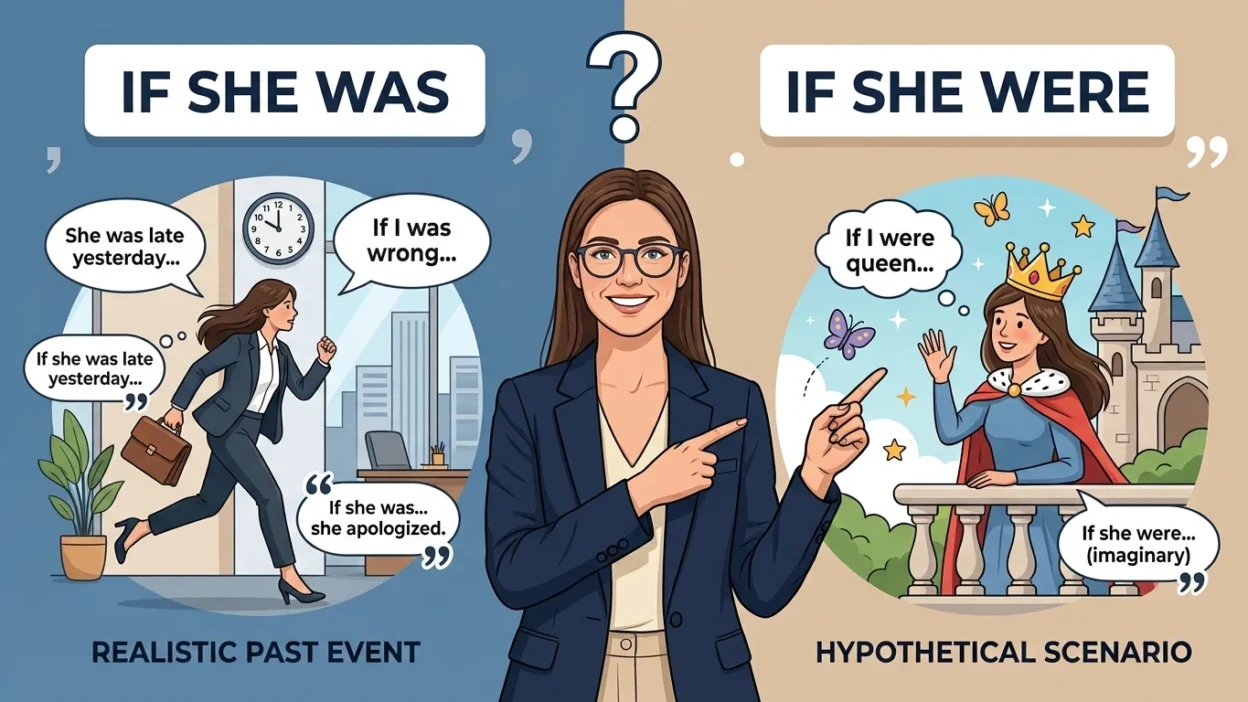
“If she was” and “if she were” look almost identical, but they are not always interchangeable. The difference comes down to whether you are talking about a real or possible situation in the past or imagining something unreal, hypothetical, or contrary to fact. This small distinction is one of the most common sources of confusion in English grammar, especially when using conditional sentences.
The key is understanding the subjunctive mood. In traditional standard English, “if she were” is preferred when the situation is hypothetical or unlikely to be true, while “if she was” is normally used when referring to a real possibility or a specific past situation. However, everyday English can be more flexible, and “if she was” is sometimes heard even in hypothetical contexts. In this guide, you’ll learn exactly when to use each form, with clear examples, common mistakes, and an easy memory trick.
Quick Answer
Use “if she were” for an unreal, imaginary, or hypothetical situation: “If she were here, she would help us.” Use “if she was” when discussing a real possibility or an uncertain past event: “If she was at home, she probably saw the message.”
Why People Confuse It
The confusion exists because was and were are both past forms of the verb be. In ordinary statements, the choice is straightforward:
- She was tired.
- They were tired.
- I was there.
- We were there.
Conditional sentences make things more complicated because English sometimes uses were to signal that a situation is hypothetical rather than simply past.
Compare these two sentences:
- If she was at the meeting, she heard the announcement.
- If she were at the meeting, she would hear the announcement.
The first sentence suggests uncertainty about a real event. Perhaps you do not know whether she attended the meeting.
The second sentence imagines a situation that is not currently true or is unlikely. Perhaps she is not at the meeting at all.
This distinction is closely connected to the subjunctive mood, particularly the past subjunctive of “be.”
First Word: “If She Was”
“If she was” is generally used when you are talking about a real possibility, an uncertain fact, or a past situation.
For example:
If she was tired, she probably went home early.
Here, the speaker does not know whether she was tired. It is a possibility based on a real situation.
Another example:
If she was at the office yesterday, she may have seen John.
The speaker is considering whether she actually was at the office. The situation is connected to reality.
Common uses of “if she was”
Use “if she was” when:
- You are uncertain about something that may have happened.
- You are describing a possible past condition.
- You are asking whether a real event occurred.
- The condition is not necessarily imaginary.
Examples
- If she was sick, she may have stayed home.
- If she was there, she probably knows what happened.
- If she was angry, I didn’t notice.
- If she was late, the teacher may have started without her.
- If she was responsible for the mistake, she should explain it.
In these examples, the speaker is not necessarily imagining an impossible situation. They are considering possibilities connected to real events.
Second Word: “If She Were”
“If she were” is traditionally used for an unreal, hypothetical, imaginary, or contrary to fact situation.
For example:
If she were here, she would help us.
The implication is that she is not here. The sentence imagines a different reality.
Another example:
If she were my manager, I would ask her for advice.
The speaker is imagining a situation in which she is the manager. It is not presented as a current fact.
This use of were is known as the subjunctive or, more specifically, the irrealis were in many grammar descriptions.
Common uses of “if she were”
Use “if she were” when:
- You are imagining a situation.
- The situation is contrary to present reality.
- The condition is unlikely or purely hypothetical.
- You are giving advice based on an imagined circumstance.
Examples
- If she were here, she would know what to do.
- If she were my friend, I would tell her the truth.
- If she were more confident, she might apply for the position.
- If she were taller, she could reach the shelf.
- If she were available, I would ask her to join us.
Comparison Table
| Expression | Typical meaning | Example | Situation |
| If she was | Real possibility or uncertain past fact | If she was tired, she went home. | She may actually have been tired. |
| If she were | Hypothetical or unreal situation | If she were tired, she would rest. | Imagined or contrary to fact. |
| If she was there | Uncertainty about a real event | If she was there, she heard us. | You don’t know if she attended. |
| If she were here | Imaginary present situation | If she were here, she would help. | She is understood to be absent. |
| If she was responsible | Possible past responsibility | If she was responsible, she’ll explain. | Responsibility is uncertain. |
| If she were responsible | Hypothetical responsibility | If she were responsible, she’d apologize. | Imagined condition. |
The most useful question is: Am I considering something that may have happened, or am I imagining something that isn’t true?
When to Use Each
Use “if she was” for possible reality
Choose “if she was” when you are unsure whether something happened.
If she was at the restaurant last night, she probably saw them.
You don’t know whether she was there. Her presence is a genuine possibility.
Use “if she were” for hypothetical situations
Choose “if she were” when the situation is imaginary or contrary to fact.
If she were at the restaurant, she would be sitting with us.
The sentence suggests that she is not actually there.
A useful contrast
Consider:
If she was upset, she didn’t show it.
This means she may have been upset in a real past situation.
Now compare:
If she were upset, she would tell me.
This is a hypothetical statement about what she would do if she became upset.
The difference is subtle but important.
Examples
Here are more examples showing how “if she was” and “if she were” work in context.
Examples with “if she was”
- If she was at work yesterday, she didn’t mention seeing you.
- If she was tired after the journey, she didn’t show it.
- If she was responsible for the report, she probably has a copy.
- If she was sick last week, that would explain her absence.
- If she was at the party, I must have missed her.
- If she was worried, she kept it to herself.
- If she was driving, she couldn’t answer the phone.
Examples with “if she were”
- If she were here, she would know exactly what to say.
- If she were my teacher, I would ask her for extra help.
- If she were more careful, she wouldn’t make so many mistakes.
- If she were available tomorrow, we could invite her.
- If she were in charge, the project might run more smoothly.
- If she were older, she could apply for the position.
- If she were honest about the problem, we could solve it.
- If she were your sister, would you treat her differently?
A particularly useful pair
If she was angry, she didn’t tell me.
This refers to a possibility in the past.
If she were angry, she would tell me.
This describes an imagined or hypothetical condition.
Common Mistakes
1. Using “was” automatically for every conditional
A common mistake is assuming that was must always follow “she” because “she was” is normally correct.
That is not true in hypothetical constructions.
❌ If she was here, she would help us.
✅ If she were here, she would help us.
In formal or careful English, were is the traditional choice for this unreal present condition.
2. Thinking “were” always refers to the past
“Were” does not necessarily mean that something happened in the past.
If she were here, she would help.
This sentence refers to the present, not the past. The use of “were” signals that the situation is hypothetical.
3. Confusing uncertainty with imagination
Consider:
If she was at home, she probably heard the noise.
You are uncertain about where she actually was.
But:
If she were at home, she would answer the phone.
This can suggest that she is not at home or that you are imagining what would happen under that condition.
4. Using “were” when discussing a confirmed past event
You normally would not say:
❌ If she were at the office yesterday, she signed the document.
If you mean that she may actually have been at the office, was is more appropriate:
✅ If she was at the office yesterday, she signed the document.
5. Assuming everyday speech always follows traditional grammar rules
Modern spoken English can be less strict about the subjunctive. Some speakers use “if she was” even in contexts where traditional grammar recommends “if she were.”
For formal writing, academic English, professional communication, and careful speech, “if she were” remains the safer choice for clearly hypothetical situations.
Memory Trick
Use this simple rule:
REAL POSSIBILITY → WAS
IMAGINED POSSIBILITY → WERE
Think of WAS = “Was it really possible?”
If she was there, she may have heard us.
Think of WERE = “What if?”
If she were here, she would help us.
Another easy trick is to look at the second part of the sentence.
If you see “would,” “could,” or “might” and the condition is clearly hypothetical, were is often the best choice:
If she were here, she would help.
This is not an absolute rule, but it is a useful shortcut for learners.
American vs British English
Both American and British English recognize the traditional distinction between “if she was” and “if she were.”
In formal writing, both varieties generally favor “if she were” for hypothetical or contrary to fact situations:
If she were available, we would invite her.
However, informal American and British speech can be more flexible. Native speakers sometimes use “was” in hypothetical constructions, especially in casual conversation.
For example:
If I was you, I’d apologize.
This form is common in everyday speech, but “If I were you” is still the traditional and widely preferred form in standard formal English.
So, if you are writing an essay, business document, formal email, or educational material, “if she were” is usually the better choice when the situation is hypothetical.
Similar Words
Understanding related conditional structures can make this grammar point much easier.
If I were
If I were you, I would wait.
This is one of the most familiar examples of the subjunctive.
If he were
If he were more careful, he wouldn’t make that mistake.
The same rule applies to he.
If it were
If it were possible, we would change the schedule.
This is also common in hypothetical statements.
If they were
If they were here, they could help us.
With they, “were” is already the normal past form, so the distinction is less visible.
If she had been
For an unreal situation in the past, English commonly uses “had been”:
If she had been there, she would have helped us.
This refers to a hypothetical past condition.
Compare:
- If she were here, she would help us. → hypothetical present
- If she had been here, she would have helped us. → hypothetical past
FAQs
Is “if she was” grammatically correct?
Yes. “If she was” is grammatically correct when referring to a real possibility, an uncertain past event, or a condition connected to something that may actually have happened.
Is “if she were” grammatically correct?
Yes. “If she were” is the traditional subjunctive form used for hypothetical, unreal, or contrary to fact situations.
Should I say “if she was” or “if she were”?
It depends on the meaning. Use “if she was” for a possible real situation and “if she were” for an imaginary or hypothetical situation.
Is “if she were” more formal?
Generally, yes. “If she were” is especially appropriate in formal writing when expressing a hypothetical or contrary to fact condition.
Can native speakers say “if she was” in a hypothetical sentence?
Yes. In informal modern English, speakers sometimes use “was” where traditional grammar would recommend “were.” However, “were” remains the safer choice in formal English.
What is the difference between “if she was there” and “if she were there”?
“If she was there” expresses uncertainty about whether she actually attended. “If she were there” normally presents her presence as hypothetical or contrary to the current situation.
Is “if I were you” the same grammar rule?
Yes. “If I were you” is a classic example of the subjunctive used for a hypothetical situation.
Final Verdict
The difference between “if she was” and “if she were” is mainly about reality versus hypothesis. Use “if she was” when you are considering something that may genuinely have happened or may have been true. Use “if she were” when you are imagining a situation, especially one that is contrary to present reality.
When in doubt, ask yourself what you are trying to communicate. Are you asking, “Did this possibly happen?” Then was is usually right. Are you asking, “What would happen if this were true?” Then were is usually the better choice. Once you recognize that distinction, this confusing pair becomes much easier to use naturally and correctly.
Remember This
If she WAS = possible reality.
If she WERE = hypothetical reality.
If she was there, she may have heard us.
If she were here, she would help us.
That simple contrast will help you choose the correct form in most situations.
Conclusion
“If she was” and “if she were” are both legitimate English constructions, but they serve different purposes. Was usually describes an uncertain or possible real situation, while were is the traditional subjunctive form for an imagined, unlikely, or contrary to fact situation.
For everyday conversation, you may hear some variation, particularly with phrases such as “if she was.” But when accuracy matters especially in formal writing, academic work, professional communication, or grammar exercises pay attention to the intended meaning. If the situation is hypothetical, “if she were” is generally the clearest and most grammatically traditional choice.

Willow Evans writes uplifting fantasy stories filled with magical worlds, courageous heroes, and meaningful life lessons. Her imaginative books encourage creativity, kindness, and hope in readers of all ages.