When you’re describing something that has happened, existed, or occurred up to the present, choosing between “there has been” and “there have been” can be surprisingly confusing. Both forms are grammatically correct, but they are used with different kinds of nouns. The key is understanding what comes after been and whether that noun is singular or plural.
The good news is that the rule is much simpler than it first appears. “There has been” is used with a singular noun or an uncountable noun, while “there have been” is used with a plural noun. Once you identify the noun that follows the phrase, the correct choice usually becomes obvious. In this guide, we’ll look at the difference, explain the grammar behind it, compare examples, and cover common mistakes so you can use both expressions naturally in everyday and formal English.
Quick Answer
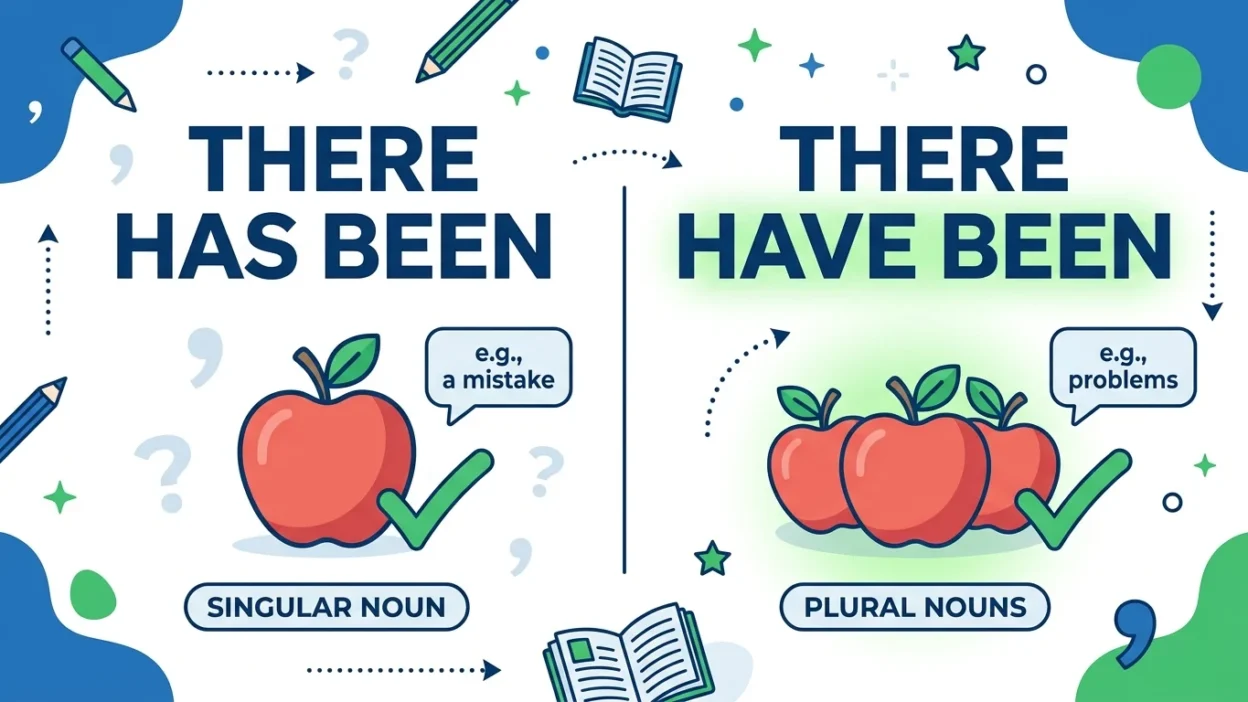
Use “there has been” before a singular or uncountable noun: There has been a problem. Use “there have been” before a plural noun: There have been several problems. The noun after been determines whether you need has or have.
Why People Confuse It
The confusion comes partly from the word “there.”
In sentences beginning with there, the subject often appears after the verb rather than before it. This can make it difficult to decide whether the verb should be singular or plural.
Compare:
- There has been a delay.
- There have been several delays.
The important nouns are delay and delays.
Another reason for the confusion is that speakers sometimes focus on “there” rather than the noun that determines subject verb agreement. However, there is functioning as a dummy or introductory subject in these constructions.
A useful question to ask is:
What noun comes after “been”?
If it is singular or uncountable, use has. If it is plural, use have.
First Word: “There Has Been”
“There has been” is used when the noun that follows is singular or uncountable.
Singular nouns
- There has been a mistake.
- There has been an accident.
- There has been a change.
- There has been a misunderstanding.
Here, mistake, accident, change, and misunderstanding are all singular countable nouns.
Uncountable nouns
“Has been” can also be followed by an uncountable noun:
- There has been some progress.
- There has been a lot of confusion.
- There has been considerable growth.
- There has been little improvement.
Words such as progress, confusion, growth, and improvement can function as uncountable nouns in these contexts, so has is appropriate.
The basic pattern is:
There + has been + singular/uncountable noun
Second Word: “There Have Been”
“There have been” is used when the noun that follows is plural.
For example:
- There have been several complaints.
- There have been many changes.
- There have been two accidents.
- There have been numerous attempts.
The plural noun controls the agreement, so have is required.
The basic pattern is:
There + have been + plural noun
Notice the difference:
- There has been a problem.
- There have been problems.
The change from problem to problems changes has to have.
Comparison Table
| Expression | Used With | Example |
| There has been | Singular noun | There has been a delay. |
| There has been | Uncountable noun | There has been some progress. |
| There have been | Plural noun | There have been several delays. |
| There have been | Multiple people/things | There have been many visitors. |
The easiest rule
Singular or uncountable → has been
Plural → have been
When to Use Each
Use “there has been” when:
- One person or thing is being discussed.
- The noun is singular.
- The noun is uncountable.
- You are describing one event or situation that has occurred.
Examples:
There has been a misunderstanding.
There has been significant improvement.
Use “there have been” when:
- More than one person or thing is involved.
- The noun is plural.
- You are describing several events or situations.
Examples:
There have been several misunderstandings.
There have been significant improvements.
A useful substitution test
Try replacing the noun with it or they.
- There has been a problem → It is a problem.
- There have been several problems → They are problems.
This isn’t a perfect test for every sentence, but it can help you recognize singular and plural nouns quickly.
Examples
- There has been a change in the schedule.
- There have been several changes in the schedule.
- There has been an increase in prices.
- There have been many complaints about the service.
- There has been a serious accident on the highway.
- There have been three accidents this month.
- There has been considerable progress since last week.
- There have been significant improvements in the system.
- There has been a misunderstanding between the two teams.
- There have been several misunderstandings during the negotiations.
- There has been enough evidence to support the claim.
- There have been numerous attempts to solve the problem.
- There has been little interest in the proposal.
- There have been many questions about the new policy.
Notice the pattern
Look at these two sentences:
There has been a problem.
There have been several problems.
The meaning is similar, but the noun changes from singular to plural. That’s why the verb changes too.
Common Mistakes
1. Using “have” with a singular noun
❌ There have been a problem.
✅ There has been a problem.
A problem is singular, so has is required.
2. Using “has” with a plural noun
❌ There has been many problems.
✅ There have been many problems.
Problems is plural, so use have.
3. Looking at “there” instead of the noun
Don’t think:
“There is one word before the verb, so I should use has.”
Instead, identify the noun being introduced.
There has been a delay.
There have been several delays.
4. Confusing “been” with “being”
These are different forms:
- There has been a problem.
- There is being a problem. ❌
The second sentence does not normally express the intended meaning. For events or situations that have occurred, has/have been is usually the appropriate construction.
5. Forgetting that uncountable nouns are usually singular
For example:
✅ There has been some progress.
❌ There have been some progress.
Although progress can describe a large amount of development, it is normally uncountable in this use.
Memory Trick
Think:
One → HAS
More than one → HAVE
So:
One problem → There has been a problem.
Many problems → There have been many problems.
You can also remember:
HAS = singular
HAVE = plural
The word “been” doesn’t change. The important choice is between has and have.
American vs British English
The distinction between “there has been” and “there have been” is essentially the same in American and British English.
Both varieties follow standard subject verb agreement:
- There has been a problem.
- There have been several problems.
You may notice differences between American and British English in vocabulary, pronunciation, spelling, or certain collective noun constructions, but this particular rule is straightforward in both varieties.
So whether you’re writing an email in the United States or preparing an essay in the United Kingdom, the same basic rule applies.
Similar Words
Several expressions are closely related to “there has been” and “there have been.”
There was vs. there has been
There was generally refers to a past situation or event:
There was a problem yesterday.
There has been connects a past event or situation to the present:
There has been a problem recently.
There were vs. there have been
There were is commonly used for completed past situations:
There were several delays last week.
There have been is the present perfect form:
There have been several delays recently.
There is vs. there has been
There is describes a present situation:
There is a problem.
There has been often emphasizes that the situation has occurred or existed up to now:
There has been a problem.
These distinctions become particularly important when choosing between the simple past, present tense, and present perfect tense.
FAQs
Is “there has been” grammatically correct?
Yes. “There has been” is grammatically correct when followed by a singular or uncountable noun, such as a problem, an accident, or some progress.
Is “there have been” grammatically correct?
Yes. “There have been” is correct when followed by a plural noun, such as several problems, many accidents, or numerous changes.
Which is correct: “there has been many” or “there have been many”?
“There have been many” is correct when many refers to a plural noun.
For example: There have been many complaints.
Can I say “there has been some”?
Yes. If the noun following some is uncountable, use has:
There has been some progress.
But with a plural noun:
There have been some changes.
Is “there has been” present perfect tense?
Yes. “Has been” forms the present perfect construction with there. It is used to describe something that occurred or existed in the past with a connection to the present.
Why do we say “there have been several” instead of “there has been several”?
Because several normally refers to more than one countable thing. The plural noun requires have:
There have been several meetings.
Can “there has been” be used with an uncountable noun?
Yes. For example:
There has been considerable progress.
Uncountable nouns are generally treated as singular for subject verb agreement.
Final Verdict
The difference between “there has been” and “there have been” is mainly a matter of singular versus plural agreement. Use there has been with a singular or uncountable noun, and use there have been with a plural noun.
When you’re unsure, don’t focus on the word “there.” Look at the noun that follows “been.” If you’re talking about one thing or an uncountable idea, choose has. If you’re talking about two or more things, choose have.
Remember This
There has been + singular/uncountable noun
There have been + plural noun
There has been a change. ✅
There have been several changes. ✅
That’s the core rule. Once you spot the noun, choosing the correct form becomes much easier.
Conclusion
Choosing between “there has been” and “there have been” doesn’t require memorizing a complicated grammar rule. The crucial point is subject verb agreement: has goes with a singular or uncountable noun, while have goes with a plural noun. This applies in everyday conversation, professional writing, academic English, and formal communication.
If you make a habit of checking the noun after “been,” you’ll quickly avoid the most common errors. Remember the simple pattern one or uncountable = has; more than one = have and you’ll know whether to write there has been or there have been with confidence.

Quinn Mitchell is celebrated for historical fiction that combines authentic settings, unforgettable characters, and compelling narratives. His thoughtful writing brings history alive while inspiring curiosity and deeper understanding among readers.