Choosing between “in” and “within” can seem simple until you need to express time, location, limits, or boundaries precisely. Both words can function as prepositions, and in some sentences they appear interchangeable. However, they often communicate slightly different ideas, especially when you are talking about deadlines, periods of time, physical boundaries, or limits.
The key is understanding what each word emphasizes. “In” is the more common and flexible choice. It can describe something located inside a place, happening during a period, or occurring after a certain amount of time. “Within” usually emphasizes a boundary or limit and often means “inside” or “before the end of a specified period.” Once you understand this distinction, choosing between in and within becomes much easier. This guide explains the difference with clear rules, practical examples, common mistakes, and an easy memory trick.
Quick Answer
“In” generally means inside a place or period, or after a particular amount of time. “Within” emphasizes a boundary, limit, or deadline. For example, “I’ll finish it in two hours” focuses on the time needed, while “I’ll finish it within two hours” stresses that two hours is the maximum allowed time.
Why People Confuse It
People confuse in vs within because both words can describe location and time.
For example:
- The documents are in the folder.
- The documents are within the folder.
Both sentences suggest that the documents are inside the folder, although within sounds more formal and emphasizes the boundaries of the folder.
The same thing happens with time:
- She will arrive in ten minutes.
- She will arrive within ten minutes.
These sentences are similar, but the emphasis changes. The first commonly means the arrival will happen after ten minutes. The second means the arrival will happen at any point before ten minutes have passed.
So, although the words sometimes overlap, they are not always interchangeable.
First Word: In
“In” is one of the most common English prepositions. It has several uses involving place, time, situations, conditions, and amounts of time.
1. “In” for location
Use in when something is inside an area, container, building, or space.
- The keys are in my bag.
- She lives in London.
- There is milk in the refrigerator.
Here, in simply identifies where something is located.
2. “In” for time
“In” can refer to a period when something happens:
- We met in 2024.
- He works best in the morning.
- The flowers bloom in spring.
It can also indicate how much time will pass before something happens:
- The train will arrive in ten minutes.
- I’ll call you in an hour.
3. “In” for a situation or condition
“In” can describe a particular state or circumstance:
- She is in trouble.
- He is in danger.
- They are in love.
4. “In” for a period needed to complete something
Consider:
I can finish the report in three days.
This usually tells us the amount of time required before the report is finished.
Second Word: Within
“Within” generally means inside a particular boundary, range, limit, or period.
It often carries a stronger sense of restriction than in.
1. “Within” for time limits
This is one of its most important uses.
Please reply within three days.
This means you can reply today, tomorrow, or on the third day, but you should not go beyond the three day limit.
Other examples:
- You must submit the application within 30 days.
- The package should arrive within a week.
- Please respond within 24 hours.
2. “Within” for physical boundaries
Use within when emphasizing that something is inside a defined area.
- The village lies within the national park.
- Keep the vehicle within the marked area.
- The school is within walking distance.
3. “Within” for limits or ranges
Within can describe an acceptable range or limit:
- The temperature remained within normal limits.
- The answer should be within 100 words.
- Keep your spending within your budget.
4. “Within” for an organization or group
It can also mean inside a particular organization, system, or group:
- There is disagreement within the company.
- The policy created debate within the organization.
- Trust is important within a team.
Comparison Table
| Feature | In | Within |
| Basic meaning | Inside or during | Inside a boundary or limit |
| Commonness | Very common | Less common, often more precise/formal |
| Time | Can mean after a period | Means before a stated limit expires |
| Location | Inside a place or area | Inside a defined boundary |
| Deadlines | Sometimes possible | Very common |
| Tone | Natural and everyday | Often more formal or precise |
| Example | I’ll return in two hours. | I’ll return within two hours. |
When to Use Each
A useful way to decide is to ask what you want to emphasize.
Use “in” when:
- You mean inside something.
- You are talking about a general period.
- You are saying how long until something happens.
- You want the most natural everyday expression.
Examples:
The children are in the classroom.
I’ll be there in ten minutes.
Use “within” when:
- You mean inside a defined boundary.
- You are giving a deadline.
- You are describing a maximum period.
- You want to emphasize a limit or range.
Examples:
Please pay the bill within seven days.
Stay within the designated area.
An important time distinction
Compare:
I’ll finish the work in two hours.
This commonly describes the amount of time needed to finish it.
I’ll finish the work within two hours.
This establishes two hours as the maximum timeframe.
The second sentence gives more emphasis to the deadline.
Examples
Here are practical examples showing how in and within work.
Examples with “in”
- The children are playing in the garden.
- I left my phone in the car.
- We moved here in 2022.
- She usually exercises in the morning.
- I’ll call you in an hour.
- The meeting starts in ten minutes.
- He found the information in the report.
- There are several mistakes in this paragraph.
Examples with “within”
- Please complete the form within five days.
- You must respond within 24 hours.
- The hotel is within walking distance of the station.
- Keep your answer within 200 words.
- The temperature stayed within the safe range.
- The house is within the city limits.
- The issue was resolved within a week.
- There was disagreement within the committee.
Comparing both
- The package will arrive in three days.
- The package will arrive within three days.
The first focuses more naturally on the expected time. The second establishes three days as the outer limit.
Common Mistakes
Mistake 1: Assuming “within” always replaces “in”
Not every sentence containing in can naturally use within.
She lives in Pakistan. ✓
She lives within Pakistan. △
The second sentence is possible in a particular context, but it sounds unusual unless a boundary or contrast is being emphasized.
Mistake 2: Confusing “in two hours” with “within two hours”
These expressions can communicate different expectations.
I’ll call you in two hours.
This normally suggests the call will happen after approximately two hours.
I’ll call you within two hours.
This means the call should happen before two hours have passed.
Mistake 3: Using “within” when no boundary matters
Because within sounds formal, learners sometimes use it unnecessarily.
There are books within the library.
This is grammatically possible, but:
There are books in the library.
is much more natural when you simply mean location.
Mistake 4: Forgetting that “within” can describe non time limits
Within is not only about deadlines.
- within the law
- within budget
- within limits
- within reach
- within the area
- within the organization
These all involve some kind of boundary or restriction.
Memory Trick
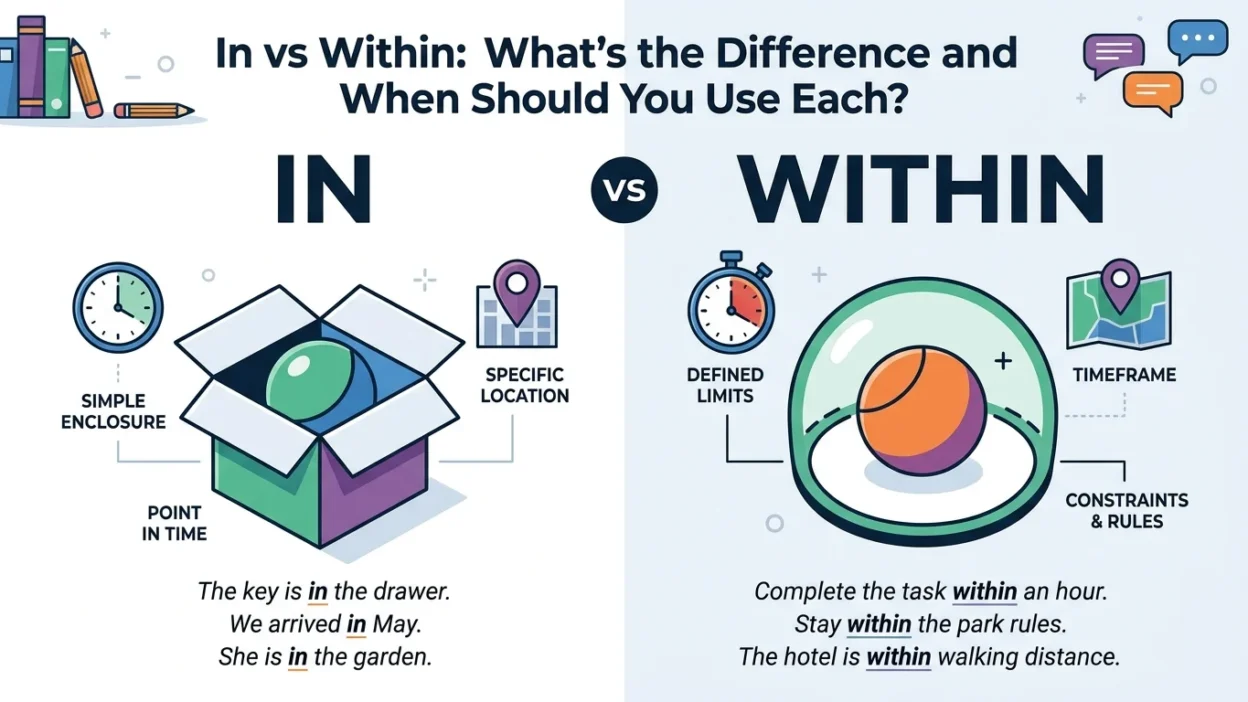
Think of IN = inside and WITHIN = inside a limit.
If you are simply saying something is inside a place or happening during a period, in is usually the natural choice.
If you can imagine a line, boundary, deadline, range, or maximum, within is often better.
Easy formula:
IN = inside
WITHIN = inside the boundary
For example:
The keys are in the drawer.
Keep the keys within the designated area.
The first identifies location. The second emphasizes a boundary.
American vs British English
The distinction between in and within is broadly the same in American and British English.
Both varieties commonly use:
- in the room
- in London
- in five minutes
- within 24 hours
- within the limits
- within walking distance
The main difference is usually style and context, rather than grammar.
In tends to sound more conversational and is extremely common in everyday speech. Within is frequently preferred when discussing official deadlines, regulations, instructions, policies, measurements, or formal boundaries.
For example, a customer service message might say:
Please respond within 48 hours.
In ordinary conversation, someone might simply say:
I’ll call you in an hour.
Similar Words
Understanding related prepositions can make the distinction even clearer.
Inside
Inside emphasizes physical location.
The children are inside the house.
During
During refers to something happening at some point in a period.
We met during the summer.
By
By means no later than a particular time.
Please arrive by 6 p.m.
This is closely related to within when talking about deadlines.
Into
Into often indicates movement from outside to inside.
She walked into the room.
Among
Among refers to being surrounded by or included in a group.
He was sitting among his friends.
FAQs
Is “in two days” the same as “within two days”?
Not necessarily. “In two days” commonly indicates when something is expected to happen, while “within two days” means it should happen no later than the end of that two day period.
Which is more common, “in” or “within”?
In is much more common in everyday English. It has a wide range of meanings and works naturally in casual and formal contexts.
Does “within” mean “before”?
When referring to a time limit, within generally means at any point before the stated period ends, including the endpoint depending on the context.
Can I say “within the room”?
Yes, but it usually sounds more formal or emphasizes the room as a boundary. “In the room” is normally more natural for ordinary location.
Is “within a week” correct?
Yes. “Within a week” means at some point before or by the end of one week.
Should I use “in” or “within” for deadlines?
Within is often the clearest choice when you mean a maximum allowed period:
Submit the application within 30 days.
Can “within” refer to places?
Yes. It can describe something located inside a defined physical area:
The property lies within the city limits.
Final Verdict
The difference between in and within is mainly about emphasis. In is the broader, more natural everyday preposition for being inside a place or describing time. Within adds the idea of a boundary, range, restriction, or deadline.
When talking about time, pay particular attention to the intended meaning. “In three days” commonly describes when something will happen, while “within three days” sets three days as the outer limit. When talking about location, use in for ordinary situations and within when a defined boundary matters.
Remember This
IN = inside or after a period
WITHIN = inside a boundary or before a limit ends
If you are simply describing where something is, in is usually the better choice. If you are emphasizing a deadline, limit, range, or boundary, within is usually more precise.
Conclusion
Learning in vs within does not require memorizing dozens of complicated grammar rules. Start by identifying whether you are simply describing an inside location or period or whether you are emphasizing a limit or boundary. That one distinction will solve most cases.
When in doubt, choose in for ordinary conversational English and consider within when you need to communicate a deadline, maximum timeframe, defined area, or specific restriction. With regular exposure to examples, the difference will quickly become intuitive.

Adam Aaron writes engaging mystery and adventure novels featuring intelligent characters, unexpected twists, and emotional storytelling. His creative imagination and compelling narratives have earned admiration from readers across generations.