
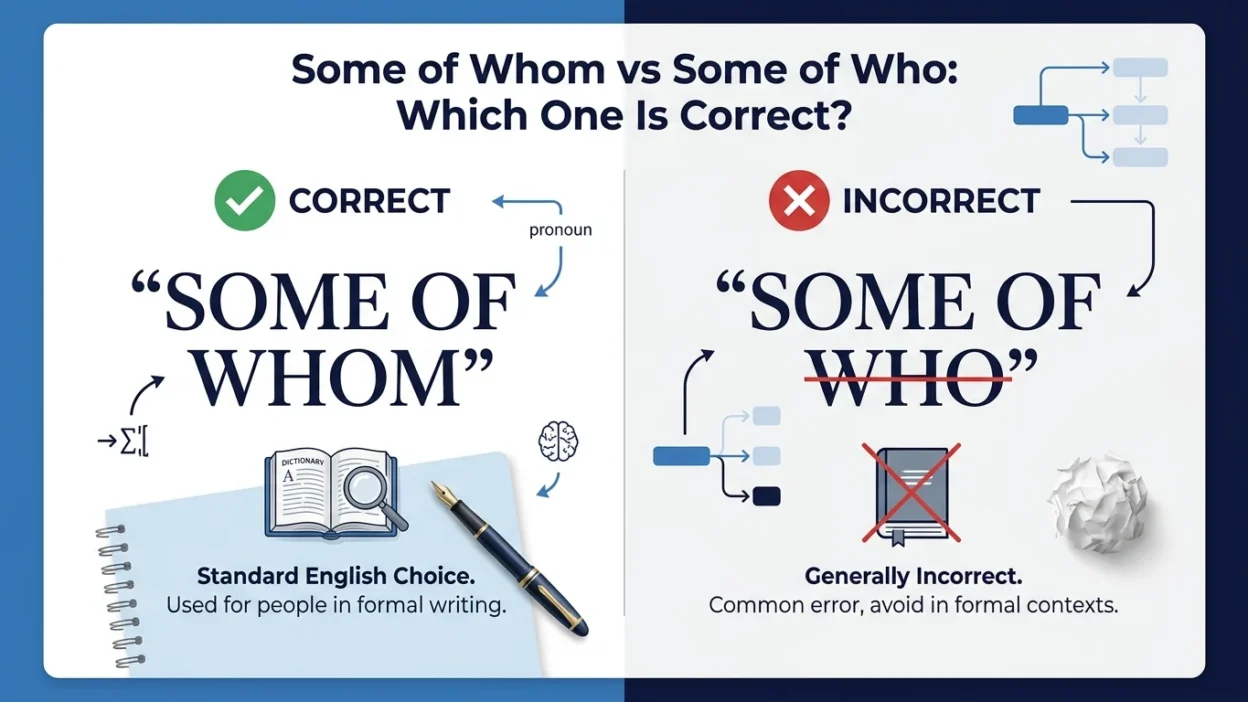
English relative pronouns can be surprisingly tricky, especially when a sentence contains phrases such as “some of whom” and “some of who.” Both may sound understandable in everyday conversation, but they do not have the same grammatical status. If you are writing an email, essay, report, article, or professional document, choosing the correct form matters.
The main issue is whether who or whom should follow the expression “some of.” In standard English, “some of whom” is the correct construction when you are referring to people who are the object of the preposition of. “Some of who” is generally considered incorrect in this structure. Once you understand the role of whom, the distinction becomes much easier to remember and use confidently.
Quick Answer
“Some of whom” is the standard and grammatically correct expression. Use it when referring to some people from a larger group, especially when the relative pronoun functions as an object. “Some of who” is generally incorrect in formal standard English.
Why People Confuse It
The confusion comes mainly from the fact that who and whom both refer to people.
In modern English, whom is used less frequently than who, particularly in casual speech. As a result, many speakers use who in places where traditional grammar calls for whom.
Consider:
I invited several writers, some of whom are award winning authors.
Here, whom refers to some of the writers. The phrase “of whom” means “of those people.”
A useful grammatical test is to replace who/whom with they/them:
- They → who
- Them → whom
In “some of whom,” the meaning is closer to “some of them.” Therefore, whom is the appropriate choice.
First Word: Some of Whom
“Some of whom” is the standard construction used when referring to some members of a previously mentioned group of people.
It is especially common after a comma in a relative clause.
Examples
- We interviewed ten candidates, some of whom had extensive experience.
- She has three brothers, some of whom live abroad.
- The conference attracted hundreds of visitors, some of whom were international students.
In each sentence, whom refers back to people already mentioned.
The structure is:
some + of + whom
This construction is particularly useful in formal and academic English.
Why “whom”?
The preposition of requires an object. Since whom is the object form of who, it fits the construction.
Compare:
- Some of them attended.
- Some of whom attended.
The grammatical relationship is essentially the same.
Second Word: Some of Who
“Some of who” is generally considered incorrect in standard English when used in place of “some of whom.”
For example:
❌ The students, some of who received scholarships, were excited.
The preferred version is:
✅ The students, some of whom received scholarships, were excited.
This error occurs because who is much more common in everyday English. Speakers often use who as a general purpose relative pronoun, even when whom would traditionally be required.
In informal speech, you may occasionally hear “some of who,” but that does not make it the preferred form for formal or edited writing.
Comparison Table
| Expression | Standard English? | Typical Use | Example |
| some of whom | ✅ Yes | Referring to some people from a group | Some of whom were teachers attended. |
| some of who | ❌ Generally no | Usually a grammatical error in this structure | Some of who were teachers attended. |
| some who | ✅ Yes | When who is the subject | Some who attended were teachers. |
| some of them | ✅ Yes | Pronoun alternative | Some of them were teachers. |
The important distinction is that “some who” and “some of whom” have different grammatical structures.
When to Use Each
Use “some of whom” when:
You are referring to some people within a previously mentioned group.
I met several researchers, some of whom specialize in linguistics.
Use “some who” when:
Who is the subject of the relative clause and there is no of.
Some who attended the lecture were students.
Notice the difference:
- Some of whom attended → whom is linked through of.
- Some who attended → who is the subject of attended.
Use “some of them” as a simpler alternative
If whom feels unnatural, you can often rewrite the sentence.
I met several researchers. Some of them specialize in linguistics.
This is completely natural and grammatically correct.
Examples
- We invited several speakers, some of whom had written bestselling books.
- The school hired twenty teachers, some of whom had previously worked overseas.
- I have many friends, some of whom live in Canada.
- She met several musicians, some of whom had performed internationally.
- The company employs hundreds of people, some of whom work remotely.
- We questioned several witnesses, some of whom remembered the incident clearly.
- The university accepted dozens of applicants, some of whom came from rural areas.
- He knows several journalists, some of whom cover international politics.
- The charity helped many families, some of whom had lost their homes.
- They interviewed five candidates, some of whom had managerial experience.
- The author thanked her colleagues, some of whom had supported her throughout the project.
- I attended a meeting with several experts, some of whom had decades of experience.
- The museum displayed works by several artists, some of whom are internationally recognized.
- We spoke with the volunteers, some of whom had traveled a long way to participate.
- The organization has thousands of members, some of whom contribute regularly to its projects.
Common Mistakes
1. Using “some of who”
❌ The employees, some of who work from home, attended the meeting.
✅ The employees, some of whom work from home, attended the meeting.
2. Confusing “some who” with “some of whom”
These structures are not interchangeable.
Some who applied were accepted.
Here, who is the subject of applied.
Some of whom were accepted had applied early.
Here, whom follows of.
3. Avoiding “whom” when it is grammatically appropriate
Many people have been taught that whom sounds overly formal. While it is true that whom is less common in everyday speech, it remains useful and standard in constructions such as:
- of whom
- to whom
- with whom
- for whom
- by whom
4. Assuming “who” is always acceptable
Modern English often uses who where traditional grammar would use whom, particularly in conversation. However, formal writing still benefits from maintaining the distinction where it is clear and useful.
Memory Trick
Here is an easy way to remember some of whom vs some of who:
“Of + them” → “of + whom.”
If you can say:
Some of them
then you can write:
Some of whom
For example:
Some of them were teachers.
becomes:
Some of whom were teachers.
Think of whom = them.
That simple substitution will help you make the right choice in most cases.
American vs British English
Both American and British English recognize “some of whom” as the standard grammatical construction.
The main difference is not that one variety uses whom while the other does not. Instead, whom has become less common in everyday speech in both varieties.
In casual American and British conversation, speakers often prefer constructions that avoid whom altogether.
For example:
I met several people. Some of them were doctors.
This sounds natural in both varieties.
However, in formal writing, “some of whom” remains widely accepted and is the safer choice.
Academic writing, professional reports, formal correspondence, and edited publications commonly retain whom in constructions where it is grammatically appropriate.
Similar Words
Several related expressions can cause similar confusion.
Some who
Use this when who is the subject of the relative clause.
Some who attended left early.
Some of whom
Use this when referring to some people within a previously mentioned group.
Several guests attended, some of whom left early.
All of whom
Refers to every person in the previously mentioned group.
She invited five colleagues, all of whom accepted.
Many of whom
Refers to many members of a group.
He has worked with many professionals, many of whom are engineers.
None of whom
Refers to no members of a previously mentioned group.
They contacted several experts, none of whom could provide an answer.
One of whom
Refers to one person within a group.
I spoke to three doctors, one of whom recommended further testing.
These expressions follow the same basic pattern: quantity + of + whom.
Final Verdict
If you are choosing between “some of whom” and “some of who,” choose “some of whom.” It is the standard construction when referring to some people within a previously mentioned group.
Remember that “some who” is also correct, but it has a different grammatical structure. If who is the subject of the following verb, use some who. If you have the construction “some of …”, the standard relative pronoun is whom.
Remember This
Some of them → some of whom
Some people who → some who
So:
✅ Some of whom = correct
❌ Some of who = generally incorrect
✅ Some who = correct, but different structure
FAQs
Is “some of whom” grammatically correct?
Yes. “Some of whom” is grammatically correct and is the standard formal construction for referring to some people from a previously mentioned group.
Is “some of who” ever correct?
In standard English, “some of who” is generally not considered correct when who is intended as the relative pronoun after of. “Some of whom” is the preferred form.
What is the difference between “some who” and “some of whom”?
“Some who” uses who as the subject of the relative clause, while “some of whom” refers to some members of a previously mentioned group.
Can I say “some of them” instead of “some of whom”?
Yes. “Some of them” is a perfectly correct alternative and is often more natural in everyday speech.
Why do we use “whom” after “of”?
Because whom is the object form of who. The preposition of introduces an object, making “of whom” the standard grammatical construction.
Is “some of whom” formal?
It can sound more formal than “some of them,” but it is completely natural in professional, academic, and carefully edited writing.
Should I use “some of whom” in an essay?
Yes. “Some of whom” is an excellent choice for formal essays and academic writing when the grammar calls for it.
Conclusion
The choice between “some of whom” and “some of who” is easier once you focus on the grammatical role of the pronoun. When you mean “some of them,” the correct relative construction is “some of whom.” It is standard, clear, and appropriate for both formal and professional English.
At the same time, do not confuse “some of whom” with “some who.” The latter is also correct when who acts as the subject of the relative clause. When in doubt, use the them/whom test: if “them” fits, “whom” is usually the right choice. That quick test can prevent one of the most common relative pronoun mistakes in English.

Hadley Price creates heartfelt contemporary fiction exploring relationships, hope, resilience, and personal growth. Her emotionally rich storytelling connects with readers through memorable characters and inspiring life experiences worldwide.