
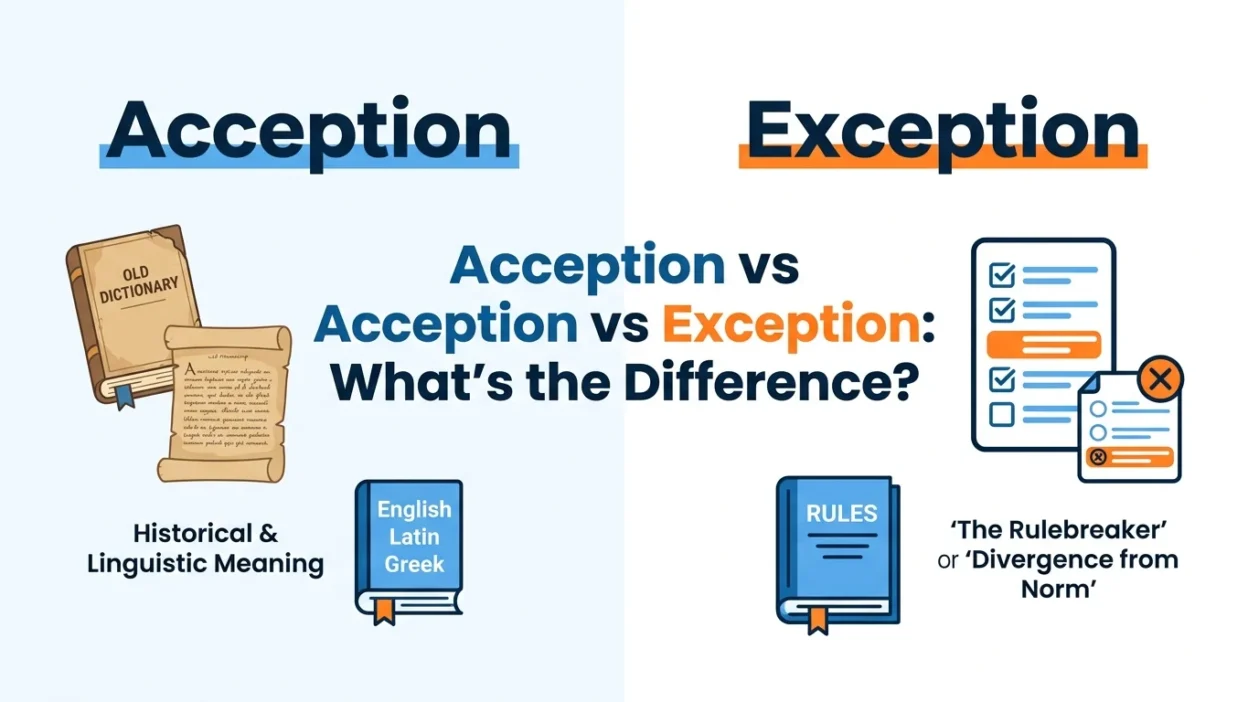
Many English learners confuse acception and exception because they look and sound somewhat similar. However, these two words are not interchangeable, and one of them is extremely uncommon in modern English. Understanding the difference can help you avoid writing mistakes and improve your vocabulary.
If you’ve ever wondered whether acception is a real word or simply a misspelling of exception, you’re not alone. This guide explains the meaning, pronunciation, usage, examples, and common mistakes in simple English. By the end, you’ll know exactly when to use each word and remember the difference with an easy memory trick.
Quick Answer
Exception is the correct word in almost every modern English context. It means something or someone that does not follow a general rule. Acception is a real but very rare English word that means acceptance or a particular meaning of a word, mostly in historical or linguistic texts. For everyday writing and speaking, you almost always need exception.
Why People Confuse Acception and Exception
People often mix up these words because:
- They have similar spelling.
- Both begin with “ac” or “ex” and end with “-ception.”
- Their pronunciation is somewhat alike.
- Spell check tools may not clearly explain the difference.
- Most people have never encountered the rare word acception.
The biggest source of confusion is assuming acception is another spelling of exception. It isn’t.
What Does “Acception” Mean?
Acception is a real English noun, but it is very rare in modern usage.
Meaning
It refers to:
- Acceptance or receiving something.
- A particular meaning or sense of a word in linguistics or older literature.
Example
- In its original acception, the word had a different meaning.
- The older acception of the term is rarely used today.
Is It Common?
No.
Outside dictionaries, historical writing, or linguistic discussions, most native English speakers never use acception.
What Does “Exception” Mean?
Exception is a common English noun.
Meaning
It refers to:
- Someone or something that does not follow a rule.
- A case that is excluded from a general statement.
Examples
- Everyone passed the exam, with one exception.
- There are no exceptions to the safety rules.
- This restaurant is an exception because it stays open all night.
This is the word you will use in almost every everyday situation.
Acception vs Exception Comparison Table
| Feature | Acception | Exception |
| Meaning | Acceptance or a particular meaning of a word | Something excluded from a rule |
| Common Today | Very rare | Very common |
| Everyday English | Almost never used | Frequently used |
| Part of Speech | Noun | Noun |
| Common Context | Linguistics, historical texts | Daily conversation and writing |
| Example | The original acception of the word | There is one exception to the rule |
When to Use Each Word
Use Acception When:
- Discussing historical meanings of words.
- Writing about linguistics.
- Referring to an older sense or acceptance in formal historical texts.
Use Exception When:
- Talking about rules.
- Mentioning something different from the rest.
- Writing emails, essays, reports, or conversations.
- Explaining exclusions.
Rule of thumb: If you’re unsure, exception is almost certainly the correct choice.
Examples of Acception and Exception
Here are more than ten examples to make the difference clear.
Acception
- The word had a different acception in medieval English.
- Its earliest acception has disappeared from modern dictionaries.
- Scholars discussed the original acception of the phrase.
- The historical acception differs from today’s meaning.
- This acception appears only in ancient texts.
Exception
- Every employee attended except one exception.
- There is no exception to the dress code.
- His case is an exception to the general rule.
- The teacher made an exception for the sick student.
- All birds can fly, with a few exceptions.
- This policy has one important exception.
- She rarely makes an exception.
Common Mistakes
Avoid these frequent errors:
❌ There is one acception to the rule.
✅ There is one exception to the rule.
❌ This is an acception to the policy.
✅ This is an exception to the policy.
❌ I made an acception for him.
✅ I made an exception for him.
Remember that acception is not another spelling of exception.
Memory Trick
Think of the letter X in exception.
EXception = eXcluded from the rule.
The X reminds you that something is left out or excluded.
For acception, think of accept because the rare word originally relates to acceptance or an accepted meaning.
American vs British English
There is no spelling difference between American and British English.
| American English | British English |
| Exception | Exception |
| Acception (rare) | Acception (rare) |
Both varieties use exception in normal writing. Acception remains rare in both.
Similar Words
These words are often confused with exception:
- Acceptance
- Acceptation
- Exemption
- Exclusion
- Acceptance vs Acceptation
- Except
- Exceptional
- Exclusive
- Inclusion
Learning these related words helps build a stronger English vocabulary.
Final Verdict
For nearly every situation, exception is the correct word.
Use exception when talking about something that does not follow a rule.
Use acception only when discussing historical language or the meaning of words in specialized linguistic contexts.
If you’re writing emails, essays, blog posts, exams, or business documents, you almost certainly want exception, not acception.
Frequently Asked Questions
Is acception a real English word?
Yes. It is a genuine English word, but it is extremely rare and mostly appears in linguistic or historical writing.
Is acception the same as exception?
No. They have completely different meanings and should not be used interchangeably.
Which word is more common?
Exception is vastly more common and is the correct choice for everyday English.
Can I use acception instead of exception?
No. In almost every case, replacing exception with acception is incorrect.
What does exception mean?
It means a person, thing, or situation that does not follow a general rule.
Why have I never seen acception before?
Because modern English rarely uses it outside dictionaries, historical works, and language studies.
Is acception a spelling mistake?
Not always. It’s a legitimate but uncommon word. However, many people accidentally type acception when they actually mean exception.
Remember This
Exception = Something left out of a rule.
Acception = A rare word meaning acceptance or a particular sense of a word.
If you’re writing everyday English, choose exception.
Conclusion
Although acception and exception look alike, their meanings and usage are very different. Exception is one of the most common English nouns and appears in everyday speech, writing, education, and business. It describes something that does not follow a general rule or pattern.
Acception, on the other hand, survives mainly in historical and linguistic contexts. Unless you’re discussing the meaning of words in older texts, you probably won’t need it. Remember this simple rule: if you’re talking about rules, exclusions, or something different from the norm, exception is almost always the right choice.

Adam Aaron writes engaging mystery and adventure novels featuring intelligent characters, unexpected twists, and emotional storytelling. His creative imagination and compelling narratives have earned admiration from readers across generations.