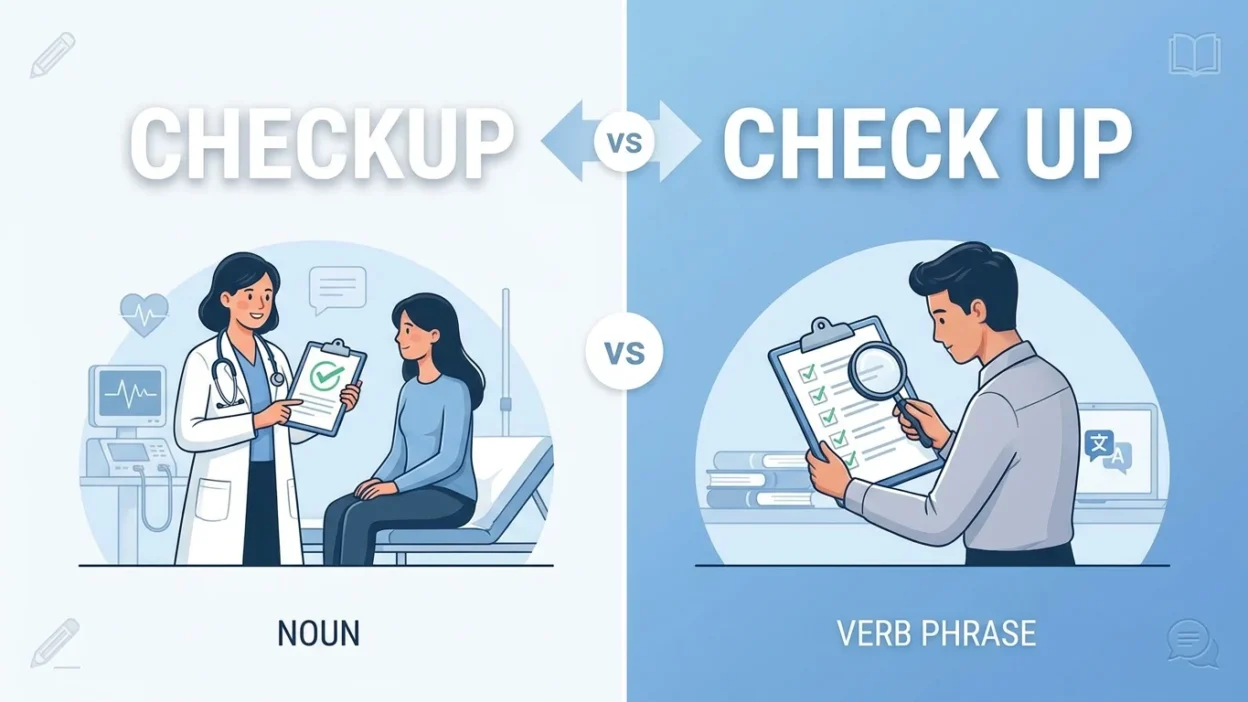
If you have ever wondered whether “checkup” or “check up” is correct, you are not alone. These two forms look almost identical, but they serve different grammatical purposes. The good news is that the distinction is fairly simple once you know what role each form plays in a sentence. Checkup is usually a noun meaning a routine examination, especially a medical examination. Check up, on the other hand, is a verb phrase meaning to examine, investigate, or make sure that something is correct or in good condition.
Understanding the difference matters because English often changes meaning when words are written together or separately. Knowing when to use checkup vs check up can help you write more naturally in emails, school assignments, workplace communication, and everyday conversations. In this guide, we will look at their meanings, grammar, examples, common mistakes, and differences in American and British English.
Quick Answer
Checkup is a noun, usually referring to a routine medical examination: “I have a checkup tomorrow.” Check up is a verb phrase meaning to examine or investigate: “The doctor will check up on you.” Use checkup for the examination itself and check up for the action of checking.
Why People Confuse It
The confusion comes from the fact that checkup and check up sound very similar and are closely related in meaning.
English frequently combines words that originally functioned separately. As a result, learners may be unsure whether a particular expression should be written as one word, two words, or sometimes even with a hyphen.
The key difference is part of speech:
- Checkup → noun
- Check up → verb phrase
- Check up on → phrasal verb meaning to investigate or make sure someone or something is okay
Compare:
I need a checkup.
The doctor will check up on me.
In the first sentence, checkup is the name of an examination. In the second, check up describes an action.
First Word: Checkup
Checkup is a noun. It usually means a routine examination, particularly one performed by a doctor or other healthcare professional.
Examples
- I have a doctor’s checkup next week.
- My annual checkup went well.
- The dentist recommended a regular checkup.
- She scheduled a routine checkup.
The word can also be used more broadly for an examination or assessment intended to determine whether something is functioning properly.
For example:
The mechanic gave the car a complete checkup.
Here, checkup refers to an inspection rather than a medical examination.
Is “checkup” one word?
Yes. When you are using it as a noun, checkup is normally written as one word.
Correct:
I have a checkup tomorrow.
Incorrect in standard usage:
I have a check up tomorrow.
Second Word: Check Up
Check up consists of the verb check and the particle up. It is generally used as part of a verb phrase.
The expression check up on someone or something means to investigate, monitor, or make sure that the person or thing is okay.
Examples
- I called to check up on my parents.
- The manager will check up on the project later.
- The nurse checked up on the patient.
- We should check up on the equipment before using it.
Notice that check up often appears with on.
There is also the expression check up, particularly in some contexts, meaning to examine or verify something. However, when referring specifically to a routine medical examination, checkup is the natural noun.
Comparison Table
| Term | Part of Speech | Meaning | Example |
| checkup | Noun | A routine examination | I have a medical checkup tomorrow. |
| check up | Verb phrase | To examine, investigate, or verify | I need to check up on the report. |
| check up on | Phrasal verb | To investigate or make sure someone/something is okay | She checked up on her children. |
| check | Verb/Noun | To examine, verify, or inspect | Please check the information. |
The simplest rule is: the examination is a checkup; the action of investigating or monitoring is to check up on something or someone.
When to Use Each
Use checkup when you are talking about an examination as a thing or event.
Use “checkup” when:
- Talking about a medical examination
- Referring to a routine examination
- Naming an inspection or assessment
- Using the word as a noun
Examples:
I need a yearly checkup.
Her checkup was completely normal.
Use check up when describing an action.
Use “check up” when:
- Someone investigates something
- Someone verifies information
- Someone makes sure a person is okay
- You use the expression check up on
Examples:
I’ll check up on the situation.
She checked up on her older people neighbor.
A useful test is to ask yourself:
“Am I talking about the examination, or am I talking about the act of checking?”
If it is the examination itself, choose checkup. If it is the action, use check up.
Examples of Checkup vs Check Up
Here are more examples to make the difference clear:
- I have a medical checkup on Friday.
→ Checkup is a noun. - The doctor recommended an annual checkup.
→ The word refers to the examination. - She went to the clinic for her checkup.
→ Again, it is a noun. - I need to check up on the children.
→ Check up on describes an action. - The supervisor checked up on the employees.
→ The supervisor investigated or monitored them. - He called to check up on his friend.
→ He wanted to make sure his friend was okay. - My dentist says I should have a regular checkup.
→ Checkup means an examination. - I’ll check up on those figures before we publish them.
→ The speaker will verify the figures. - The mechanic performed a complete checkup of the vehicle.
→ Checkup is being used as a noun for an inspection. - The nurse checked up on the patient during the night.
→ Checked up on is a verb phrase. - Her annual checkup showed that everything was fine.
→ The examination itself is a checkup. - We should check up on the equipment before the presentation.
→ The phrase describes an inspection or verification.
Common Mistakes
1. Writing “check up” as a noun
A common mistake is:
I have a check up tomorrow.
For a routine examination, the standard spelling is:
I have a checkup tomorrow.
2. Writing “checkup on” when you need a verb
You would not normally say:
I will checkup on him.
Instead, write:
I will check up on him.
Here, check up is functioning as a verb phrase.
3. Confusing “checkup” with “check”
These words are related but are not always interchangeable.
The doctor gave me a checkup.
This means a medical examination.
The doctor checked my blood pressure.
This describes a specific action.
4. Assuming “up” always belongs to the verb
English phrasal verbs can be tricky because particles such as up, out, and off can change meaning. In checkup, however, the two elements have formed a single noun.
5. Using “checkup” as a verb
Avoid:
The doctor will checkup the patient.
Better:
The doctor will check the patient.
Or, depending on the intended meaning:
The doctor will check up on the patient.
Memory Trick
Use this simple memory trick:
One word = one thing.
Two words = an action.
Think:
- A checkup = an examination
- To check up on = to investigate or make sure someone/something is okay
You can remember it with this sentence:
“The checkup is the event; check up is the action.”
If you can put “a” or “my” before the word, checkup is likely correct:
- a checkup
- my checkup
- her checkup
- an annual checkup
If you can put “will,” “can,” or “should” before check, you are probably dealing with the verb:
- will check up
- can check up
- should check up
American vs British English
Checkup is well established in American English as a noun, particularly for a routine medical examination.
British English also commonly uses check up, with a hyphen, especially in traditional British usage.
For example:
- American English: I have a checkup tomorrow.
- British English: I have a check up tomorrow.
The meaning is essentially the same. The spelling difference is mainly a matter of regional and editorial convention.
Meanwhile, the verb phrase remains separate:
I need to check up on him.
So if you are writing for an American audience, checkup is a natural noun spelling. For British audiences, check up is also widely encountered.
Similar Words
Several related words can cause similar confusion.
Check
Check means to examine, inspect, verify, or look at something.
Please check your email.
Examination
Examination is a formal noun for the act or process of examining something.
The doctor performed an examination.
Inspection
Inspection usually refers to a careful examination to assess condition, quality, or compliance.
The building passed its inspection.
Screening
Screening often refers to testing intended to detect a disease or condition before symptoms appear.
She went for a cancer screening.
Check in
Check in is different from checkup. It can refer to registering at a hotel, airport, or event, or making brief contact with someone.
Hotel check in begins at 3 p.m.
Follow up
A follow up is a subsequent appointment, action, or examination after an earlier event.
The doctor scheduled a follow up appointment.
These terms are related to checking or examining, but they should not be treated as synonyms in every context.
Final Verdict
So, checkup vs check up is not really a question of choosing one universally correct spelling. Both are correct, but they perform different grammatical jobs.
Use checkup when you mean an examination, especially a routine medical examination. Use check up when you are describing the action of investigating or monitoring something, especially in the phrase check up on.
Remember This
Checkup = the examination.
Check up = the action.
If you remember that simple distinction, you will know when to write checkup and when to write check up.
FAQs
1. Is it “checkup” or “check up”?
Both are correct, but they have different functions. Checkup is a noun meaning an examination. Check up is a verb phrase, commonly used in check up on, meaning to investigate or make sure someone or something is okay.
2. Is “checkup” one word?
Yes. Checkup is normally written as one word in American English when it is used as a noun.
I have a checkup tomorrow.
British English commonly uses check up with a hyphen.
3. Is “check up” a phrasal verb?
Yes. Check up on is a phrasal verb meaning to investigate, monitor, or make sure that someone or something is okay.
I called to check up on her.
4. Is “medical checkup” correct?
Yes. Medical checkup is a standard expression meaning a routine medical examination.
He goes for a medical checkup every year.
5. Can “checkup” be used as a verb?
No, not in standard modern English. Use check, check on, or check up on, depending on the intended meaning.
6. Is “check up” British or American?
Check up is particularly common in British English. American English generally prefers checkup as the noun.
7. What is the difference between “checkup” and “check up”?
They generally have the same meaning when used as nouns. Checkup is the usual American spelling, while check up is common in British English.
Conclusion
The difference between checkup and check up becomes easy once you focus on grammar rather than pronunciation. Checkup is a noun for an examination, especially a routine medical examination. Check up is a verb phrase describing the act of investigating, verifying, or monitoring something, often followed by on.
For everyday writing, remember the practical rule: “I have a checkup” but “I will check up on him.” American English generally writes the noun as checkup, while British English often uses check up. With this distinction in mind, you can avoid one of the most common spelling and usage mistakes involving the word check.

Nova Turner specializes in imaginative science fiction blending futuristic technology, thrilling adventures, and powerful human emotions. Her innovative storytelling inspires curiosity, creativity, and exploration among readers of every age.