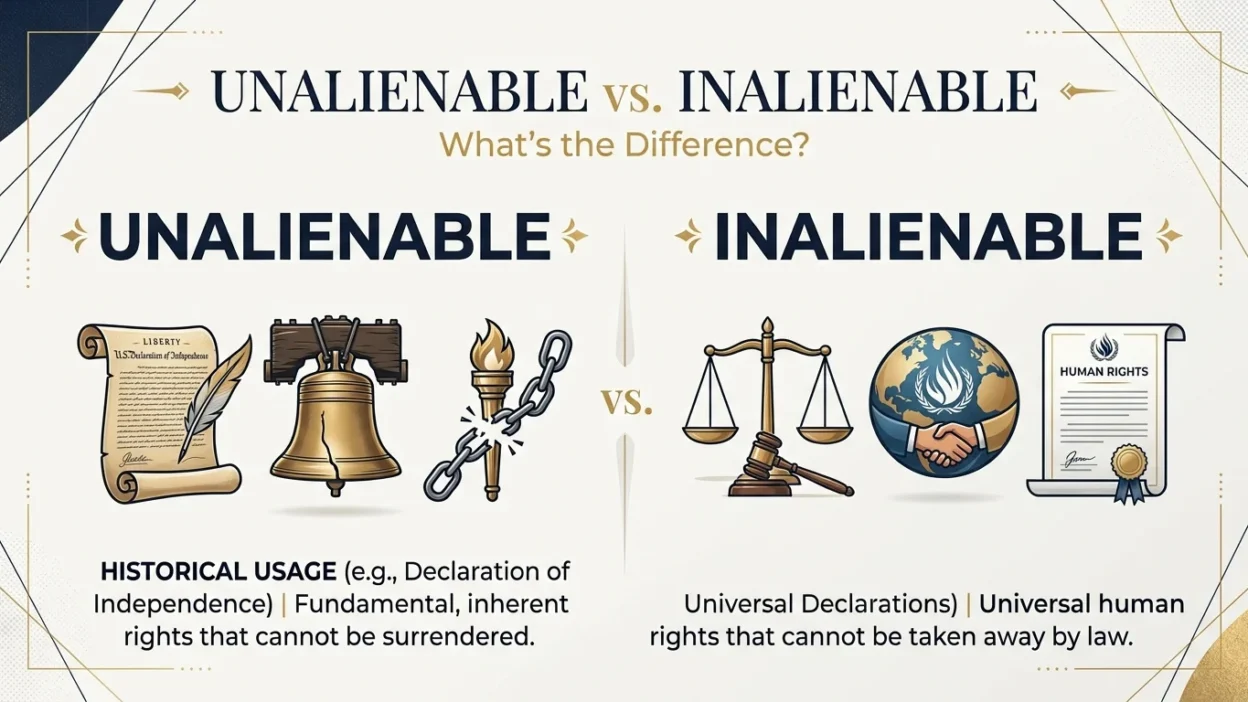
If you have ever seen both unalienable and inalienable, you may have wondered whether one is correct and the other is a spelling mistake. The good news is that both words are legitimate English adjectives, and both describe something that cannot be taken away, transferred, surrendered, or separated from its owner.
Their meanings are so close that dictionaries often treat them as synonyms. However, one form appears more frequently in modern English, while the other has a particularly strong association with historical, legal, and political language.
Understanding the difference between unalienable vs. inalienable is useful because these words often appear in discussions about human rights, freedom, liberty, ownership, and constitutional principles.
Although they can usually be substituted for each other without changing the basic meaning, their usage and historical associations are worth knowing. In this guide, we will examine both words, compare their meanings, look at practical examples, and explain which form sounds more natural in different contexts.
Quick Answer
Unalienable and inalienable have essentially the same meaning: something that cannot be surrendered, transferred, or taken away. Inalienable is generally more common in modern English, while unalienable is especially familiar from the phrase “unalienable Rights” in the U.S. Declaration of Independence.
Why People Confuse It
The confusion comes from both words being built around the adjective alienable, which means capable of being transferred or given away.
The prefixes in- and un- can both create negative meanings in English:
- alienable → capable of being transferred
- inalienable → not capable of being transferred
- unalienable → not capable of being transferred
This makes the two forms look almost interchangeable—and, in meaning, they largely are.
The bigger distinction is usage and historical association, rather than definition.
First Word: Unalienable
Unalienable means impossible to give away, transfer, surrender, or take away.
It is an adjective and is particularly well known because of the famous phrase “unalienable Rights” in the United States Declaration of Independence.
For example:
Every person possesses certain unalienable rights.
The word can be used outside political writing, too, although it tends to have a more formal or historical tone.
Meaning of Unalienable
Depending on context, unalienable can mean:
- Impossible to transfer
- Impossible to surrender
- Impossible to take away
- Permanently belonging to someone
- Inherent and fundamental
Example
Freedom is an unalienable part of human dignity.
Here, unalienable emphasizes that freedom is regarded as something inherent rather than something that can simply be handed over.
Second Word: Inalienable
Inalienable has essentially the same meaning as unalienable.
It describes something that cannot legally, morally, or inherently be transferred, surrendered, or taken away.
For example:
Human beings have inalienable rights to dignity and freedom.
Inalienable is the more commonly encountered form in contemporary general and formal English.
It frequently appears in discussions involving:
- Human rights
- Civil liberties
- Personal freedoms
- Constitutional law
- Political philosophy
- Moral principles
- Fundamental rights
Meaning of Inalienable
Inalienable can describe something that is:
- Impossible to transfer
- Impossible to surrender
- Inherently possessed
- Permanently attached to a person or status
- Fundamental rather than temporary
For most modern writing, inalienable is the safer everyday choice when you need this meaning.
Comparison Table
| Feature | Unalienable | Inalienable |
| Basic meaning | Cannot be transferred or taken away | Cannot be transferred or taken away |
| Part of speech | Adjective | Adjective |
| Correct English? | Yes | Yes |
| Modern frequency | Less common | More common |
| Historical association | Strong, especially in U.S. founding language | Broad modern and formal usage |
| Common context | Rights, liberty, historical documents | Rights, law, ethics, politics |
| Example | Unalienable rights | Inalienable rights |
| Interchangeable? | Usually | Usually |
When to Use Each
In most contemporary writing, inalienable is the more natural choice.
Use inalienable when you are writing a modern article, academic paper, legal discussion, formal essay, or general explanation.
Education is sometimes described as an inalienable part of human dignity.
Choose unalienable when you are:
- Quoting or discussing historical American language
- Referring specifically to the Declaration of Independence
- Deliberately using an older or more traditional expression
- Preserving the wording of a historical document
For example:
The Declaration of Independence refers to “unalienable Rights.”
A Simple Rule
If you are unsure which word to use in modern writing, choose inalienable.
If you are discussing the exact historical wording of the Declaration of Independence, unalienable may be the appropriate form.
Examples
Here are examples showing how both words work in context:
- Every individual has inalienable rights.
- The Declaration of Independence speaks of unalienable Rights.
- Freedom of conscience is considered by many to be inalienable.
- The constitution protects certain inalienable freedoms.
- They argued that human dignity is an inalienable value.
- The document describes liberty as an unalienable right.
- No government should deny people their inalienable human rights.
- The author used the historical term “unalienable” deliberately.
- The right to personal dignity is often described as inalienable.
- The founders believed certain rights were unalienable.
- She regarded freedom as an inalienable part of human existence.
- The speech referred to the unalienable nature of individual liberty.
- Some philosophers consider moral autonomy an inalienable human characteristic.
- The phrase “unalienable Rights” has become closely associated with American history.
Notice that replacing inalienable with unalienable, or vice versa, would usually preserve the basic meaning. The main change would be stylistic or historical.
Common Mistakes
1. Assuming “unalienable” is incorrect
It is not incorrect.
Unalienable is a legitimate English word with the same basic meaning as inalienable.
2. Assuming “inalienable” means something different
In most contexts, it does not.
Both words describe something that cannot be alienated—that is, transferred, surrendered, or separated from its holder.
3. Using “inalienable” when quoting a historical source
If you are reproducing the exact wording of a historical document, changing the word can make the quotation inaccurate.
The U.S. Declaration of Independence famously uses “unalienable Rights.”
4. Treating “unalienable” as a spelling error
The spelling may look unusual to modern readers, but it is established English.
5. Confusing the words with “inalienable ownership”
The meaning depends on context. Inalienable does not simply mean “something I own.” It suggests that the right, quality, or possession cannot be transferred or surrendered.
Memory Trick
Here is an easy way to remember the distinction:
INALIENABLE = the modern default.
Think:
Inalienable = impossible to alienate.
The word alienate can mean to transfer or separate something from its original holder.
So:
alienable → can be transferred
inalienable → cannot be transferred
For unalienable, remember its famous historical connection:
UNALIENABLE → “Unalienable Rights” → Declaration of Independence
This makes it easier to remember why you may encounter both forms.
American vs British English
There is no major difference in basic meaning between unalienable and inalienable in American and British English.
However, American English has a particularly strong historical association with unalienable because of the Declaration of Independence and its famous reference to “unalienable Rights.”
In contemporary English on both sides of the Atlantic, inalienable is generally the more familiar and versatile form.
So, if you are writing for an international audience and are not referring to a historical quotation, inalienable is usually the best choice.
Similar Words
Several related words can help clarify the meaning:
Alienable
Alienable means capable of being transferred or surrendered.
The property is alienable under the terms of the agreement.
Inalienable
Inalienable means impossible to transfer or surrender.
Freedom is considered an inalienable right.
Unalienable
Unalienable also means impossible to transfer or surrender.
The document describes liberty as an unalienable right.
Inherent
Inherent means naturally existing as part of something.
Human dignity is an inherent quality.
Indefeasible
Indefeasible means unable to be defeated, annulled, or made void, particularly in legal contexts.
Although these words overlap in some situations, they are not perfect synonyms.
Final Verdict
Unalienable and inalienable are both correct words, and they have essentially the same meaning. Both describe something that cannot be transferred, surrendered, separated, or taken away.
The practical difference is mainly one of frequency, style, and historical association. Inalienable is generally the better choice for modern English, while unalienable has a distinctive historical connection with the language of the U.S. Declaration of Independence.
Remember This
Inalienable = the common modern choice.
Unalienable = equally valid, but strongly associated with historical language, especially “unalienable Rights.”
If you are writing a modern sentence and are unsure which form to choose, inalienable will usually be the safest option.
Frequently Asked Questions
Is “unalienable” a real word?
Yes. Unalienable is a legitimate English adjective meaning something cannot be transferred, surrendered, or taken away.
Is “inalienable” or “unalienable” more common?
Inalienable is generally more common in modern English. Unalienable remains familiar because of its use in the U.S. Declaration of Independence.
Are unalienable and inalienable synonyms?
Yes. In ordinary usage, they are essentially synonyms. Both refer to something that cannot be transferred or surrendered.
Why does the Declaration of Independence say “unalienable Rights”?
The Declaration uses the historical form “unalienable Rights.” That wording has become especially famous in American political and historical language.
Can I use “inalienable rights” in American English?
Absolutely. Inalienable rights is standard modern English and is widely used in legal, political, academic, and human rights discussions.
Is “unalienable rights” grammatically correct?
Yes. Unalienable rights is grammatically correct. It is simply less common in general modern usage than inalienable rights.
Which word should I use in formal writing?
For most modern formal writing, inalienable is the safest choice. Use unalienable when historical wording, quotation, or stylistic context makes it appropriate.
Conclusion
The choice between unalienable vs. inalienable is much less complicated once you understand that both words essentially express the same idea. Each describes something that cannot be transferred, surrendered, or taken away. The main distinction is not meaning but usage: inalienable is generally more common today, while unalienable carries a stronger historical association.
When writing a modern article, essay, or formal document, inalienable will usually sound natural and familiar. If you are discussing the Declaration of Independence or intentionally preserving historical language, unalienable may be the better choice. Both are correct, so you do not need to treat one as a spelling mistake.

Willow Evans writes uplifting fantasy stories filled with magical worlds, courageous heroes, and meaningful life lessons. Her imaginative books encourage creativity, kindness, and hope in readers of all ages.