Many English learners and even native speakers confuse opposed and apposed because the words look and sound similar. However, these terms have very different meanings and are used in completely different contexts. Choosing the wrong one can change the meaning of a sentence and make your writing less precise.
Understanding the distinction between opposed vs apposed is especially important in academic writing, biology, grammar, and everyday communication. While opposed is common in regular conversation and means “against” or “in disagreement,” apposed is a specialized term used to describe things placed side by side. This guide explains the meanings, examples, and differences in simple language so you can use each word correctly with confidence.
Quick Answer
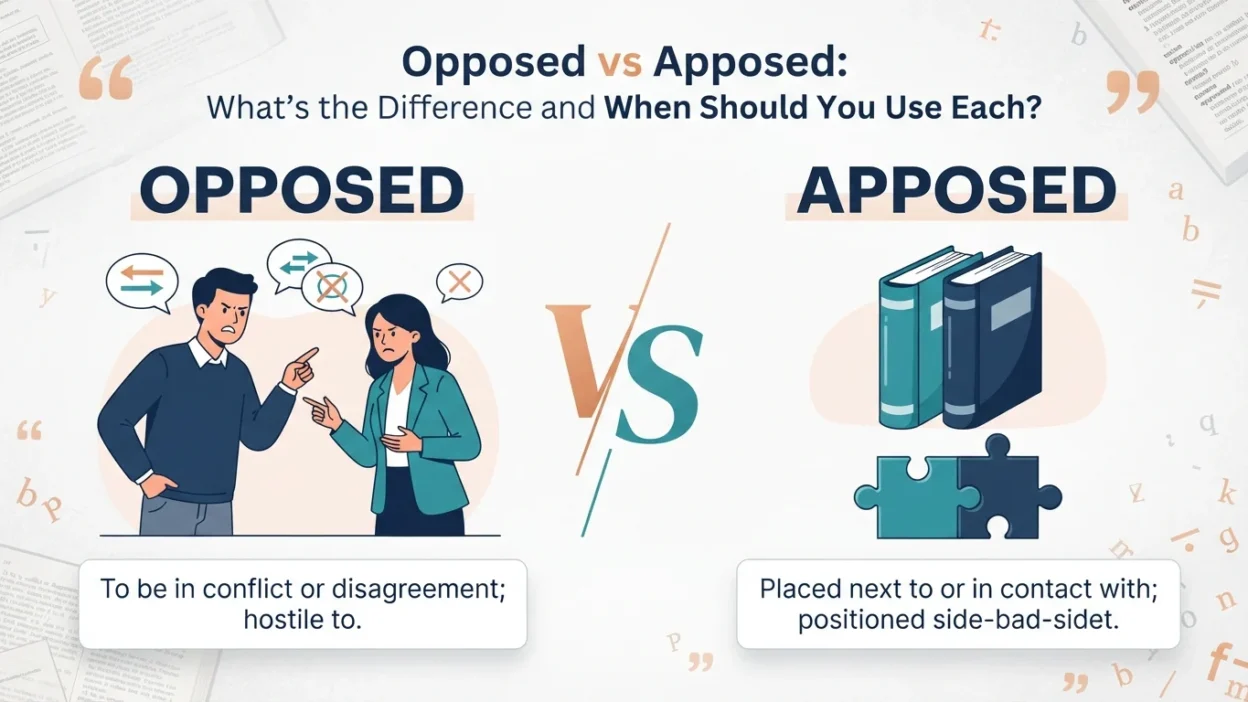
Opposed means against, contrary to, or in disagreement with something. Apposed means placed next to or side by side, often in technical, grammatical, or scientific contexts. Use opposed when talking about conflict or disagreement, and use apposed when describing position, arrangement, or apposition.
Why People Confuse It
People often mix up opposed and apposed because:
- They differ by only one letter.
- Both are past participle forms ending in -posed.
- They have similar pronunciation in fast speech.
- Apposed is much less common, so writers sometimes assume opposed is always correct.
- Both words can appear in formal or academic writing.
Despite these similarities, their meanings are unrelated.
What Does “Opposed” Mean?
Opposed is the past form and adjective form of the verb oppose, which means:
- To disagree with
- To resist
- To be against something
Common meanings of opposed:
- Opposed to an idea
- Opposed to a policy
- Opposed forces in a conflict
- Opposed viewpoints
Examples:
- Many residents were opposed to the new construction project.
- She is strongly opposed to smoking indoors.
- The two teams held opposed positions during the debate.
- They remained firmly opposed throughout the negotiations.
LSI keywords: against, disagreement, resistance, contrary opinions, conflict, opposing views.
What Does “Apposed” Mean?
Apposed comes from the verb appose, meaning to place something next to another thing.
The word is commonly used in:
- Grammar
- Anatomy
- Biology
- Medicine
- Technical writing
Examples of apposed:
- Two leaves were apposed along the stem.
- The doctor observed apposed tissue surfaces.
- In grammar, an appositive noun is apposed to another noun.
Because it is a technical term, apposed is much less common in everyday English.
LSI keywords: placed side by side, adjacent, apposition, anatomy terms, grammatical structure.
Opposed vs Apposed: Comparison Table
| Feature | Opposed | Apposed |
| Meaning | Against or in disagreement | Placed next to something |
| Verb Origin | Oppose | Appose |
| Usage | Everyday and formal English | Technical and academic English |
| Context | Arguments, opinions, policies | Grammar, anatomy, biology |
| Commonness | Very common | Rare |
| Example | She opposed the proposal. | The structures were apposed. |
When to Use Each Word
Use opposed when:
- Talking about disagreement
- Expressing resistance
- Describing conflicting ideas
- Discussing debates or opinions
Use apposed when:
- Describing objects placed side by side
- Writing about grammar
- Discussing anatomy or biology
- Using technical language
A simple test:
- If the meaning is against, choose opposed.
- If the meaning is next to, choose apposed.
Examples of Opposed and Apposed in Sentences
Here are more examples to clarify the difference:
Opposed Examples
- The committee was opposed to the budget cuts.
- He remained opposed to the decision.
- The lawyer argued against the opposed side.
- Public opinion was strongly opposed.
- They held opposed political views.
- Several groups were opposed to the law.
Apposed Examples
- The petals were neatly apposed.
- The scientist described the apposed surfaces.
- The cells remained closely apposed.
- In the sentence, the descriptive noun was apposed to the subject.
- The tissues became apposed during healing.
- The structures appeared tightly apposed under the microscope.
Common Mistakes
Writers often make these errors:
❌ The citizens were apposed to the proposal.
✅ The citizens were opposed to the proposal.
❌ Two tissue layers were opposed in the diagram.
✅ Two tissue layers were apposed in the diagram.
❌ She is apposed to the plan.
✅ She is opposed to the plan.
Always check whether you mean disagreement or physical placement.
Memory Trick
A simple way to remember the difference:
- Opposed = Opponent = Against
- Apposed = Adjacent = Next to
The letter A in apposed can remind you of adjacent.
American vs British English
There is no significant difference between American and British English in the meanings of opposed and apposed.
However:
- Opposed is common in both varieties.
- Apposed remains a specialized term in academic, scientific, and grammatical writing in both the US and the UK.
Similar Words
You may also encounter these related words:
- Opposing – conflicting or against
- Contrary – different or opposite
- Resistant – unwilling to accept
- Adjacent – next to
- Appositive – a grammatical noun placed beside another noun
- Juxtaposed – placed side by side for comparison
Remember This
Opposed means against. Apposed means beside.
If people are disagreeing, use opposed. If things are physically next to each other, use apposed.
Final Verdict
Although opposed and apposed differ by only one letter, they serve completely different purposes. Opposed is a common word used to express disagreement, conflict, or resistance. It appears frequently in everyday conversations, news articles, and formal writing.
Apposed, on the other hand, is a technical term that describes objects, structures, or words placed side by side. It is most often found in scientific, medical, or grammatical contexts. Remember the simple rule: against equals opposed; next to equals apposed.
Frequently Asked Questions
Is apposed a real English word?
Yes. Apposed is a correct English word, mainly used in technical, medical, biological, and grammatical contexts.
What does opposed mean?
Opposed means against, in disagreement, or resistant to something.
Can apposed mean against?
No. Apposed refers to things placed side by side, not disagreement.
Which word is more common?
Opposed is far more common in everyday English.
Is apposed used in grammar?
Yes. In grammar, words or phrases can be apposed to another noun as an appositive structure.
How do I remember the difference?
Think: Opposed = Opponent and Apposed = Adjacent.
Are opposed and opposite the same?
Not exactly. Opposed means against, while opposite refers to position, direction, or contrast.
Conclusion
Confusing opposed vs apposed is understandable because the words look alike, but their meanings are very different. Opposed relates to disagreement, resistance, or conflict, while apposed refers to things placed side by side.
By remembering the simple rule opposed means against, apposed means beside you can avoid common mistakes and use both words accurately in writing and speech. A small spelling difference can make a big difference in meaning.

Nova Turner specializes in imaginative science fiction blending futuristic technology, thrilling adventures, and powerful human emotions. Her innovative storytelling inspires curiosity, creativity, and exploration among readers of every age.