“Eaten” and “ate” both come from the verb eat, so it is easy to assume they can be used interchangeably. They cannot. The main difference is grammatical: ate is the simple past tense of eat, while eaten is the past participle. Knowing which form to choose depends largely on whether you are using a helping verb such as have, has, or had.
This distinction becomes much easier once you understand verb forms and sentence structure. You generally use ate when describing a completed action in the past: “I ate breakfast at seven.” You use eaten in perfect tenses or after certain auxiliary verbs: “I have eaten breakfast.” In this guide, we’ll compare eaten vs ate, explain their meanings and grammatical roles, examine common mistakes, and provide practical examples so you can use both forms naturally and confidently.
Quick Answer
Ate is the simple past tense of eat, while eaten is its past participle. Use ate for a completed past action and eaten with have, has, or had in perfect constructions. For example: “She ate lunch” but “She has eaten lunch.”
Why People Confuse It
The confusion happens because ate and eaten are two forms of the same irregular verb:
- Eat — present/base form
- Ate — simple past
- Eaten — past participle
Unlike regular verbs, eat does not form its past tense by simply adding -ed.
For example:
- I eat breakfast every morning.
- I ate breakfast yesterday.
- I have eaten breakfast already.
The biggest clue is the word that comes before the verb. If you see have, has, or had, you will normally need eaten, not ate.
First Word: Eaten
Eaten is the past participle of eat. It is not normally used by itself to express a completed past action.
It commonly appears with auxiliary verbs such as:
- have eaten
- has eaten
- had eaten
- will have eaten
Examples
- I have eaten already.
- She has eaten breakfast.
- They had eaten before we arrived.
- By noon, he will have eaten lunch.
The word eaten can also appear in passive constructions:
- The cake was eaten by the children.
- All the cookies have been eaten.
Key point
Think of eaten as a form that usually needs a helping verb when it is functioning as a verb in a perfect tense.
Second Word: Ate
Ate is the simple past tense of eat. Use it when talking about something that happened and finished in the past.
Examples:
- I ate breakfast at 8 a.m.
- She ate the entire sandwich.
- We ate at a restaurant last night.
- He ate too much yesterday.
Unlike eaten, ate does not require have, has, or had to make it a past tense verb.
Key point
Use ate when you are simply placing an eating action in the past.
Comparison Table
| Feature | Ate | Eaten |
| Verb form | Simple past | Past participle |
| Base verb | Eat | Eat |
| Typical use | Completed past action | Perfect tenses/passive constructions |
| Common pattern | Subject + ate | Subject + have/has/had + eaten |
| Example | I ate lunch. | I have eaten lunch. |
| Can it normally stand alone as the main past verb? | Yes | No |
| Time reference | Often a specific or finished past time | Often connected to another time or present result |
When to Use Each
Use “ate” for a completed past action
Choose ate when the sentence simply tells us that something happened in the past.
- I ate pizza last night.
- Maria ate breakfast before school.
- We ate at noon.
Specific past time expressions often work naturally with ate:
- yesterday
- last night
- this morning, when referring to a finished morning
- two hours ago
- last week
- in 2024
Use “eaten” with perfect tenses
Use eaten after have, has, or had when forming perfect constructions.
- I have eaten already.
- She has eaten dinner.
- They had eaten before the movie started.
The perfect construction often connects a past action with another time, event, or present situation.
A useful test
Ask yourself:
Do I have “have,” “has,” or “had” before the verb?
If yes, eaten is usually the correct choice.
I have eaten.
She has eaten.
They had eaten.
Not:
I have ate. ❌
She has ate. ❌
They had ate. ❌
Examples
Here are practical examples showing the difference between ate and eaten.
- I ate breakfast at seven.
Use ate because this is a simple past action. - I have eaten breakfast already.
Use eaten because it follows have. - She ate the last piece of cake.
The action happened in the past. - She has eaten the last piece of cake.
Has requires the past participle eaten. - We ate at an Italian restaurant yesterday.
The specific past time makes simple past natural. - We have eaten at that restaurant before.
The present perfect describes past experience. - He ate too much at dinner.
This is a straightforward completed past action. - He had eaten before the guests arrived.
Had eaten shows that one past action happened before another. - They ate all the sandwiches.
Simple past is correct. - They have eaten all the sandwiches.
Have eaten uses the past participle. - Did you eat lunch?
Notice that after did, we use the base form eat, not ate or eaten. - Have you eaten lunch?
Have is followed by the past participle eaten. - I ate sushi last Friday.
- I have eaten sushi many times.
These examples show an important pattern: ate describes a past event, while eaten is normally part of a larger verb construction.
Common Mistakes
1. “I have ate”
Incorrect: I have ate lunch.
Correct: I have eaten lunch.
After have, use the past participle eaten.
2. “She has ate”
Incorrect: She has ate already.
Correct: She has eaten already.
The pattern is:
has + eaten
3. “I eaten breakfast”
Incorrect: I eaten breakfast.
Correct: I ate breakfast.
Correct: I have eaten breakfast.
Eaten generally needs a helping verb in this type of sentence.
4. “Did you ate?”
Incorrect: Did you ate breakfast?
Correct: Did you eat breakfast?
After did, use the base form eat.
The same rule applies to other verbs:
- Did you go?
- Did she see it?
- Did they eat?
5. “I had ate”
Incorrect: I had ate before they arrived.
Correct: I had eaten before they arrived.
After had, use eaten.
Memory Trick
Use this simple three step pattern:
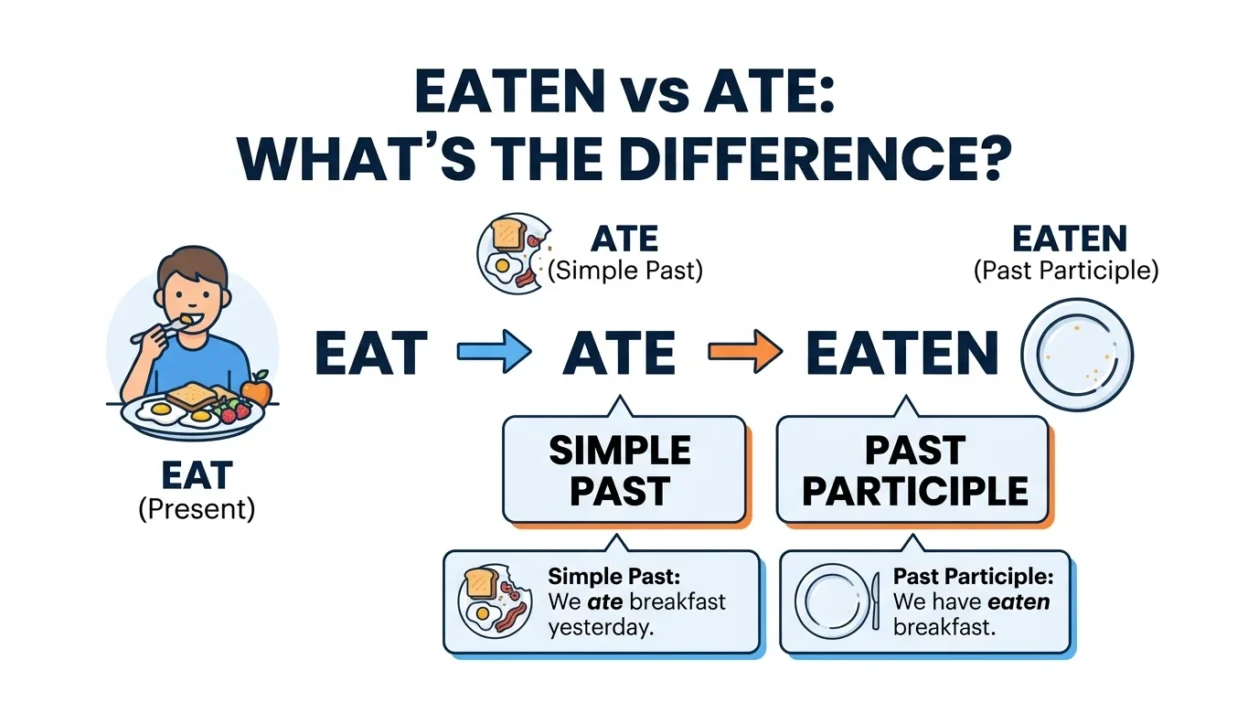
Eat → Ate → Eaten
Think of the forms as:
- Eat = now or general
- Ate = past
- Eaten = with a helper
A quick memory sentence is:
Yesterday I ate; today I have eaten.
For example:
- Yesterday, I ate pizza.
- I have eaten pizza before.
If you remember “helper verb + eaten,” you will avoid many common errors.
American vs British English
There is no major difference between American and British English in the basic distinction between ate and eaten.
Both varieties use:
- ate as the simple past form
- eaten as the past participle
For example, both American and British speakers would normally say:
- I ate breakfast at eight.
- I have eaten breakfast already.
There can be differences between American and British English in how the present perfect is used in certain contexts. For instance, British English may use the present perfect more frequently for recent events connected to the present, while American English can sometimes use the simple past in similar situations.
However, this does not change the basic grammatical forms:
eat → ate → eaten
Similar Words
Understanding eaten vs ate becomes easier when you compare them with other forms and related verbs.
Eat
Eat is the base or present form.
- I eat breakfast every day.
- Do you eat meat?
Ate
Ate is the simple past.
- I ate breakfast earlier.
- She ate the whole sandwich.
Eaten
Eaten is the past participle.
- I have eaten breakfast.
- They had eaten before we arrived.
Eating
Eating is the present participle or gerund.
- I am eating lunch.
- Eating too quickly can be uncomfortable.
So the complete basic pattern is:
eat → ate → eaten → eating
FAQs
Is “eaten” past tense?
Not exactly. Eaten is the past participle of eat. The simple past tense is ate.
Is “I have ate” grammatically correct?
No. The correct form is “I have eaten.” After have, use the past participle eaten.
Is “I ate” correct?
Yes. “I ate” is grammatically correct when describing a completed action in the past.
Can I say “I eaten”?
Usually, no. In a sentence such as “I ___ breakfast,” you need ate or have eaten: “I ate breakfast” or “I have eaten breakfast.”
Which is correct: “Have you ate?” or “Have you eaten?”
“Have you eaten?” is correct because have is followed by the past participle.
Which is correct: “Did you eat?” or “Did you ate?”
“Did you eat?” is correct. After did, use the base form eat.
What are the three forms of eat?
The three principal forms are:
eat — ate — eaten
The first is the base form, the second is the simple past, and the third is the past participle.
Remember This
Ate = simple past.
Eaten = past participle, usually used with a helping verb.
The easiest examples to remember are:
I ate breakfast yesterday.
I have eaten breakfast already.
If you see have, has, or had, think eaten. If you are simply describing a completed action in the past, think ate.
Final Verdict
The difference between eaten and ate is grammatical rather than a difference in meaning. Both refer to the act of consuming food, but they perform different jobs in a sentence. Ate is the simple past form, while eaten is the past participle.
When in doubt, look at the words around the verb. “I ate” works on its own as a simple past statement, while “I have eaten” uses eaten with a helping verb. Once you recognize this pattern, choosing between ate and eaten becomes much more natural.
Conclusion
Learning the difference between ate vs eaten is mainly about understanding English verb forms. Ate tells us that an eating action happened in the past, while eaten usually appears with auxiliary verbs such as have, has, or had. This small distinction can make a significant difference in grammatical accuracy.
The best way to remember the rule is to practice the three forms together: eat, ate, eaten. Say “I ate yesterday” for a simple past event, but say “I have eaten” when using the perfect tense. With that pattern in mind, you can confidently use these forms in everyday conversation and formal writing.

Hadley Price creates heartfelt contemporary fiction exploring relationships, hope, resilience, and personal growth. Her emotionally rich storytelling connects with readers through memorable characters and inspiring life experiences worldwide.