If you are unsure whether to write gluing or glueing, you are not alone. Both forms look reasonable because the verb glue ends in a vowel followed by a consonant, and English spelling rules can be surprisingly inconsistent when words take the -ing suffix. You may see both spellings online, in dictionaries, or in writing from different English speaking regions, which makes the choice even more confusing.
The good news is that there is a clear answer for modern standard English. Gluing is the preferred and most widely accepted spelling, particularly in American English and contemporary British English. Glueing is an older or less common variant that still appears occasionally, but it is generally not the best choice for modern everyday writing. Understanding why gluing is preferred will help you spell similar words correctly and write with greater confidence.
Quick Answer
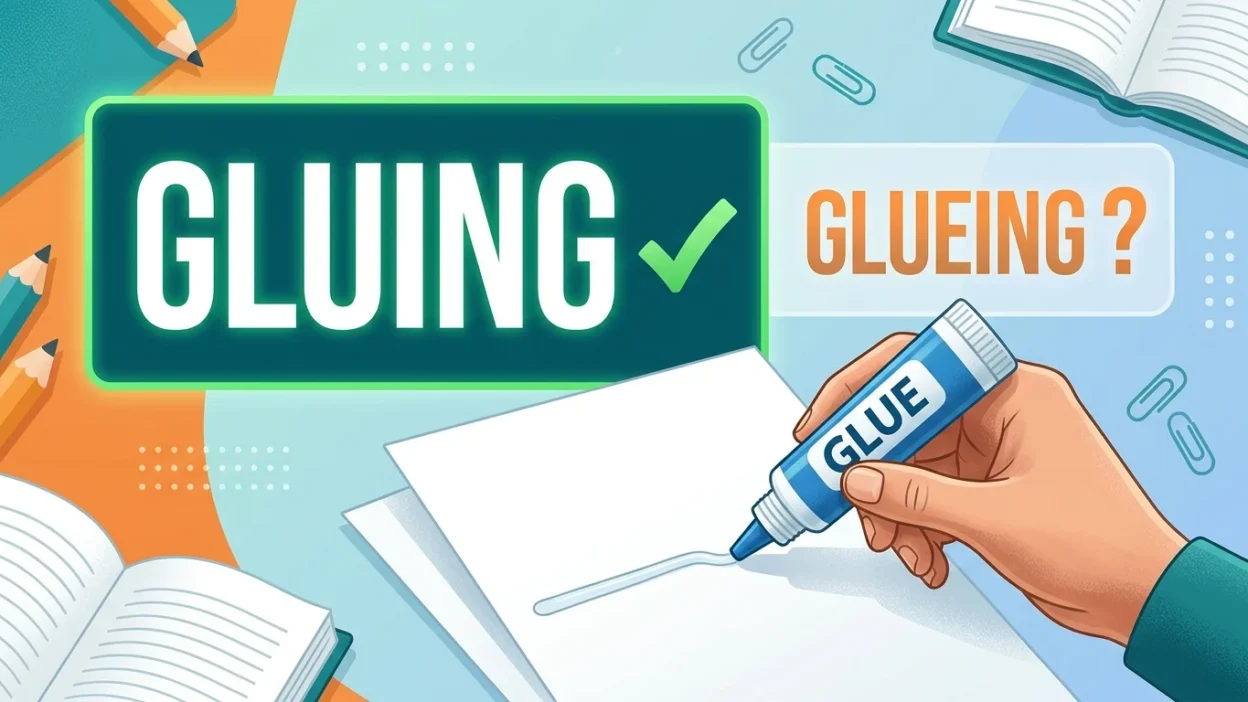
Gluing is the standard and preferred spelling of the present participle and gerund of glue. Glueing is an alternative spelling found occasionally, especially in older usage, but it is much less common. For modern English writing, choose gluing.
Why People Confuse It
The confusion comes mainly from the unusual appearance of the word glue.
When we add -ing to many English verbs, the spelling seems straightforward:
- paint → painting
- jump → jumping
- clean → cleaning
So it is natural to wonder whether:
- glue → gluing
- glue → glueing
The second version may feel more logical because it keeps the entire spelling of glue before adding -ing.
There is also a pronunciation issue. Glueing visually suggests that every letter in glue remains unchanged. However, English spelling does not always work that way.
In modern standard usage, gluing is the established form.
First Word: Gluing
Gluing is the standard present participle and gerund form of the verb glue.
It means joining something to another surface or object with glue.
Examples:
- She is gluing the pieces together.
- I spent the afternoon gluing photographs into the album.
- He is gluing the broken handle back onto the cup.
- The children were gluing paper shapes onto cardboard.
The word can function as part of a continuous verb phrase:
They are gluing the labels onto the boxes.
It can also function as a noun like gerund:
Gluing requires patience and precision.
For most modern writing, gluing should be your default choice.
Second Word: Glueing
Glueing is a less common variant spelling of the present participle of glue.
It is not simply meaningless or completely incomprehensible. Readers will generally understand it, and it can be found in dictionaries and historical or variant usage. However, it is considerably less common than gluing in contemporary English.
For that reason, using glueing may make your writing look unusual or old fashioned.
Compare:
- She is gluing the pieces together. ✅
- She is glueing the pieces together. ⚠️ Less common variant
If you are writing an essay, website article, business document, school assignment, or professional communication, gluing is normally the safer and more natural choice.
Comparison Table
| Feature | Gluing | Glueing |
| Base verb | glue | glue |
| Meaning | Joining with glue | Joining with glue |
| Standard modern spelling | Yes | Less common variant |
| Common in contemporary writing | Very common | Uncommon |
| Recommended for general use | Yes | Usually avoid |
| Example | She is gluing the paper. | She is glueing the paper. |
The key point is simple: both forms can be encountered, but gluing is the preferred modern spelling.
When to Use Each
Use “gluing” in modern standard English
Choose gluing when you mean attaching one thing to another with adhesive.
For example:
- We are gluing the model together.
- She enjoys gluing decorations onto cards.
- The worker is gluing the panels to the frame.
This is the form you should normally use in:
- Academic writing
- Professional writing
- Blog posts
- School assignments
- Emails
- Instructions
- Technical writing
- Everyday communication
Use “glueing” only when a specific source or style requires it
Glueing may appear in older texts, historical documents, or sources that retain variant spelling.
You generally do not need to choose it yourself unless you are reproducing an original text or following a particular editorial convention.
For contemporary writing, gluing is the better option.
Examples
Here are several natural examples showing how gluing is used:
- She is gluing the broken pieces back together.
- The children are gluing colored paper onto the poster.
- I spent an hour gluing the model airplane together.
- He is gluing the label to the package.
- We finished gluing the photographs into the scrapbook.
- Gluing the two surfaces together requires a clean workspace.
- The students were gluing cardboard shapes onto the project.
- She carefully started gluing the decorations onto the box.
- The carpenter is gluing the wooden pieces before clamping them.
- They are gluing the fabric to the backing material.
- Avoid moving the pieces immediately after gluing them.
- He enjoys gluing together miniature models.
- The children learned how to make a collage by gluing pictures onto paper.
- We had trouble gluing the two uneven surfaces together.
Examples with “glueing”
You may occasionally encounter sentences such as:
- She is glueing the pieces together.
- He spent the morning glueing cardboard onto the board.
These are understandable, but gluing is the more conventional modern spelling.
Common Mistakes
1. Assuming “glueing” must be correct because “glue” stays unchanged
This is the most common reasoning behind the spelling.
English spelling does not require every letter of a base word to remain visually unchanged when a suffix is added. Established usage matters.
2. Treating “glueing” as the only possible spelling
Some writers assume that because the verb is glue, the only logical form must be glueing.
In contemporary standard English, gluing is actually the preferred form.
3. Confusing spelling with pronunciation
The pronunciation of gluing does not mean that the word has lost its connection to glue. The spelling simply follows the conventional formation used in modern English.
4. Changing the spelling to “glueing” in formal writing
Although readers can understand glueing, it is less familiar to many modern readers. In professional or academic contexts, gluing is usually the cleaner choice.
5. Thinking every English variant is equally common
English contains many accepted variants, but acceptance does not necessarily mean equal frequency.
Gluing and glueing illustrate this perfectly: the latter can be encountered, but the former is much more established in current usage.
Memory Trick
Here is an easy way to remember the preferred spelling:
Glue + ing = gluing
Think of it as:
GLU + ING → GLUING
You do not need to preserve the final e in the spelling.
A useful comparison is:
- glue → gluing
- true → truing
- blue → bluing
So when you are writing about attaching something with adhesive, remember:
“Use glue, but when it is happening, use gluing.”
American vs British English
There is no major American versus British distinction that makes glueing the normal form in one variety and gluing the normal form in the other.
Gluing is widely preferred in contemporary English on both sides of the Atlantic.
You may encounter glueing in British sources, older publications, or other variant usage, but this does not make it the standard British equivalent of American gluing.
So, unlike some spelling differences such as:
- color / colour
- organize / organise
- traveled / travelled
the choice between gluing and glueing is not primarily an American versus British spelling distinction.
For most readers, gluing is the safest modern form.
Similar Words
Understanding gluing becomes easier when you compare it with other words that behave similarly.
Glue → gluing
This is the form discussed in this article.
She is gluing the pieces together.
Cue → cueing
The verb cue commonly becomes cueing.
The director is cueing the actors.
Dye → dyeing
Dyeing is especially interesting because dropping the e would create confusion with dying.
She is dyeing her clothes blue.
Tie → tying
Here, the spelling changes more significantly:
He is tying his shoes.
Lie → lying
Again, the final letters change:
The dog is lying on the floor.
These examples demonstrate why English spelling cannot always be predicted simply by attaching -ing to the unchanged base word.
FAQs
Is “gluing” or “glueing” correct?
Gluing is the preferred modern spelling. Glueing is a less common variant that can still be found, particularly in older or variant usage.
Is “glueing” a misspelling?
Not necessarily. Glueing is an established variant spelling, but it is much less common than gluing. For contemporary general writing, gluing is recommended.
Why is it spelled “gluing” instead of “glueing”?
The spelling gluing is the conventional modern form created from glue with the -ing ending. English spelling conventions do not always preserve every letter of the base word.
Is “gluing” American English?
No. Gluing is used in both American and British English and is the preferred modern spelling in general usage.
What is the past tense of glue?
The past tense is glued.
She glued the pieces together yesterday.
What is the noun form of glueing or gluing?
Gluing can itself function as a gerund, which means it can act like a noun.
Gluing the pieces requires patience.
Should I use “gluing” in formal writing?
Yes. Gluing is the better choice for formal, academic, professional, and general contemporary writing.
Final Verdict
If you are deciding between gluing and glueing, choose gluing in almost all modern writing.
Gluing is the standard, familiar, and widely preferred form of the verb glue when used with -ing. Glueing is a recognized variant, but its use is comparatively uncommon and may sound unusual to contemporary readers.
Remember This
Gluing = preferred modern spelling
Glueing = less common variant
So if you are writing a sentence such as:
“She is ___ the broken pieces together.”
The best answer is:
She is gluing the broken pieces together.
When in doubt, gluing is the spelling to choose.
Conclusion
The difference between gluing and glueing is less complicated than it first appears. Both forms can be found in English, but they are not equally common. Gluing is the established modern spelling and is the form most writers should use when describing the act of joining things with glue.
Whether you are writing an academic assignment, a set of instructions, a professional email, or an everyday message, choosing gluing will give your writing the most natural contemporary appearance. Remember the simple rule: glue + ing becomes gluing. Once you have memorized that pattern, you can confidently avoid the less common glueing in ordinary modern English.

Quinn Mitchell is celebrated for historical fiction that combines authentic settings, unforgettable characters, and compelling narratives. His thoughtful writing brings history alive while inspiring curiosity and deeper understanding among readers.