If you have ever wondered whether the correct spelling is embed or imbed, you are not alone. Both forms appear in dictionaries and published English, which makes this pair more confusing than ordinary spelling mistakes. At first glance, the two words seem interchangeable, but modern English has a clear preference. Embed is by far the more common spelling, especially when talking about websites, technology, media, data, or placing something firmly within another thing.
Imbed is not simply a misspelling, however. It is a legitimate variant of embed and has been used in English for centuries. In contemporary writing, though, choosing the right form depends largely on convention and context. This guide explains the difference between embed and imbed, shows how each word works in real sentences, and gives you a simple way to remember which spelling to use. By the end, you will know why embed is usually the safest choice.
Quick Answer
Embed and imbed have the same basic meaning: to place something firmly or deeply within something else. However, embed is the standard and much more common spelling in modern English, particularly in technology and online contexts. Imbed is a valid but less common variant.
Why People Confuse It
The confusion comes from the fact that both “embed” and “imbed” are recognized English words.
They share essentially the same meaning and can function as verbs. For example:
- You can embed an image in a webpage.
- You can imbed an image in a webpage.
Both sentences are grammatically possible, but the first sounds much more natural to most modern readers.
Another reason for the confusion is pronunciation. Both words are generally pronounced the same way, so listening cannot help you distinguish between them.
The difference is primarily one of spelling preference and usage frequency, not meaning.
First Word: Embed
Embed is the preferred spelling in modern standard English.
As a verb, embed means to fix, place, or insert something deeply or firmly into another thing.
Common meanings of “embed”
- To place an object physically inside another material
- To insert information into a document
- To place digital media directly on a webpage
- To make an idea or habit firmly established
- To position something within a larger system or structure
Examples
- The workers embedded the tiles into the concrete.
- You can embed a video directly into the article.
- The website allows users to embed images.
- The experience became embedded in her memory.
- The software embeds the data into the final report.
The word is particularly common in digital technology, where you frequently hear phrases such as:
- embed a video
- embed a link
- embed an image
- embed code
- embedded content
- embedded system
- embedded media
Because technology overwhelmingly favors embed, this spelling is the best choice for most modern writing.
Second Word: Imbed
Imbed is a legitimate spelling variant of embed.
It carries the same basic meaning: to place or fix something deeply or firmly within something else.
For example:
The stone was imbedded in the wall.
Although grammatically acceptable, imbed and its forms such as imbedded and imbedding are considerably less common than embed, embedded, and embedding.
You may still encounter imbed in dictionaries, older publications, formal writing, or contexts where an author prefers the traditional variant.
For most readers today, however, embed will look more familiar.
Forms of “imbed”
- imbed
- imbeds
- imbeded ❌
- imbedded
- imbedding
- imbededness ❌
One important point is that the past tense form is imbedded, with a double b. However, modern writers generally prefer embedded.
Comparison Table
| Feature | Embed | Imbed |
| Meaning | To place firmly or deeply inside something | Same meaning |
| Standard modern usage | Very common | Less common |
| Technology | Extremely common | Rare |
| Web writing | Preferred | Unusual |
| Dictionaries | Recognized | Recognized |
| Past tense | Embedded | Imbedded |
| Best choice for most writing | Yes | Usually no |
When to Use Each
Use “embed” in most situations
Choose embed when you are writing for a modern audience, especially in:
- Websites
- Blogs
- Academic writing
- Business communication
- Technical documentation
- Software discussions
- Social media
- Journalism
- General English
For example:
Correct and natural:
Please embed the YouTube video in the article.
Possible but unusual:
Please imbed the YouTube video in the article.
The second sentence is not necessarily wrong, but the first is much more idiomatic.
Use “imbed” when following a specific style or source
There is no major grammatical problem with imbed. If a publication, dictionary, organization, or established style consistently uses imbed, you can follow that preference.
The key distinction is this:
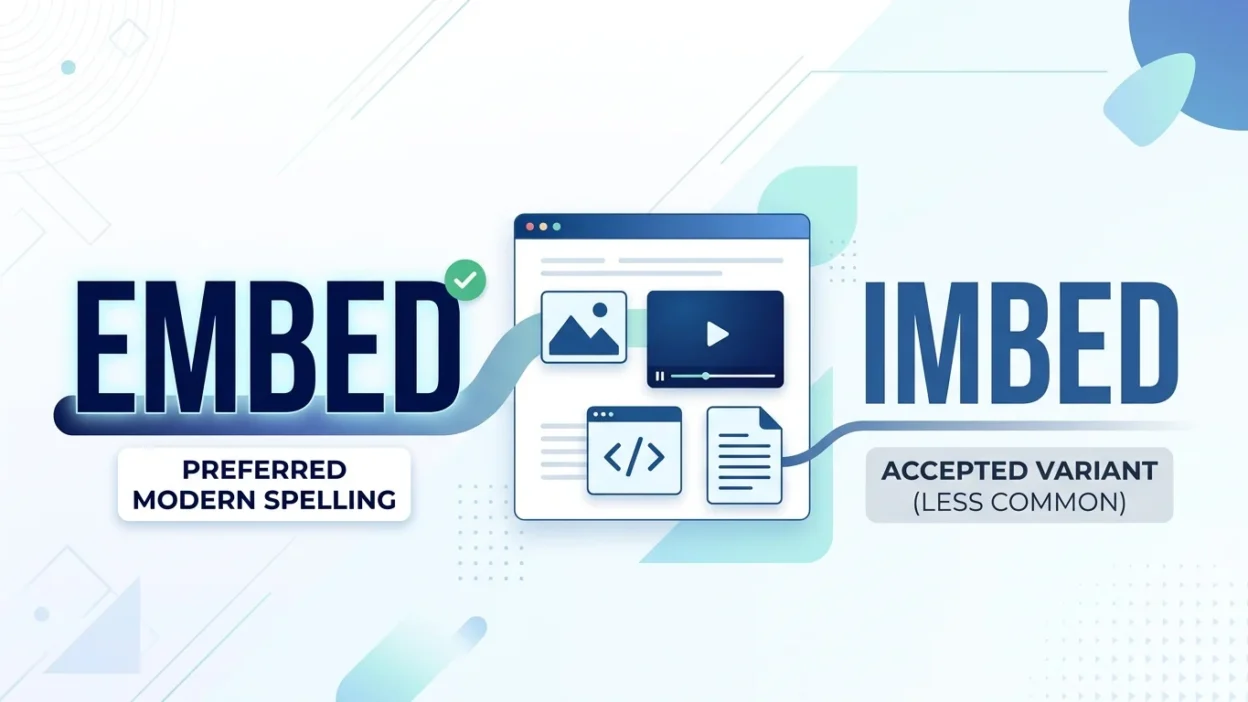
Embed = preferred modern form
Imbed = accepted alternative form
Examples
- Please embed the chart in your presentation.
- The journalist embedded a video in the online article.
- The program can embed images into PDF documents.
- The sensor was embedded inside the device.
- These values are deeply embedded in the company’s culture.
- You can embed the audio player on your website.
- The photographer embedded the watermark into the image.
- The researcher found the sample embedded in the rock.
- The developer used code to embed the map on the webpage.
- The memory of that day remained embedded in his mind.
- The needle became embedded in the wooden surface.
- The application lets users embed external content.
- The roots were imbedded deep in the soil.
- The fragment was imbedded in the metal.
- Although imbed is acceptable, embed is more common in modern English.
Notice that examples 13 and 14 are grammatically possible but use the less common spelling.
Common Mistakes
1. Assuming “imbed” is always wrong
It is not. Imbed is a legitimate variant, although it is much less common.
2. Treating the two spellings as equally common
They are not. In contemporary English, embed is substantially more frequent.
3. Writing “embeded”
This is a common spelling error.
The correct spelling is:
- embed
- embedded
- embedding
Because embed ends in a consonant preceded by a stressed short vowel, the final b is doubled before endings such as -ed and -ing.
4. Writing “embedd”
The base form is simply:
embed
Not embedd.
5. Using “imbed” in technical writing without a reason
Technical and digital writing overwhelmingly favors embed. Using imbed may make your writing look unnecessarily unusual.
Memory Trick
Here is an easy way to remember the difference:
“Embed” is the spelling embedded in modern English.
Think about the word web:
Web → embed
Whenever you are talking about putting a video, image, map, code, or other content into a webpage, think embed.
Another simple rule:
When in doubt, choose EMBED.
You will almost always be making the conventional modern choice.
American vs British English
Both American and British English recognize embed and imbed as variants.
However, embed is the dominant form in modern usage in both varieties of English. The difference is therefore not primarily an American versus British spelling issue.
In contemporary British and American technology writing, you are far more likely to see:
embedded video
than:
imbedded video
The same applies to phrases such as embedded content, embedded system, and embedding data.
So whether your audience is in the United States, the United Kingdom, Canada, Australia, or elsewhere, embed is generally the safest choice.
Similar Words
Several words are related to embed, but they are not always interchangeable.
Insert
Insert means to put something into something else.
Insert the card into the machine.
It is usually more neutral than embed.
Incorporate
Incorporate means to include something as part of a larger whole.
The report incorporates several new findings.
Integrate
Integrate means to combine something with another system or structure.
The new software integrates with existing tools.
Implant
Implant means to place something firmly inside, especially in medical or biological contexts.
The surgeon implanted a small device.
Ingrain
Ingrain usually refers to an idea, habit, or quality becoming deeply established.
The principle was ingrained in her thinking.
These words overlap with embed in certain contexts, but their meanings and typical applications differ.
FAQs
Is “imbed” a correct word?
Yes. Imbed is a legitimate variant of embed. It is grammatically correct but considerably less common in modern English.
Which is more common, embed or imbed?
Embed is much more common. It is especially dominant in technology, web development, digital media, journalism, and general modern writing.
Is “imbed” a spelling mistake?
Not necessarily. Although many people assume it is incorrect, imbed is an accepted variant spelling of embed.
Should I use embed or imbed in formal writing?
Use embed unless you have a specific reason to follow a source or style that prefers imbed. Embed is the more widely recognized modern form.
Is it “embedded” or “imbedded”?
Both forms exist, corresponding to embed and imbed. However, embedded is much more common and is the preferred form in most contemporary writing.
What does embed mean in technology?
In technology, embed commonly means to place content, such as a video, image, map, audio file, or code, directly into another webpage, application, or document.
Is “embed” used in British English?
Yes. Embed is widely used in British English, just as it is in American English. It is generally the preferred modern spelling in both varieties.
Final Verdict
Embed and imbed have the same fundamental meaning, and both are legitimate English spellings. The important difference is usage: embed is the overwhelmingly more common and recognizable form in contemporary English.
If you are writing an article, email, report, website, academic paper, or technical document, embed is almost always the better choice. Reserve imbed for situations where a particular source or style specifically uses it.
Remember This
Embed = preferred modern spelling
Imbed = accepted but less common variant
When you need to choose one, embed is the safe, natural, and widely accepted option.
Conclusion
The distinction between embed and imbed is unusual because neither spelling is inherently wrong. Both describe the act of placing something firmly or deeply within something else. The real difference is modern usage: embed has become the standard form, particularly in technology and digital communication.
So, if you are unsure which spelling to use, choose embed. Whether you are embedding a video, embedding an image, embedding information in a document, or describing something physically embedded in another object, this spelling will sound natural to the broadest range of English readers.

Nova Turner specializes in imaginative science fiction blending futuristic technology, thrilling adventures, and powerful human emotions. Her innovative storytelling inspires curiosity, creativity, and exploration among readers of every age.